


Wet-Bulb Temperature: Humanity's Climate Time Bomb
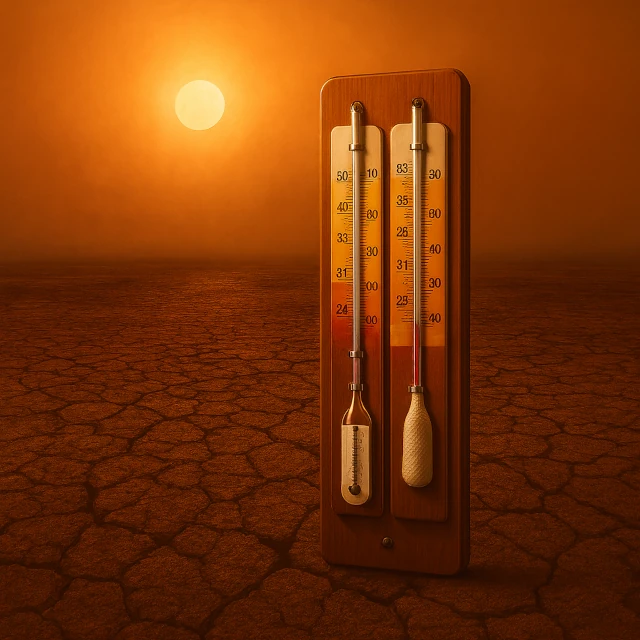
The image of a cracked desert illustrates the deadly danger of high wet-bulb temperature.
This measurement, obtained using a psychrometer (two thermometers, one dry and one wet), assesses the risk to the human body.
Beyond a certain threshold, humidity prevents sweat evaporation, making thermal regulation impossible and threatening survival within hours.
Image source: astronoo.com (new window)
Scientific Summary
Wet-bulb temperature combines air temperature and relative humidity, measuring the air's ability to dissipate body heat through sweat evaporation. A wet-bulb temperature of 35°C is considered the absolute theoretical survival limit: even a healthy person at rest in the shade can no longer regulate their internal temperature. This threshold can be reached with 35°C and 100% humidity, or 45°C and 70% humidity. Climate change is making these lethal conditions more frequent, threatening up to 1.2 billion people by 2100.
What is wet-bulb temperature and why is it a deadly threshold for the human body?
Wet-bulb temperature combines air temperature and relative humidity. It measures the air's ability to cool the body through sweat evaporation. A wet-bulb temperature of 35°C is considered the absolute theoretical survival limit: even a healthy person, at rest and in the shade, can no longer regulate their internal temperature. This threshold can be reached with 35°C and 100% humidity, or 45°C and 70% humidity. Climate change is making these deadly conditions more frequent, threatening up to 1.2 billion people by 2100.
Also worth exploring
Continue your exploration of the Universe with these topics:
What is Wet-Bulb Temperature?
The wet-bulb temperature is a physical indicator that combines air temperature and relative humidity. Unlike the dry temperature we usually read on thermometers, wet-bulb temperature reflects the actual ability of the air to absorb and dissipate heat from the human body through evaporation.
The Vital Mechanism of Thermoregulation
This measurement is crucial for understanding the physiological limits of the human body. Our organism maintains an internal temperature of about 37°C through sweating: when sweat evaporates from the skin, it carries away thermal energy, cooling us down. But this evaporation mechanism only works if the surrounding air is not already saturated with water vapor.
N.B.:
Sweat evaporation can only effectively cool the body if the ambient air contains less humidity than the skin's surface. When the air is saturated with water vapor (close to 100% humidity), water molecules can no longer escape from the skin into the atmosphere. Sweat then remains liquid on the skin without evaporating, preventing the dissipation of body heat. This is why a temperature of 35°C with 100% humidity is deadly, while a temperature of 50°C in dry air (20-30% humidity) remains survivable: in the latter case, evaporation still works.
A Historical Scientific Measurement
The concept of wet-bulb temperature was formalized in the 19th century with the invention of the psychrometer, an instrument consisting of two thermometers: one with a dry bulb and the other with a wet bulb wrapped in a water-soaked wick. The temperature difference between the two allows determining the relative humidity of the air and deducing the wet-bulb temperature, an essential indicator for assessing heat stress.
Deadly Combinations of Wet-Bulb Temperature
Scientific research has established that a wet-bulb temperature of 35°C represents an absolute theoretical limit for human survival. At this threshold, even a perfectly healthy person, at complete rest, in the shade, and with unlimited access to water, can no longer dissipate the heat produced by their basal metabolism. This limit can be reached through different combinations of dry temperature and relative humidity. Heat becomes deadly long before reaching extreme temperatures when humidity is high.
| Temperature (°C) | Relative Humidity (%) | Tolerance Duration | Comment |
|---|---|---|---|
| 35°C | 100% | 6-8 hours max | Absolute theoretical survival limit |
| 35°C | 70% | Several hours to 1 day | Moderate discomfort, rest and hydration required |
| 40°C | 90% | 1-2 hours | Immediate danger, high risk of heatstroke |
| 40°C | 60% | 3-4 hours | Severe heat stress, risk of heatstroke |
| 40°C | 30% | 6-8 hours | Tolerable at rest with adequate hydration |
| 45°C | 70% | 1-2 hours | Immediate danger |
| 45°C | 40% | 2 hours | Limit even for acclimatized individuals |
| 45°C | 20% | 2-3 hours | Extreme desert conditions, rapid dehydration |
| 50°C | 50% | 30-60 minutes | Severe heat stress, urgent evacuation required |
| 50°C | 30% | 1-2 hours | Deadly danger even at rest, possible loss of consciousness |
| 50°C | 10% | 2-3 hours | Extreme aridity, respiratory burns, critical dehydration |
Geographical Areas at Risk
Climate change is dangerously amplifying the frequency and intensity of extreme humid heat episodes. Tropical and subtropical coastal regions are among the most vulnerable, as they combine high temperatures and high atmospheric humidity, a particularly deadly combination for the human body.
Global Hotspots
Climate projections identify several critical zones where the 35°C wet-bulb temperature threshold could be regularly exceeded by the end of the century if greenhouse gas emissions continue at the current rate. The Persian Gulf tops this concerning list: the United Arab Emirates, Qatar, Kuwait, and some coastal regions of Iran are already experiencing sporadic peaks approaching this deadly threshold. The Indian subcontinent is another major area of concern, with Pakistan, India, and Bangladesh experiencing increasingly intense heatwaves. The Ganges Delta, densely populated, combines extreme humidity and scorching temperatures during the pre-monsoon season.
Southeast Asia, including Thailand, Vietnam, the Philippines, and Indonesia, also shows increasing vulnerability, as does the Red Sea region and the Horn of Africa. Northern Australia, some coastal areas of Central America and the Caribbean, and the southern United States complete this geography of risk.
Recent Alarming Events
Recent data confirm the worsening of the phenomenon. In 2021, the Pakistani city of Jacobabad recorded a wet-bulb temperature of 34°C, nearing the human survival threshold. That same year, the heat dome that struck the Pacific Northwest caused hundreds of deaths in Canada and the United States, particularly in British Columbia, where the dry temperature exceeded 49°C in Lytton. Although wet-bulb temperatures remained slightly below 35°C, the massive mortality underscores the lethality of these events, even without reaching the absolute theoretical limit.
Future Projections and Climate Scenarios
Climate models predict a alarming increase in extreme humid heat events during this century. According to the IPCC (intergovernmental Panel on Climate Change), in a +2°C warming scenario compared to the pre-industrial era, billions of people could be regularly exposed to wet-bulb temperatures exceeding 31°C.
The Catastrophic Scenario: Uninhabitable Zones
With warming of +3°C or more, some densely populated regions could experience wet-bulb temperatures reaching or exceeding 35°C for several hours, or even several consecutive days. Such a situation would render these areas simply uninhabitable without permanent air conditioning.
1.2 Billion People Potentially at Risk
A study published in Nature in 2023 estimates that by 2100, in the worst-case scenario (+4°C), up to 1.2 billion people could live in areas exposed each year to at least one deadly humid heat event. These projections exclude technological adaptation capacities but highlight the potential scale of the crisis.
- Source: Science Advances – The emergence of heat and humidity too severe for human tolerance (Colin Raymond et al., 2020) (new window), NCBI – Evaluating the 35°C wet-bulb temperature adaptability threshold (PSU HEAT Project) (new window), NCBI – Greatly enhanced risk to humans as a consequence of empirically determined lower moist heat stress tolerance (new window), NCBI – Temperature and humidity based projections of a rapid rise in global heat stress exposure (new window), IPCC – Reports on Climate Change (new window), Nature Scientific Data – Daily Max Simplified Wet-Bulb Globe Temperature dataset (1940-2022) (new window), NOAA Climate.gov – Brief periods of dangerous humid heat arrive decades early (new window).
FAQ: Everything about wet-bulb temperature and its deadly dangers
What is the difference between dry-bulb and wet-bulb temperature?
Dry-bulb temperature is what a standard thermometer reads; it does not account for humidity. Wet-bulb temperature combines temperature and relative humidity. It reflects the air's actual ability to cool the body through sweat evaporation. A dry temperature of 50°C in a desert (dry air) can be more bearable than 35°C with 100% humidity, where evaporation is impossible.
Why is a wet-bulb temperature of 35°C a mortality threshold?
At a wet-bulb temperature of 35°C, the air is fully saturated with water vapor. Sweat can no longer evaporate from the skin, blocking the body's primary cooling mechanism. Even a perfectly healthy person, still, in the shade, and well-hydrated will see their internal temperature rise inexorably, leading to fatal heatstroke within hours.
Which regions of the world are most threatened by extreme humid heat?
The most vulnerable areas are coastal tropical and subtropical regions where heat and humidity are naturally high. This includes the Persian Gulf (UAE, Qatar, Kuwait, Iran), the Indian subcontinent (India, Pakistan, Bangladesh), Southeast Asia (Thailand, Vietnam, Philippines), the Red Sea, the Horn of Africa, northern Australia, and parts of the United States. Deadly episodes are already occurring: Jacobabad (Pakistan) reached a wet-bulb temperature of 34°C in 2021.
 From Black Basalt to Blue Oceans: Earth's Changing Palette
  Plate Tectonics: The Invisible Engine Moving the Continents
  The Number 360: The Mathematical Key to the Babylonian Sky
  Wet-Bulb Temperature: Humanity's Climate Time Bomb
  Why Doesn't Earth's Atmosphere Escape into Space?
  Origins of Earth: Magmatic Chaos and the Birth of the Solid World
  Earth's Atmosphere: The Invisible Shield Protecting Life
  The 5 Cosmic "End of the World" Scenarios (and Why They Won't Happen)
  Where does the water in the oceans come from? Three key stages
  From Carbon 14 to Uranium-Lead: The Science of Dating
  Major Natural Disasters: What Are the Most Likely Threats?
  The Boundary of Space: Where Does It Really Begin?
  536: The Year Without a Summer and the Beginning of the Late Antique Little Ice Age
  The leap second: scheduled end in 2035
  Planetary Alignments: A Fascinating but Relative Phenomenon
  All Deserts of the World
  Earth's Paleoclimates and Carbon Dioxide
  What is the effect of large lakes and water reservoirs on Earth's rotation?
  International Date Line
  Start Date of the Seasons: A Complex Celestial Mechanism
  Paleomagnetism: the magnetic memory of rocks
  3D Simulator: Revolutions of the Planets
  Geological Time and Mass Extinctions: From the Ordovician to the Cretaceous
  Earth History: Timeline Compressed into 24 Hours
  Earth's Water: An Extraterrestrial Origin?
  Reading the Sky: Understanding Declination and Right Ascension
  How is Earth's magnetic field born and why does it reverse?
  Earth's Magnetosphere: The Invisible Shield
  Fujita Scale: Classifying the Fury of Tornadoes
  Earth's Radioactivity: The Internal Energy of Our Planet
  The Deep Sea: Exploring the Deepest Ocean Trenches
  Why Are Days Getting Longer?
  The Depths of the Earth: From the Lithosphere to the Core
  Earth's Movements: How Earth Traces Its Spiral Through the Universe?
  How much is the sea level rising?
  The Life of Earth: Structure and Layers of the Earth
  The Eccentricity of Earth's Orbit: An Ellipse That Changes Everything
  Little Ice Age: The History of a Natural Climatic Cooling
  The Quest for Time: How Ancient Civilizations Used Astronomy?
  Van Allen Belt: A Rampart Against Cosmic Particles
 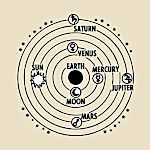 The Cosmos in Our Measure: When Man Invents the Universe
  What is the pendulum fixed relative to?
  Problem of longitude at sea
 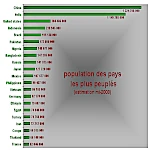 World population, still gallopingin 2008
 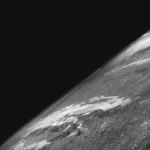 The Oldest Image of Earth from Space
  Earth's Obliquity and Variations in Its Axis of Rotation
  The Astronomical Unit Fixed: A Length, No Longer an Orbit
  Water: one molecule, three states on Earth
  Simulator, the round of near-Earth cruisers
  Satellites that measure underwater relief
  Hadean's Hell
  The First Free Flight of an Astronaut in Space
  The first measurement of the Earth-Sun distance
  La The Announced End of the World on December 21, 2012: A Millennial Prophecy
 The Equinoxes: An Astronomical Event
 Milankovitch Cycles: The Astronomical Rhythm of Earth's Climate
 Why Is Earth So Often Cloudy?