


Why doesn't Earth's atmosphere escape into space?
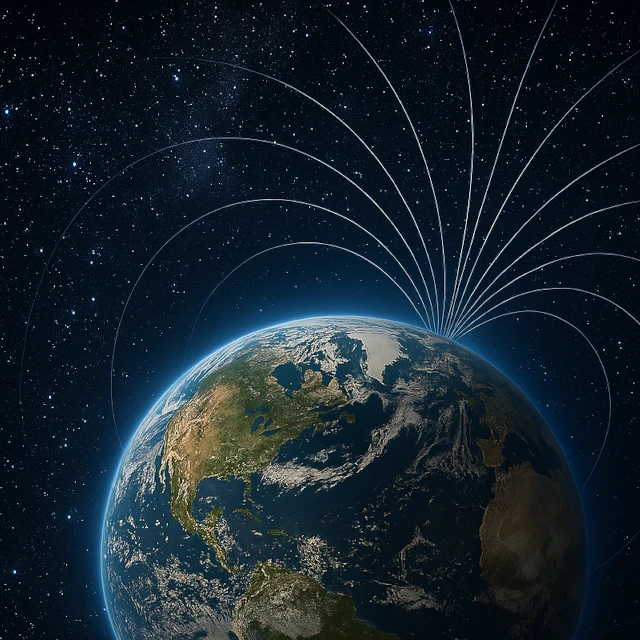
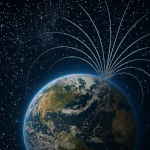
Earth’s atmosphere, a thin bluish film, is shown here with its magnetic shield (field lines) that protects it from the energetic particles of the solar wind. Why doesn't it gradually escape?
Image source: astronoo.com (new window) — AI-generated image, public domain.
Scientific summary
The article explains why Earth's atmosphere does not escape into space, by analysing the competition between antagonistic effects. On one side, gravity imposes an effective barrier on heavy molecules (nitrogen, oxygen) via an escape velocity of 11 km/s; on the other, thermal agitation gives light molecules (hydrogen, helium) enough energy to slowly escape through Jeans escape. At the same time, Earth's magnetic field counteracts the solar wind, which would otherwise erode the gaseous envelope, while that same solar wind, if not deflected, would accelerate the dispersion of gases. Thus, the atmosphere undergoes a continuous but infinitesimal loss of its light elements, while heavier ones remain captive over geological timescales. Without this magnetic protection, Earth would suffer the fate of Mars, whose atmosphere was blown away.
Why doesn't Earth's atmosphere escape into space?
Why doesn't this thin film of air fly off into the void of space? After all, its molecules are in a perpetual dance, and nothing material holds them back. The answer lies in a subtly balanced struggle of influences. The first barrier is gravitational: Earth exerts such a powerful attraction that nitrogen and oxygen, the pillars of our air, are condemned to stay near the ground, their thermal speed being far below the 11 km/s needed to break free from its grip. But in the upper atmosphere, where air becomes rarefied, solar radiation turns thermal agitation into a true escape engine. The lightest atoms, hydrogen and helium, then draw enough energy to fly off into space. Yet this leakage is benign, because a third actor enters the scene: Earth's magnetic field. Like an invisible shield, it deflects the charged particles of the solar wind that would otherwise scratch and tear away the atmosphere. Earth does lose some molecules, but this haemorrhage is so slow that it spreads over millions of years. It is precisely this fragile balance between retention, escape, and protection that preserves our planet from the arid fate of Mars.
Also worth exploring
Continue your exploration of the Universe with these topics:
Earth's atmosphere: the result of a dynamic and fragile equilibrium
A balance between gravity, temperature, and the magnetosphere
This thin film of air that makes life possible is the result of a dynamic and fragile equilibrium. Yet Earth's atmosphere is remarkably stable over billions of years. The atmosphere does not simply "rest" on Earth like a blanket "glued" by gravity. It consists of gases in perpetual motion, whose molecules possess kinetic energy that drives them to slowly escape into space. So why haven't they all dispersed into the vacuum of space?
Table of effects: gravity, temperature, and magnetic shield
| Retention factor | Role and effect | Escape factor | Role and effect |
|---|---|---|---|
| Earth's gravity | Main attractive force. Retains the vast majority of molecules, especially heavy ones (N2, O2). | Temperature (Kinetic energy) | Gives speed to molecules. The fastest (and lightest) can reach escape velocity. |
| Magnetic field (Magnetosphere) | Shield against solar wind. Protects the atmosphere from erosion and excessive heating. | Solar wind | Flow of energetic particles. Can strip atoms (without magnetic shield) and contribute to heating. |
| High molecular mass | Kinetic parameter. At a given temperature, heavy molecules (nitrogen, oxygen) have lower speeds, greatly reducing the probability of reaching escape velocity. | Low molecular mass | Kinetic parameter. Light molecules (hydrogen, helium) more easily reach high speeds and dominate thermal escape (Jeans escape(thermal atmospheric escape process)), explaining their rarity. |
The master force: gravitation
Escape velocity and Jeans escape
The main actor in this retention is gravity (universal gravitational attraction between two masses). Formulated by Isaac Newton (1643-1727) and refined by Albert Einstein (1879-1955), it attracts any mass toward Earth's centre. Every molecule of nitrogen, oxygen, or water vapour is subject to this force. For a molecule to escape permanently, it must reach what is called the escape velocity (minimum speed an object must reach to escape the gravitational attraction of a celestial body without further propulsion).
An atmospheric boundary in continuity
At Earth's surface, this velocity is ≈ 11 km·s⁻¹. However, the atmosphere has no sharp boundary; it gradually thins until it merges with interplanetary space. As altitude increases, the gravitational potential becomes shallower and the escape velocity decreases slowly with distance from Earth's centre.
The ballistic regime of the exosphere
In the very rarefied layers of the exosphere, located several thousand kilometres in altitude, collisions become extremely rare. Molecules then follow quasi-free ballistic trajectories. A tiny fraction of them, belonging to the tail of the Maxwell-Boltzmann distribution, can locally reach or exceed the escape velocity.
Jeans escape on geological timescales
This mechanism, called Jeans escape (thermal atmospheric escape process), leads to a continuous but extremely slow loss of the atmosphere. It primarily affects the lightest species, such as hydrogen and, to a lesser extent, helium. Heavier molecules, such as nitrogen or oxygen, remain overwhelmingly bound to Earth's gravitational well.
Even at these high altitudes, the vast majority of air molecules are energetically far from escape. The atmosphere is therefore gravitationally captive on geological timescales, despite the absence of a material wall and despite a real, but infinitesimal, leakage of particles at great distances from Earth's centre.
N.B.:
Although the Kármán line at 100 km marks the symbolic boundary between atmosphere and space, Earth's gaseous influence actually extends far beyond, over several tens of thousands of kilometres, before merging with interplanetary vacuum.
Table of Earth's atmospheric layers
| Atmospheric layer | Typical altitude | Characteristic temperature | Dominant molecules | Physical regime | Physical comments |
|---|---|---|---|---|---|
| Troposphere | 0 to 12 km | 288 K to 216 K (15 °C to −57 °C) | N₂, O₂, Ar, H₂O | Dense collisional | Homogeneous mixing by convection, thermal speeds far below escape velocity. |
| Stratosphere | 12 to 50 km | 216 K to 270 K (−57 °C to −3 °C) | N₂, O₂, O₃ | Collisional | Presence of ozone, UV absorption, temperature inversion, hydrostatic equilibrium dominant. |
| Mesosphere | 50 to 85 km | 270 K to 180 K (−3 °C to −93 °C) | N₂, O₂ | Rarefied collisional | Coldest layer, very low density, thermal agitation still insufficient for escape. |
| Thermosphere | 85 to 500 km | 500 K to >1500 K (227 °C to >1227 °C) | O, N₂, He | Transitional collisional | High kinetic temperature due to UV and X‑ray absorption, density too low for massive escape. |
| Exosphere | >500 km | >1000 K (>727 °C) | H, He, traces of O | Quasi‑free ballistic | Rare collisions, ballistic trajectories, onset of Jeans escape(thermal atmospheric escape process). |
Temperature: the engine of escape
Kinetic energy and thermal agitation
The temperature of a gas is directly related to the average kinetic energy of its molecules. The hotter the atmosphere, the more agitated the molecules and the greater the probability that some reach escape velocity. The upper layers of the atmosphere, such as the thermosphere (atmospheric layer between about 80 km and 600 km altitude, where temperature increases sharply with altitude), can reach over 1500 °C under solar radiation. Paradoxically, an astronaut would not burn there, because the particle density is so low that the heat transferred is negligible. But this high temperature means that the light atoms present at these altitudes (like hydrogen and helium) are very energetic.
Molecular mass, a discriminating factor
This is where the second factor comes into play: the mass of the molecule. The average speed of a gas particle at a given temperature is inversely proportional to the square root of its mass \( v_{avg} \propto \frac{1}{\sqrt{m}} \). Light atoms (hydrogen, helium) therefore move much faster than heavy ones (nitrogen, oxygen) at the same temperature. They thus have a much greater probability of crossing the gravitational barrier.
Consequences of selective escape
Earth actually loses part of its atmosphere, especially the lightest elements. This process, called atmospheric escape, is extremely slow on a human timescale (hundreds of millions or billions of years for a significant change) but measurable. This is why our current atmosphere is so poor in free hydrogen and helium, unlike the gas giants.
The invisible shield: Earth's magnetic field
Protection against the solar wind thanks to the magnetic field
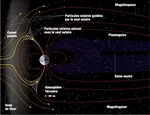
The third key piece of the puzzle is the magnetosphere (magnetic field surrounding Earth, generated by motions of molten metal in its outer core). This shield, generated by motions in Earth's outer core, deflects most of the solar wind (constant flow of charged particles (mainly protons and electrons) ejected by the Sun). Without this protection, this flow of energetic particles would directly strike the upper atmosphere.
Thus, without a magnetic field, the solar wind would directly erode the atmosphere by knocking off molecules (sputtering) and would heat it, accelerating the escape of the fastest atoms into space. The tragic example of Mars, which lost its global magnetic field billions of years ago, illustrates this scenario. Its atmosphere, once denser, was largely blown away by the solar wind, leaving a cold and desert planet.
What to remember: A dynamic equilibrium over the long term
A system in dynamic equilibrium on geological timescales
Earth's atmosphere is therefore not a static system, but one in dynamic equilibrium. There are losses (escape of light atoms, ionised particles ejected along magnetic field lines at the poles) but also gains (mantle degassing through volcanism, possible inputs from ice‑rich comets). Over geological timescales, atmospheric composition and pressure have changed considerably, largely due to the appearance of life (oxygen production by photosynthesis). The current stability is therefore relative and precarious.
References
FAQ: All about Earth's atmosphere and its escape
What is Jeans escape?
Jeans escape is an atmospheric escape mechanism that mainly affects light molecules (hydrogen, helium) in the very high layers of the atmosphere (exosphere). At these altitudes, collisions are rare and molecules follow ballistic trajectories. Some, at the tail of the Maxwell-Boltzmann distribution, can locally reach or exceed the escape velocity from gravity. This process is extremely slow on a human scale, but it explains why our atmosphere is poor in free hydrogen and helium.
What is the role of Earth's magnetic field in retaining the atmosphere?
Earth's magnetic field (magnetosphere) acts as an invisible shield that deflects most of the solar wind (flow of energetic particles). Without this protection, the solar wind would directly strike the upper atmosphere, eroding molecules by sputtering and heating it, which would accelerate the escape of atoms. The example of Mars, which lost its global magnetic field billions of years ago and whose atmosphere was largely blown away, illustrates this scenario.
Why does Earth mainly lose hydrogen and helium?
Atmospheric loss depends on two factors: temperature and molecular mass. At a given temperature, the average speed of molecules is inversely proportional to the square root of their mass. Light atoms (hydrogen, helium) therefore move much faster than heavy atoms (nitrogen, oxygen). They thus have a much greater probability of reaching or exceeding the gravitational escape velocity (about 11 km/s at the surface). This is why hydrogen and helium preferentially escape, while nitrogen and oxygen remain mostly captive.
Could Earth ever lose its atmosphere like Mars?
Unlike Mars, Earth has two major assets: stronger gravity (about 2.6 times that of Mars) and an active global magnetic field that protects it from the solar wind. As long as these two conditions remain, Earth's atmosphere will remain stable on geological timescales. The current loss is infinitesimal (a few hundred tonnes per year for hydrogen) and does not threaten the longevity of our atmosphere for several billion years, long after the Sun will have radically changed.
What is the difference between Earth's atmosphere and that of Mars?
The main difference lies in density and composition. The Martian atmosphere is extremely thin (less than 1% of Earth's surface pressure) and composed of 95% carbon dioxide. Earth, thanks to its higher gravity and magnetic field, has retained a dense atmosphere dominated by nitrogen and oxygen. Mars lost most of its primordial atmosphere about 4 billion years ago, when its magnetic field weakened, exposing its gaseous envelope to erosion by the solar wind.
How is Earth's atmospheric loss measured?
Scientists use several methods to quantify atmospheric escape. Satellites like the Cluster (ESA) or MMS (NASA) missions measure charged particles escaping along magnetic field lines. Ground‑based instruments observe emission lines of hydrogen (like the Lyman‑alpha line) in the exosphere. Finally, numerical models simulate molecular speed distributions to estimate escape fluxes. These measurements converge on an annual loss of about 3 kg·s⁻¹ for hydrogen, i.e. about 100,000 tonnes per year — a negligible rate on geological timescales.
 From Black Basalt to Blue Oceans: Earth's Changing Palette
  Plate Tectonics: The Invisible Engine Moving the Continents
  The Number 360: The Mathematical Key to the Babylonian Sky
  Wet-Bulb Temperature: Humanity's Climate Time Bomb
  Why Doesn't Earth's Atmosphere Escape into Space?
  Origins of Earth: Magmatic Chaos and the Birth of the Solid World
  Earth's Atmosphere: The Invisible Shield Protecting Life
  The 5 Cosmic "End of the World" Scenarios (and Why They Won't Happen)
  Where does the water in the oceans come from? Three key stages
  From Carbon 14 to Uranium-Lead: The Science of Dating
  Major Natural Disasters: What Are the Most Likely Threats?
  The Boundary of Space: Where Does It Really Begin?
  536: The Year Without a Summer and the Beginning of the Late Antique Little Ice Age
  The leap second: scheduled end in 2035
  Planetary Alignments: A Fascinating but Relative Phenomenon
  All Deserts of the World
  Earth's Paleoclimates and Carbon Dioxide
  What is the effect of large lakes and water reservoirs on Earth's rotation?
  International Date Line
  Start Date of the Seasons: A Complex Celestial Mechanism
  Paleomagnetism: the magnetic memory of rocks
  3D Simulator: Revolutions of the Planets
  Geological Time and Mass Extinctions: From the Ordovician to the Cretaceous
  Earth History: Timeline Compressed into 24 Hours
  Earth's Water: An Extraterrestrial Origin?
  Reading the Sky: Understanding Declination and Right Ascension
  How is Earth's magnetic field born and why does it reverse?
  Earth's Magnetosphere: The Invisible Shield
  Fujita Scale: Classifying the Fury of Tornadoes
  Earth's Radioactivity: The Internal Energy of Our Planet
  The Deep Sea: Exploring the Deepest Ocean Trenches
  Why Are Days Getting Longer?
  The Depths of the Earth: From the Lithosphere to the Core
  Earth's Movements: How Earth Traces Its Spiral Through the Universe?
  How much is the sea level rising?
 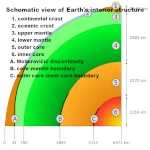 The Life of Earth: Structure and Layers of the Earth
  The Eccentricity of Earth's Orbit: An Ellipse That Changes Everything
  Little Ice Age: The History of a Natural Climatic Cooling
  The Quest for Time: How Ancient Civilizations Used Astronomy?
 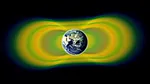 Van Allen Belt: A Rampart Against Cosmic Particles
  The Cosmos in Our Measure: When Man Invents the Universe
  What is the pendulum fixed relative to?
  Problem of longitude at sea
  World population, still gallopingin 2008
  The Oldest Image of Earth from Space
  Earth's Obliquity and Variations in Its Axis of Rotation
  The Astronomical Unit Fixed: A Length, No Longer an Orbit
  Water: one molecule, three states on Earth
  Simulator, the round of near-Earth cruisers
  Satellites that measure underwater relief
  Hadean's Hell
  The First Free Flight of an Astronaut in Space
  The first measurement of the Earth-Sun distance
  La The Announced End of the World on December 21, 2012: A Millennial Prophecy
 The Equinoxes: An Astronomical Event
 Milankovitch Cycles: The Astronomical Rhythm of Earth's Climate
 Why Is Earth So Often Cloudy?