


The Sky Ordered Our Week: Monday, Tuesday, Wednesday…
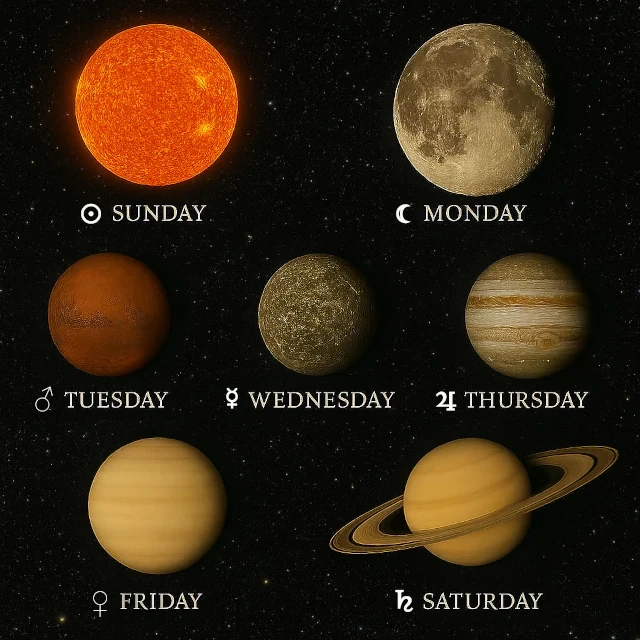
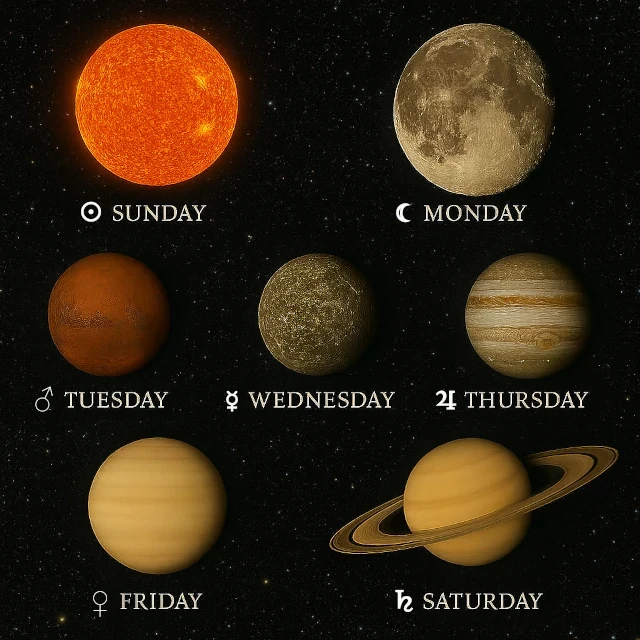
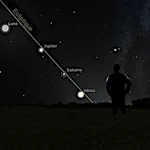
Representation of the seven ancient "planets" (Sun, Moon, Mars, Mercury, Jupiter, Venus, Saturn) in the order that determined our week.
Image source: astronoo.com (new window)
Scientific Summary
The order of the days of the week (Monday, Tuesday, Wednesday, Thursday, Friday, Saturday, Sunday) originates from an ancient astrological rule called the "rule of planetary hours." The Babylonians established an order of the "wandering stars" (planets) from slowest to fastest: Saturn, Jupiter, Mars, Sun, Venus, Mercury, Moon. By assigning each hour of the day to a planet in this cyclical order, the first hour of the first day fell to Saturn (Saturday), and the first hour of the following day to the Sun (Sunday), then to the Moon (Monday), etc., thus generating the sequence we know.
Why are the days of the week in this precise order: Monday, Tuesday, Wednesday…?
The order of the days of the week comes from an ancient astrological rule called the "rule of planetary hours." The Babylonians established an order of the "wandering stars" (planets) from slowest to fastest: Saturn, Jupiter, Mars, Sun, Venus, Mercury, Moon. By assigning each hour of the day to a planet in this cyclic order, the first hour of the first day fell to Saturn (Saturday), and the first hour of the next day to the Sun (Sunday), then to the Moon (Monday), etc., thus generating the sequence we know.
Also worth exploring
Continue your exploration of the Universe with these topics:
From planet to modern day
This table shows how the names of the days, derived from the same Latin astrological background, evolved differently across language families.
| Governing star | Latin origin | French (Romance language) | Spanish (Romance language) | English (Germanic language) | Etymology |
|---|---|---|---|---|---|
| ☉ Sun | Dies Solis | Dimanche | Domingo | Sunday | From Latin dominicus (Lord's day). English retains the solar reference. |
| ☾ Moon | Dies Lunae | Lundi | Lunes | Monday | Directly derived from the Latin name for the Moon (Luna). |
| ♂ Mars | Dies Martis | Mardi | Martes | Tuesday | From the Roman god Mars. English comes from Tiw (Germanic god of war). |
| ☿ Mercury | Dies Mercurii | Mercredi | Miércoles | Wednesday | From the Roman god Mercury. English comes from Woden (Odin, supreme Germanic god). |
| ♃ Jupiter | Dies Jovis | Jeudi | Jueves | Thursday | From the Roman god Jupiter/Jove. English comes from Thor, its Nordic equivalent. |
| ♀ Venus | Dies Veneris | Vendredi | Viernes | Friday | From the Roman goddess Venus. English comes from Frigg or Freya, Nordic goddesses of love. |
| ♄ Saturn | Dies Saturni | Samedi | Sábado | Saturday | French and Spanish derive from the Hebrew Sabbat. English retains the reference to Saturn. |
The "Chaldean" order of the planets: a hierarchy based on observation
The key to this order lies in the observation of the ancient sky. Mesopotamian, then Greek and Roman civilizations identified seven "wandering stars" visible to the naked eye, which they called "planets": the Moon, Mercury, Venus, the Sun, Mars, Jupiter, and Saturn. According to the geocentric cosmology of the time, it was believed that these celestial bodies exerted an influence on human affairs.
A succession of days inherited from a learned tradition
The established order of our days (Monday, Tuesday, Wednesday, Thursday, Friday, Saturday, Sunday) is so familiar to us that it seems natural. Yet, this succession is not the result of chance, but the product of a learned tradition over two millennia old, blending Babylonian astronomy, Roman mythology, and astrological calculations.
The Chaldean order and the criterion of apparent speed
The so-called "Chaldean" order of the planets (Saturn, Jupiter, Mars, Sun, Venus, Mercury, Moon) was established by Babylonian astronomers between the 8th and 6th centuries BCE. It was determined by the apparent orbital periods around the Earth, from longest to shortest, according to the geocentric model of the time. This order of "presumed slowness" classified the planets as follows: Saturn (≈ 29.5 years, the slowest), Jupiter (≈ 11.9 years), Mars (≈ 687 days), Sun (≈ 1 year), Venus (≈ 224 days), Mercury (≈ 88 days), Moon (≈ 27.3 days, the fastest).
Transmission in the Greco-Roman world
This order was then adopted by the Greeks, then systematized by Roman scholars such as Ptolemy (2nd century) for astrology and the calculation of planetary hours.
The rule of "planetary hours"
Each hour of the day and night was governed by a planet in a perpetual cycle, influencing, according to beliefs, the auspicious moment to undertake any action.
A cycle based on the planetary order
This attribution followed a precise cycle based on the supposed order of the planets. The first hour was governed by Saturn (the slowest planet), then a cyclical sequence was applied.
The calculation mechanism
Saturn ruled the first hour of the day. The 8th, 15th, and 22nd hours also returned to Saturn. In order of "slowness", the 23rd hour was governed by Jupiter, and the 24th hour was governed by Mars. The first hour of the following day therefore returned to the Sun.
From hour to day to our modern week
By continuing this logic, we obtained the order of the days as we know them. The entire day took the name of the planet that governed its first hour. Thus was born the sequence: Saturn (Saturday), Sun (Sunday), Moon (Monday), Mars (Tuesday), Mercury (Wednesday), Jupiter (Thursday), Venus (Friday).
The astrological mechanics that fixed our week
If we start the cycle with Saturn (1st hour of the 1st day), then by applying the 24-hour rule, we obtain the ancient/original order of the days as used in Roman times.
| Day Latin name | 1st hour → "Master of the day" | Following hours (cyclical sequence) | 24th hour (last) |
|---|---|---|---|
| Saturday Dies Saturni | ♄ Saturn | ♃ → ♂ → ☉ → ♀ → ☿ → ☾ → ♄ → … | ♂ Mars |
| Sunday Dies Solis | ☉ Sun (next in order after Mars) | ♀ → ☿ → ☾ → ♄ → ♃ → ♂ → ☉ → … | ☿ Mercury |
| Monday Dies Lunae | ☾ Moon (next after Mercury) | ♄ → ♃ → ♂ → ☉ → ♀ → ☿ → ☾ → … | ♀ Venus |
| Tuesday Dies Martis | ♂ Mars (next after Venus) | ☉ → ♀ → ☿ → ☾ → ♄ → ♃ → ♂ → … | ♃ Jupiter |
| Wednesday Dies Mercurii | ☿ Mercury (next after Jupiter) | ♀ → ☾ → ♄ → ♃ → ♂ → ☉ → ☿ → … | ☾ Moon |
| Thursday Dies Jovis | ♃ Jupiter (next after Moon) | ♂ → ☉ → ♀ → ☿ → ☾ → ♄ → ♃ → … | ♄ Saturn |
| Friday Dies Veneris | ♀ Venus (next after Saturn) | ☿ → ☾ → ♄ → ♃ → ♂ → ☉ → ♀ → … | ☉ Sun |
Note: The sequence of planets in the cycle is always the same: ♄ Saturn → ♃ Jupiter → ♂ Mars → ☉ Sun → ♀ Venus → ☿ Mercury → ☾ Moon → (then it starts again). The apparent "jump" between the master of one day and that of the next is due to the 24 intervening hours.
What is the first day of the week?
There is no natural first day of the week. The placement of Sunday or Monday at the head of the weekly cycle is a matter of cultural and religious conventions. Sunday long held this position in the West due to its importance in biblical and Christian tradition, institutionalized in the time of Constantine. Conversely, the ISO 8601 standard, adopted in 1988, sets Monday as the first day of the week in a secular and administrative context.
| First day | Last day (weekend) | Global coverage | Basis |
|---|---|---|---|
| Monday | Sunday | ~65% of the world population (Europe, Asia, Africa, South America) | ISO Standard (organizational logic) |
| Sunday | Saturday | ~30% of the world population (North America, Australia, Israel, Philippines) | Religious tradition (Judeo-Christian heritage) |
FAQ: Everything about the origin of the order of the days of the week
What is the "Chaldean order" of the planets?
The Chaldean order is a sequence of the seven "wandering stars" (planets) established by Babylonian astronomers between the 8th and 6th centuries BCE. It was based on their apparent speed around the Earth in the geocentric model, from slowest to fastest: Saturn (~29.5 years), Jupiter (~11.9 years), Mars (~687 days), Sun (~1 year), Venus (~224 days), Mercury (~88 days), Moon (~27.3 days). This order was transmitted to the Greeks and then to the Romans.
How did the "rule of planetary hours" fix the order of the days?
Ancient astrologers divided the day into 24 hours (day and night). Each hour was governed by a planet following the Chaldean order in a perpetual cycle. The planet that governed the first hour of a day gave its name to that entire day. Starting with Saturn (1st hour of the 1st day), the 24th hour fell to Mars. The first hour of the next day therefore fell to the Sun (Sunday). Continuing the calculation gives the sequence: Saturday (Saturn), Sunday (Sun), Monday (Moon), Tuesday (Mars), Wednesday (Mercury), Thursday (Jupiter), Friday (Venus).
Why does the first day of the week vary between cultures?
There is no natural first day of the week. Sunday is placed first in cultures with Judeo-Christian tradition (about 30% of the world population, including North America, Australia, and Israel) because it is the biblical day of rest. ISO 8601 standard (adopted in 1988) sets Monday as the first day for organizational and secular reasons; it is the standard used in Europe, Asia, Africa, and South America (about 65% of the world population).
 ETNO, Relics of the Primordial Chaos: In Pursuit of the Ghost of Planet Nine
  Phantom Super-Earths: The Lost Worlds of the Solar System
  Why aren't orbits perfect circles?
  Winds of the solar system and giant planets
  The Sky Ordered Our Week: Monday, Tuesday, Wednesday...
  3D Simulator: Revolutions of the Planets
  Mercury: The Planet with Two Faces
  Venus vs Earth: Why Did the "Twin" Become a Hell?
  Earth, the Blue Planet: A Fragile Jewel in the Universe
  Mars: Six Decades of Robotic Exploration on the Eve of Human Flight
  Jupiter: A Failed Star at the Heart of Our System
  Saturn: The Harmony of Orbital Resonances
  Uranus: Why Is It the Strangest Planet in the Solar System?
  Neptune: The Blue Giant of the Solar System
  Roche limit
  Remarkable characteristics of the planet Mercury
  Remarkable Characteristics of Venus, the Burning Hell with Acid Clouds
  Unique Characteristics of Earth: The Living Planet
  Remarkable characteristics of the planet Mars
  Remarkable characteristics of the planet Jupiter
  Saturn Revealed: Amazing Features of the Ringed Planet
  Characteristics and Mysteries of Uranus, the Tilted Planet
  Remarkable characteristics of the planet Neptune
  Characteristics of Planets: What Makes Them Unique
  Venus, Veiled Planet: A Puzzle in our Solar System
  Live on Mars
  The seven wonders of the World
  Planet 9: The Enigma That Challenges Planetary Models
  Axial Tilt of Planets: An Unstable Dance Through the Ages
  Comparative sizes of planets and stars
  The Journey of the Planets Along the Ecliptic: A Cosmic Choreography
  Declination and right ascension
  Saturn's Rings: A Ring System in Jeopardy