


Plate Tectonics: The Invisible Engine Moving the Continents
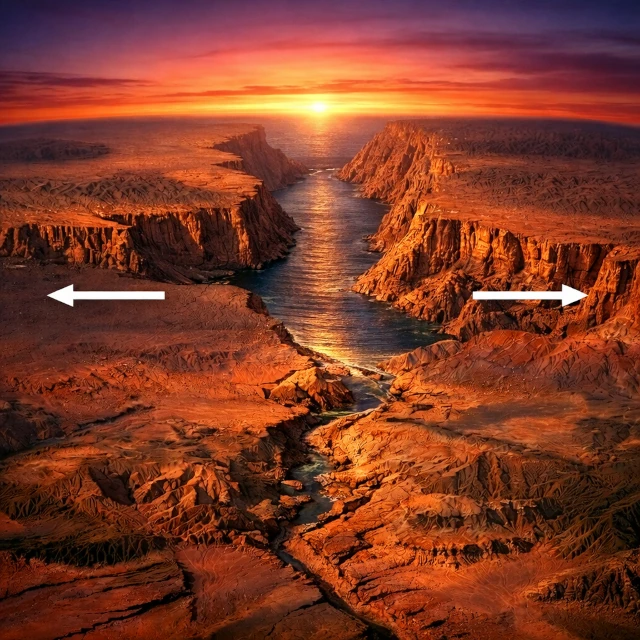
Plate tectonics.
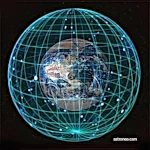
The large lithospheric plates move slowly: their floor is continuously created at mid-ocean ridges and disappears in subduction zones where it sinks back into the mantle.
The Earth's internal heat, from radioactive decay and primordial heat, has powered this planetary mechanism for over 4 billion years.
Image source: astronoo.com (new window)
Scientific Summary
Plate tectonics describes the movement of rigid segments of the Earth's lithosphere on the viscous asthenosphere, driven by mantle convection and the pull of subducting plates. This process, which moves continents at 1 to 15 cm per year, is responsible for the formation of mountain ranges, earthquakes, volcanism, and the supercontinent cycle (like Pangaea). It profoundly influences climate via the CO₂ cycle and ocean configuration, making Earth the only known planet with active plate tectonics.
Why do continents move slowly?
Continents move because they rest on rigid tectonic plates (the lithosphere) that glide over a more viscous and partially molten layer, the asthenosphere. The real engine of this movement is thermal convection in the Earth's mantle: hot rocks rise, cool down, and sink back, dragging the plates like rafts. Added to this is a major "traction" effect: the weight of cold plates plunging into subduction zones contributes as much, if not more, than the push at oceanic ridges. Thus, plates advance 1 to 15 centimeters per year – an imperceptible speed on our scale, but one that, over hundreds of millions of years, breaks up supercontinents, raises mountain ranges like the Himalayas, and shapes the Earth's surface.
Also worth exploring
Continue your exploration of the Universe with these topics:
A Long-Rejected Idea: Continental Drift
In 1912, meteorologist Alfred Wegener (1880-1930) proposed that the continents once formed a single supercontinent, Pangaea, and have been drifting slowly for hundreds of millions of years. The similarity of the African and South American coastlines, the continuity of geological formations from one continent to another, and the presence of identical fossils on lands now separated by oceans all support his theory. However, the scientific community rejected it, as there was no credible mechanism to explain the movement of entire continental masses.
It was not until the 1950s-1960s that mapping the ocean floors revealed the mid-ocean ridges. Plate tectonics then took its modern form, thanks to the work of Harry Hess (1906-1969), who proposed seafloor spreading, and J. Tuzo Wilson (1908-1993), who introduced the concepts of hotspots and transform faults.
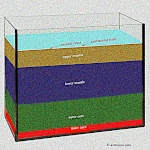
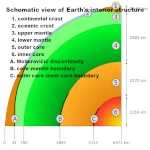
The Earth's Internal Structure: A Thermal Machine
The Earth is structured in concentric layers with very different properties. The temperature at the center reaches about 5,100 degrees Celsius, from two sources: the primordial heat inherited from accretion 4.5 billion years ago, and the heat continuously produced by the decay of uranium-238, thorium-232, and potassium-40.
| Layer | Thickness (km) | Temperature (°C) | State | Tectonic Role |
|---|---|---|---|---|
| Lithosphere | 5 to 70 | 0 to 300 | Rigid solid | Forms the moving tectonic plates |
| Astenosphere | 200 to 300 | 300 to 900 | Viscous, partially molten | Allows the sliding of lithospheric plates |
| Lower Mantle | 2,200 | 900 to 3,700 | Viscous solid | Site of deep convection currents |
| Outer Core | 2,260 | 3,700 to 5,000 | Liquid | Generates the Earth's magnetic field |
| Inner Core | 1,220 | 5,000 to 5,100 | Solid | Reservoir of primordial heat |
The Real Engine of the Plates
Over millions of years, the solid mantle behaves like a very viscous fluid and undergoes thermal convection: hot rocks rise, cool at the surface, and then sink back down. These convection cells drive the lithospheric plates above them, much like rafts on a river.
However, the mechanism is more complex: Don Anderson (1933-2014) and Claude Allègre (1937-) showed that the pull exerted by cold plates sinking in subduction contributes as much, if not more, than the push from the ridges. The weight of old, cooled plates is indeed a major driving force of the system.
Imperceptible Movements with Colossal Consequences
The plates move between 1 and 15 centimeters per year: the Atlantic, for example, widens by about 2.5 centimeters each year, or the width of a fingernail, moving Europe and America a meter apart every forty years. The two continents, now separated by nearly 6,000 kilometers, began to drift apart about 180 million years ago during the breakup of Pangaea.
The Three Types of Plate Boundaries
At divergent boundaries, two plates move away from each other and magma rises to form new oceanic crust. This is the mechanism of mid-ocean ridges: the Mid-Atlantic Ridge extends over more than 16,000 kilometers, and Iceland is one of the few places where it emerges above sea level.
At convergent boundaries, two plates collide. If one is oceanic, it sinks beneath the other in subduction, generating volcanoes, earthquakes, and tsunamis, as along the Peru-Chile Trench. If both are continental, the crust folds to form mountain ranges: the Himalayas were born this way, 50 million years ago, from the collision between the Indian and Eurasian plates.
At transform faults, two plates slide laterally past each other without creating or destroying crust. The friction accumulates stress that is released as earthquakes: the San Andreas Fault in California is the most famous example.
Evidence and Measurements of Plate Tectonics
Rocks formed at the ridges record the orientation of the Earth's magnetic field at the time of their solidification. Since this field has reversed many times, symmetrical bands of alternating polarity are observed on either side of the ridges, direct proof of the expansion of the ocean floor. This work by Drummond Matthews (1931-1997) and Frederick Vine (1939-) was decisive in the 1960s.
| Plate | Area (106 km2) | Speed (cm/year) | Dominant Type | Notable Associated Phenomenon |
|---|---|---|---|---|
| Pacific Plate | 103 | 5 to 10 | Subduction and translation | Pacific Ring of Fire, Mariana Trench |
| North American Plate | 76 | 2 to 3 | Divergence (east) and translation (west) | Mid-Atlantic Ridge, San Andreas Fault |
| Eurasian Plate | 68 | 2 to 3 | Divergence (west) and collision (south) | Himalayas (collision with the Indian Plate) |
| African Plate | 61 | 2 to 3 | Multiple divergence | East African Rift, nascent ocean |
| Antarctic Plate | 60 | 1 to 2 | Divergence (edges) | Surrounded by ridges on almost its entire perimeter |
| Indo-Australian Plate | 58 | 6 to 7 | Rapid convergence (north) | Himalayas, Australian Alps, Sumatra earthquakes |
| South American Plate | 44 | 2 to 3 | Divergence (east) and subduction (west) | Andes, Peru-Chile Trench, active volcanoes |
| Nazca Plate | 16 | 7 to 8 | Rapid subduction | Subduction under South America, formation of the Andes |
| Philippine Plate | 5.5 | 6 to 8 | Subduction (east and west) | Philippine island arc, intense volcanism |
| Arabian Plate | 5 | 2 to 3 | Collision (north) and divergence (south) | Red Sea (nascent rift), Zagros, Caucasus |
N.B.: The speeds indicated are average values measured by space geodesy (GPS). They can vary significantly depending on the part of the plate considered and the axis of measurement. The area includes, in some cases, smaller adjacent plates when geologists group them under the same name.
Pangaea and Past Supercontinents
Paleomagnetic and geochemical data allow us to trace the successive assemblies and dispersals of continental masses. This cycle, called the Wilson Cycle in honor of J. Tuzo Wilson (1908-1993), predicts that in about 250 million years, the continents will come together again to form a new supercontinent, sometimes nicknamed Pangea Proxima or Amasia, depending on the models.
| Supercontinent | Formation | Dispersion | Remark |
|---|---|---|---|
| Nuna / Columbia | ~ 1.8 billion years ago | ~ 1.5 billion years ago | First well-documented supercontinent; centered around 30-40° N, mainly in the northern tropical hemisphere |
| Rodinia | ~ 1.1 billion years ago | ~ 750 million years ago | Its breakup may have triggered a global glaciation; centered around 10-20° S, straddling the equator |
| Pangaea | ~ 335 million years ago | ~ 175 million years ago | Fragments into Laurasia (north) and Gondwana (south); centered around 10° N, extending from 85° S to 85° N |
| Pangaea Proxima / Amasia | ~ in 250 million years | - | Future supercontinent predicted by models; centered around 30-60° N depending on scenarios, around the Arctic pole for Amasia |
Geodynamic and Climatic Consequences
Plate tectonics profoundly influences climate and life:
- CO2 cycle: subduction volcanoes and ridges inject CO2 into the atmosphere, while rain, infiltrating silicate rocks, dissolves this CO2 and carries it to the oceans as carbonates: this dual mechanism acts as a geochemical thermostat on geological time scales.
- Fluid circulation: the position of the continents shapes ocean currents, atmospheric circulation, and the distribution of rainfall across the globe.
- Recycling: tectonics recycles nutrients between the Earth's interior and the surface, and regulates the composition of the atmosphere over long time scales.
- Emergence of a complex biosphere: tectonics isolates animal and plant populations, paving the way for the appearance of new species.
FAQ – Plate tectonics: the slow dance of continents
What is the difference between continental drift and plate tectonics?
Continental drift, proposed by Alfred Wegener in 1912, is the idea that continents move. Plate tectonics is the more complete theory that explains how and why they move: the Earth's lithosphere is divided into rigid plates that slide on the viscous asthenosphere, driven by mantle convection currents.
Why was Wegener's theory rejected in his time?
Because he could not explain the mechanism capable of moving entire continental masses. It took the mapping of the ocean floor in the 1950s-1960s to discover mid-ocean ridges and establish the modern theory of plate tectonics.
How fast do tectonic plates move?
Between 1 and 15 centimeters per year. For example, the Atlantic Ocean widens by about 2.5 centimeters each year, moving Europe away from America by one meter every forty years. The Pacific Plate moves 5-10 cm/year, while the Antarctic Plate moves only 1-2 cm/year.
What actually makes the plates move?
The main engine is thermal convection in the Earth's mantle: hot rocks rise, cool at the surface, then sink. However, the pull exerted by cold plates plunging into subduction zones contributes as much, if not more, than the push from ridges. The weight of old, cooled plates is a major driving force of the system.
What are the three types of plate boundaries?
Divergent boundaries: plates move apart, magma rises and forms new oceanic crust (mid-ocean ridges). Convergent boundaries: plates collide; if one is oceanic, it plunges into subduction (volcanoes, earthquakes); if both are continental, they form mountains (Himalayas). Transform faults: plates slide laterally past each other (San Andreas Fault).
How do we know plates actually move?
Through several lines of evidence: GPS observation of current movements; magnetic stripes symmetric about ridges, recording reversals of Earth's magnetic field; continuity of fossils and geological formations between separated continents; and the global distribution of volcanoes and earthquakes, which precisely follows plate boundaries.
What is Pangea and the Wilson Cycle?
Pangea is the last supercontinent, formed about 335 million years ago and beginning to break up 175 million years ago. The Wilson Cycle describes the cyclic assembly and dispersal of supercontinents every 400-500 million years. After Pangea, continents will gather again in about 250 million years to form a new supercontinent (Pangea Proxima or Amasia).
What is the impact of plate tectonics on climate?
Tectonics deeply influences climate: subduction volcanoes inject CO₂ into the atmosphere while rainwater weathering of silicate rocks captures that CO₂, creating a natural geochemical thermostat. The position of continents also shapes ocean currents and atmospheric circulation, as shown by Antarctica's isolation contributing to its glaciation.
Why are there so many volcanoes and earthquakes around the Pacific?
This is the "Pacific Ring of Fire," where several plates (Pacific, Nazca, Philippine, etc.) converge and subduct beneath continental plates. Friction and rock melting in subduction generate intense volcanism, while stress accumulation produces frequent earthquakes, including some of the most powerful ever recorded.
Is Earth the only planet with plate tectonics?
In the solar system, only Earth has complete active plate tectonics, with rigid mobile plates, ridges, and subduction zones. Mercury and the Moon have a single immobile crust; Mars shows traces of ancient activity but nothing active; Venus might have a peculiar form of tectonics (mobile blocks) but not plates similar to Earth's.
 From Black Basalt to Blue Oceans: Earth's Changing Palette
  Plate Tectonics: The Invisible Engine Moving the Continents
  The Number 360: The Mathematical Key to the Babylonian Sky
  Wet-Bulb Temperature: Humanity's Climate Time Bomb
  Why Doesn't Earth's Atmosphere Escape into Space?
  Origins of Earth: Magmatic Chaos and the Birth of the Solid World
  Earth's Atmosphere: The Invisible Shield Protecting Life
  The 5 Cosmic "End of the World" Scenarios (and Why They Won't Happen)
  Where does the water in the oceans come from? Three key stages
  From Carbon 14 to Uranium-Lead: The Science of Dating
  Major Natural Disasters: What Are the Most Likely Threats?
  The Boundary of Space: Where Does It Really Begin?
  536: The Year Without a Summer and the Beginning of the Late Antique Little Ice Age
  The leap second: scheduled end in 2035
  Planetary Alignments: A Fascinating but Relative Phenomenon
  All Deserts of the World
  Earth's Paleoclimates and Carbon Dioxide
  What is the effect of large lakes and water reservoirs on Earth's rotation?
  International Date Line
  Start Date of the Seasons: A Complex Celestial Mechanism
  Paleomagnetism: the magnetic memory of rocks
  3D Simulator: Revolutions of the Planets
  Geological Time and Mass Extinctions: From the Ordovician to the Cretaceous
  Earth History: Timeline Compressed into 24 Hours
  Earth's Water: An Extraterrestrial Origin?
  Reading the Sky: Understanding Declination and Right Ascension
  How is Earth's magnetic field born and why does it reverse?
 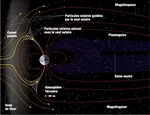 Earth's Magnetosphere: The Invisible Shield
  Fujita Scale: Classifying the Fury of Tornadoes
  Earth's Radioactivity: The Internal Energy of Our Planet
  The Deep Sea: Exploring the Deepest Ocean Trenches
  Why Are Days Getting Longer?
  The Depths of the Earth: From the Lithosphere to the Core
  Earth's Movements: How Earth Traces Its Spiral Through the Universe?
  How much is the sea level rising?
  The Life of Earth: Structure and Layers of the Earth
  The Eccentricity of Earth's Orbit: An Ellipse That Changes Everything
  Little Ice Age: The History of a Natural Climatic Cooling
  The Quest for Time: How Ancient Civilizations Used Astronomy?
  Van Allen Belt: A Rampart Against Cosmic Particles
  The Cosmos in Our Measure: When Man Invents the Universe
  What is the pendulum fixed relative to?
  Problem of longitude at sea
  World population, still gallopingin 2008
  The Oldest Image of Earth from Space
  Earth's Obliquity and Variations in Its Axis of Rotation
  The Astronomical Unit Fixed: A Length, No Longer an Orbit
  Water: one molecule, three states on Earth
  Simulator, the round of near-Earth cruisers
  Satellites that measure underwater relief
  Hadean's Hell
  The First Free Flight of an Astronaut in Space
  The first measurement of the Earth-Sun distance
  La The Announced End of the World on December 21, 2012: A Millennial Prophecy
 The Equinoxes: An Astronomical Event
 Milankovitch Cycles: The Astronomical Rhythm of Earth's Climate
 Why Is Earth So Often Cloudy?