


The Number 360: The Mathematical Key to the Babylonian Sky
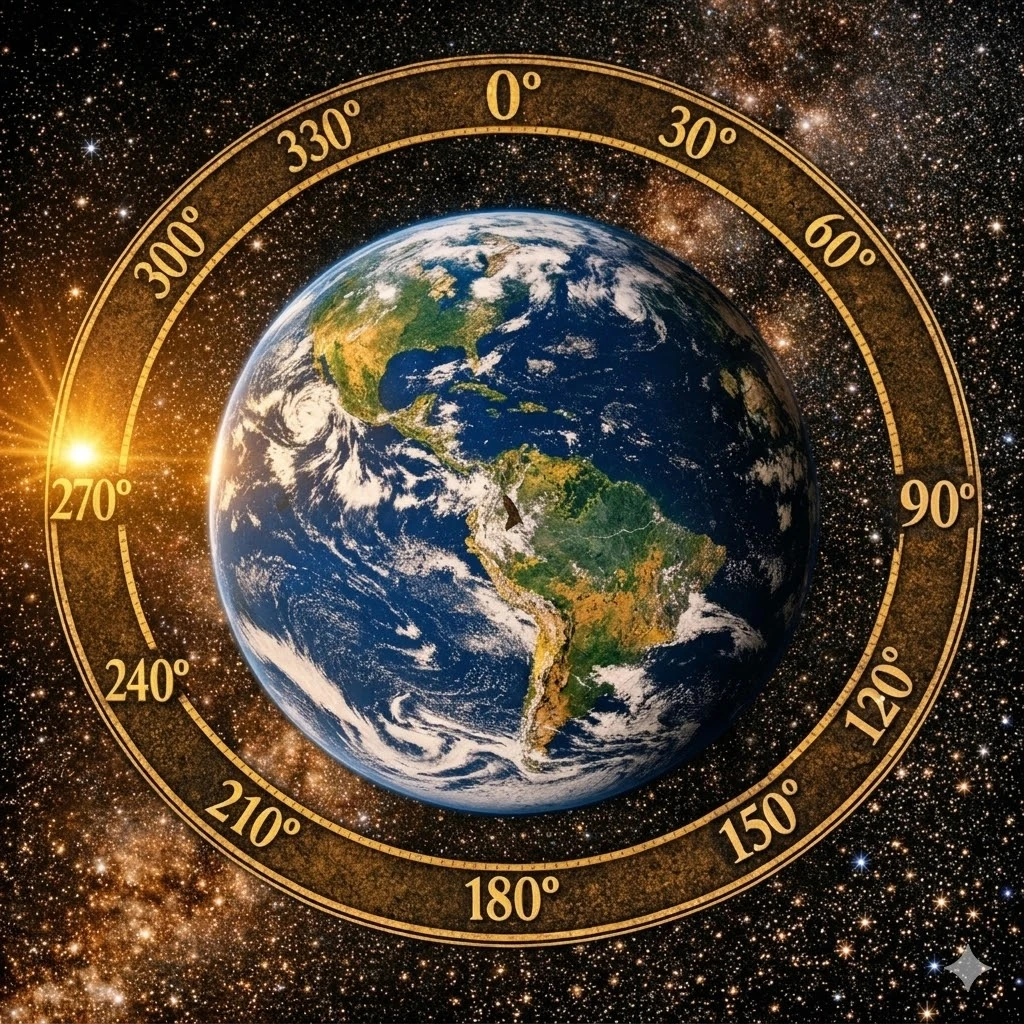
The division of the circle into 360 degrees is not a pure mathematical coincidence.
It is rooted in the observation of the sky, the Earth's revolution around the Sun, and the legacy of ancient civilizations.
Image source: astronoo.com (new window) (AI-generated image, public domain).
Scientific Abstract
The division of the circle into 360 degrees is not a law of nature, but a human convention inherited from the Babylonians (c. 2000–500 BCE). This choice, influenced by their sexagesimal numeral system (base 60), rests on two observations: the Sun travels about 1 degree per day across the celestial vault, returning to its position after ~360 days, and the number 360 has 24 divisors, making calculations easier. This convention, formalized by the Greeks (Hipparchus, Ptolemy), became established for its arithmetic convenience and remains universal in navigation, cartography, and astronomy.
Why is a circle divided into 360 degrees?
A circle is divided into 360 degrees not for a geometric or physical reason, but by a human choice inherited from the Babylonians more than 3,000 years ago. These astronomers used a base-60 numeral system (sexagesimal) and noticed that the Sun moved about 1 degree per day across the celestial vault, returning to its initial position after about 360 days. They chose 360 for its arithmetic richness (24 integer divisors) which makes it easy to divide the circle into equal parts, a convention later transmitted by the Greeks (Hipparchus, Ptolemy) down to our own day.
Also worth exploring
Continue your exploration of the Universe with these topics:
360 degrees: the oldest unit of measurement still in use?
A division born of celestial observation
Open a protractor, look at a compass dial, or consult a map: everywhere, the circle is divided into 360 degrees. This number seems self-evident, as if it were written into the nature of things. Yet nothing in pure geometry requires 360 rather than 100 or 1000. This number is the fruit of a human choice, more than three millennia old, and that choice was dictated by the sky.
The starting question is almost childlike: the Earth rotates on its axis in 24 hours, thus defining the day. It revolves around the Sun in about 365 days, describing an almost circular orbit. And a circle is 360 degrees, or almost exactly 1 degree per day. Is there a link between these three observations? The answer is yes, but in an unexpected sense: it is not nature that chose 360, it is humanity that chose 360 by drawing inspiration from nature.
The Babylonians, pioneers of mathematical astronomy
A sexagesimal system in the service of the sky
It all begins in Mesopotamia (historical region corresponding to present-day Iraq, cradle of mathematical astronomy), between the Tigris and the Euphrates, in what is now Iraq. As early as the 2nd millennium BCE, Babylonian scribes recorded their observations of the sky on clay tablets with remarkable precision. They used a sexagesimal (counting system based on base 60, still used for hours, minutes, and degrees) numeral system, that is, base 60. This is why we still count 60 seconds in a minute, 60 minutes in an hour, and 60 arcminutes in a degree.
These astronomer-mathematicians observed night after night the progression of the Sun across the celestial vault. From one night to the next, the Sun moves about 1 degree among the fixed stars, along a great circle that the Greeks would later call the ecliptic (apparent annual trajectory of the Sun on the celestial sphere, crossing the 12 constellations of the zodiac). The Babylonians found that the Sun returned to its initial position after about 360 days, a convenient approximation of the real year (365.25 days). It was then natural, for minds accustomed to base 60 and eager to divide this great perfect celestial circle, to choose 360: a number both close to the year and extraordinarily rich in divisors.
360: an arithmetically perfect number
A wealth of divisors
The choice of 360 is not due solely to the sky. It also owes much to mathematics. The number 360 has 24 integer divisors:
- 1, 2, 3, 4, 5, 6, 8, 9, 10, 12, 15, 18, 20, 24, 30, 36, 40, 45, 60, 72, 90, 120, 180, and 360.
This arithmetic richness is crucial for astronomers and engineers who, without calculators, had to divide circles into equal portions by hand. Dividing a circle into 2, 3, 4, 5, 6, 8, 9, 10, or 12 equal parts always gives a whole number of degrees. No other number of comparable size offers such computational convenience.
From Babylon to Greece: the transmission of knowledge
Hipparchus and Ptolemy, heirs and transmitters
It was the Greek astronomers who inherited and formalized the Babylonian system. Hipparchus of Nicaea (c. 190–120 BCE), considered the founder of positional astronomy, explicitly used the division of the circle into 360 degrees to map the stars and measure celestial positions. He was also the first to systematically subdivide these degrees into 60 arcminutes and each minute into 60 arcseconds, definitively consolidating the Babylonian sexagesimal legacy.
Claudius Ptolemy (c. 100–170), in his major work the Almagest, took up and amplified this framework. The Almagest remained the reference of Western and Arab astronomy until the 16th century, thus ensuring the transmission of the Babylonian degree to all subsequent scientific civilization. It is this uninterrupted thread that explains why a French engineer, a Japanese navigator, and a Brazilian architect all today use exactly the same angle of 360 degrees.
Axial rotation and orbital revolution: two independent movements
Two movements of distinct origins
Let us now return to the initial physical question. Are the day (Earth's rotation on its axis, about 24 hours) and the year (revolution around the Sun, 365.25 days) physically linked? The answer from astrophysicists is clear: no.
These two movements have distinct origins:
- The Earth's axial rotation is a legacy of the formation of the solar system, 4.56 billion years ago. When the protoplanetary disk collapsed under its own gravity, the conservation of angular momentum (physical quantity that measures the amount of rotation of a system, and which is conserved in the absence of external torque) set the proto-Earth into rotation. Since then, this rotation has been slowing very slowly under the effect of tidal friction exerted by the Moon: in the age of the dinosaurs, a day lasted only about 23 hours.
- The orbital revolution is entirely governed by the Earth-Sun distance and the mass of the Sun, in accordance with Johannes Kepler's third law (1571–1630): \( T^2 \propto a^3 \), where \( T \) is the orbital period and \( a \) the semi-major axis of the ellipse. If the Earth were closer to the Sun, its year would be shorter, but its day would remain unchanged.
The fact that the year contains about 365 times the duration of a day is therefore a pure geographic contingency, linked to the accidental distance at which the Earth formed around its star. There is no physical mechanism that synchronizes these two time scales.
The real coincidence: 360 versus 365
A known but accepted discrepancy
Here is the crucial point that intuition can miss. The year does not last 360 days, but 365.25 days. The degree therefore does not correspond exactly to the Sun's daily displacement. In reality, the Sun moves each day by \( \frac{360°}{365.25} \approx 0.9856° \), that is, almost, but not quite, 1 degree.
The Babylonians knew this. Their most precise astronomical tablets, such as the MUL.APIN (collection of Babylonian tablets describing planetary movements with great precision, dating from the 1st millennium BCE) series (c. 1000 BCE), already carefully distinguished the 365-day year from the idealized 360-day year. They deliberately chose 360 as the base of their angular system, accepting a slight approximation, because the arithmetic advantages of this number far outweighed the disadvantage of a discrepancy of a few days.
Comparison of systems of angular division of the circle
The table below compares the main divisions of the circle used throughout history and their numerical bases.
| Civilization or system | Era | Division of the circle | Numerical base | Main use |
|---|---|---|---|---|
| Babylon | c. 2000–500 BCE | 360 degrees | Sexagesimal (base 60) | Astronomy, calendar, celestial cartography |
| Greece (Hipparchus, Ptolemy) | 2nd century BCE – 2nd century CE | 360 degrees, 60 minutes, 60 seconds | Inherited sexagesimal | Positional astronomy, trigonometry |
| Medieval Islam | 8th–15th century CE | 360 degrees | Transmitted sexagesimal | Navigation, astronomy, architecture |
| French Revolution (gradian) | 1795 CE | 400 gradians | Decimal (base 10) | Geodesy, topography (limited use) |
| Modern mathematics (radian) | 19th–20th century CE | \( 2\pi \) radians | Continuous (natural) | Analysis, physics, theoretical engineering |
| Current universal use | Present | 360 degrees | Babylonian sexagesimal | Navigation, cartography, architecture, astronomy |
N.B.:
The radian, the International System (SI) unit for angles, is defined as the ratio of arc length to the radius of the circle.
A full turn equals exactly \( 2\pi \) radians, which makes the formulas of physics and mathematical analysis more elegant than in any other angular unit.
But in daily practice, the Babylonian degree reigns unchallenged.
360: A 3,000-year-old legacy
A convention still alive
The Earth turns, the seasons return, and our circles have 360 degrees because astronomers, more than 3,000 years ago, decided that geometry would follow the rhythm of the stars. It is not nature that imposed this number, it is human intelligence that chose it by reading nature. The scribes of Babylon, armed with reeds to engrave fresh clay and eyes fixed on the night sky of Mesopotamia, chose 360 because this number reconciled two contradictory requirements: staying true to the rhythm of the sky and lending itself easily to hand calculation.
References
- Encyclopaedia Britannica – Almagest (new window)
- Wikipedia – Degree (angle) (new window)
- IFLScience – Why Are There 360 Degrees In A Circle? (new window)
- TIME – Why Are There 360 Degrees in a Circle? Here's the History (new window)
- UNLV – Ancient Babylonian astronomers and why we have 360 degrees (new window)
FAQ: Why 360 degrees in a circle?
Does the number 360 come from a physical or natural law?
No. Nothing in pure geometry requires 360 rather than 100 or 1000. The choice of 360 is a human choice, more than three millennia old, dictated by the observation of the sky and by arithmetic considerations. It is not nature that imposed this number, it is human intelligence that chose it by reading nature.
What is the link between 360 degrees and the 365-day year?
The Babylonians observed that the Sun moves about 1 degree per day among the fixed stars and returns to its initial position after about 360 days, a convenient approximation of the real year (365.25 days). The discrepancy of 5.25 days was known, but the arithmetic advantages of 360 (which divides easily by 2, 3, 4, 5, 6, 8, 9, 10, 12, etc.) outweighed calendrical precision.
Why did the Babylonians choose base 60?
The Babylonians used a sexagesimal (base 60) numeral system, from which we have inherited for measuring time (60 seconds, 60 minutes) and angles (60 arcminutes, 60 arcseconds). Base 60 is exceptionally rich in divisors (1, 2, 3, 4, 5, 6, 10, 12, 15, 20, 30, 60), which greatly facilitates manual calculations of fractions.
Are Earth's rotation and its revolution around the Sun linked?
No. These two movements have distinct physical origins. Axial rotation (the day) is a legacy of the formation of the solar system and the conservation of angular momentum. Orbital revolution (the year) is governed by the Earth-Sun distance and the mass of the Sun (Kepler's law). The fact that the year contains about 365 days is a pure geographic contingency, with no physical link.
Are there other units for measuring angles?
Yes. The French Revolution introduced the gradian (400 gradians in a full circle) for geodesy and topography, without lasting success. Modern mathematics uses the radian (2π radians in a full circle), which is the International System (SI) unit and makes physics and analysis formulas more elegant. But in daily practice (navigation, cartography, architecture), the Babylonian degree remains universal.
Why has the degree not been replaced by a decimal unit such as the gradian?
The French Revolution attempted a complete reform with the gradian (1/400 of the circle) and the metric system, but only the decimal units of length, mass, and volume endured. The gradian remained of very limited use (certain topographic maps) because the degree was already universally anchored after more than 2,000 years of use in astronomy, navigation, and cartography. Cultural and practical inertia prevailed over decimal rigor.
 From Black Basalt to Blue Oceans: Earth's Changing Palette
  Plate Tectonics: The Invisible Engine Moving the Continents
  The Number 360: The Mathematical Key to the Babylonian Sky
  Wet-Bulb Temperature: Humanity's Climate Time Bomb
  Why Doesn't Earth's Atmosphere Escape into Space?
  Origins of Earth: Magmatic Chaos and the Birth of the Solid World
  Earth's Atmosphere: The Invisible Shield Protecting Life
  The 5 Cosmic "End of the World" Scenarios (and Why They Won't Happen)
  Where does the water in the oceans come from? Three key stages
  From Carbon 14 to Uranium-Lead: The Science of Dating
  Major Natural Disasters: What Are the Most Likely Threats?
  The Boundary of Space: Where Does It Really Begin?
  536: The Year Without a Summer and the Beginning of the Late Antique Little Ice Age
  The leap second: scheduled end in 2035
  Planetary Alignments: A Fascinating but Relative Phenomenon
  All Deserts of the World
  Earth's Paleoclimates and Carbon Dioxide
  What is the effect of large lakes and water reservoirs on Earth's rotation?
  International Date Line
  Start Date of the Seasons: A Complex Celestial Mechanism
  Paleomagnetism: the magnetic memory of rocks
  3D Simulator: Revolutions of the Planets
  Geological Time and Mass Extinctions: From the Ordovician to the Cretaceous
  Earth History: Timeline Compressed into 24 Hours
  Earth's Water: An Extraterrestrial Origin?
  Reading the Sky: Understanding Declination and Right Ascension
  How is Earth's magnetic field born and why does it reverse?
  Earth's Magnetosphere: The Invisible Shield
  Fujita Scale: Classifying the Fury of Tornadoes
  Earth's Radioactivity: The Internal Energy of Our Planet
  The Deep Sea: Exploring the Deepest Ocean Trenches
  Why Are Days Getting Longer?
  The Depths of the Earth: From the Lithosphere to the Core
  Earth's Movements: How Earth Traces Its Spiral Through the Universe?
  How much is the sea level rising?
  The Life of Earth: Structure and Layers of the Earth
  The Eccentricity of Earth's Orbit: An Ellipse That Changes Everything
  Little Ice Age: The History of a Natural Climatic Cooling
  The Quest for Time: How Ancient Civilizations Used Astronomy?
  Van Allen Belt: A Rampart Against Cosmic Particles
  The Cosmos in Our Measure: When Man Invents the Universe
  What is the pendulum fixed relative to?
  Problem of longitude at sea
  World population, still gallopingin 2008
  The Oldest Image of Earth from Space
  Earth's Obliquity and Variations in Its Axis of Rotation
  The Astronomical Unit Fixed: A Length, No Longer an Orbit
  Water: one molecule, three states on Earth
  Simulator, the round of near-Earth cruisers
  Satellites that measure underwater relief
  Hadean's Hell
  The First Free Flight of an Astronaut in Space
  The first measurement of the Earth-Sun distance
  La The Announced End of the World on December 21, 2012: A Millennial Prophecy
 The Equinoxes: An Astronomical Event
 Milankovitch Cycles: The Astronomical Rhythm of Earth's Climate
 Why Is Earth So Often Cloudy?