


Why does infrared pass through dust clouds?

The Pillars of Creation seen by Hubble. In visible light (left), dust obscures the interior of the columns. In near-infrared (right), light penetrates the gas and reveals the numerous nascent stars previously invisible.
Image source: NASA, ESA, and the Hubble Heritage Team (STScI/AURA) (new window)
Scientific Summary
Interstellar dust strongly absorbs and scatters ultraviolet and visible light, obscuring many regions of the Universe. Infrared light, with its longer wavelength, generally interacts less efficiently with small dust grains and can therefore penetrate clouds that are opaque in the visible spectrum. This property allows the observation of young stars, protoplanetary disks, and regions behind dense molecular clouds.
However, the phenomenon is more subtle than simple transparency of dust. The extinction depends on wavelength, grain size and composition, as well as the column of material crossed. At certain infrared wavelengths, dust still absorbs radiation and can even become a source of thermal emission. Observations from the JWST (james Webb Space Telescope) precisely exploit this complementarity between near- and mid-infrared to study the most buried regions of the cosmos.
Why does infrared pass through cosmic dust clouds?
Astronoo answers this question by deciphering the physics of light-matter interaction. Visible light represents only a small part of the electromagnetic spectrum. When it encounters a cosmic dust cloud, the small grains efficiently absorb and scatter visible photons. Light from a star behind the cloud is then strongly attenuated, or even completely obscured.
As the wavelength increases towards the infrared, the interaction with dust grains generally becomes less efficient. Some of the radiation can then pass through the cloud. This is why a region that appears almost black in a visible image can reveal many bright stars when observed in the near-infrared.
Also worth exploring
Continue your exploration of the Universe with these topics:
Cosmic dust: an imperfect screen
Grains much smaller than a cell
Interstellar dust consists of solid grains formed notably from silicates, carbon, and carbonaceous compounds. Their size is generally on the order of a few tens to a few hundred nanometers, with a very wide size distribution. These grains are tiny on a human scale but numerous enough to produce considerable extinction when their concentration is high.
The efficiency of the interaction between a grain and radiation depends notably on the ratio between the characteristic grain size \(a\) and the wavelength \(\lambda\). A useful parameter is the size parameter: \( x=\frac{2\pi a}{\lambda} \)
When the wavelength becomes large compared to the grain size, the parameter \(x\) decreases, and light scattering generally becomes less efficient. This trend partly explains why longer infrared wavelengths penetrate deeper into dusty clouds.
Absorption and scattering
Two phenomena must be distinguished. Scattering changes the photon's direction of propagation, while absorption removes the photon from the observed beam. In both cases, the light from a source behind the cloud is diminished.
In the visible range, dust grains efficiently scatter and absorb radiation. In the near-infrared, extinction decreases sharply under many astrophysical conditions. Infrared observation therefore does not eliminate the dust, but reduces the effect of the screen it constitutes.
Optical depth: measuring a cloud's opacity
A fundamental quantity in astrophysics
The amount of material crossed by radiation can be described by the optical depth \(\tau_\lambda\). It depends on the wavelength and the amount of dust present along the line of sight.
In a simplified description: \( \tau_\lambda=\kappa_\lambda\Sigma \) where \(\kappa_\lambda\) is the mass opacity of the dust and \(\Sigma\) the column density of material crossed.
The flux transmitted by an absorbing screen is then written as: \( F_{\mathrm{obs}}=F_0e^{-\tau_\lambda} \)
When \(\tau_\lambda\ll1\), the medium is optically thin, and a large part of the radiation passes through the cloud. When \(\tau_\lambda\gg1\), the medium is optically thick, and radiation from the source behind is strongly suppressed.
Extinction expressed in magnitudes
Astronomers also use extinction \(A_\lambda\), expressed in magnitudes: \( A_\lambda=1{,}086\,\tau_\lambda \)
The transmitted flux can then be written: \( \frac{F_{\mathrm{obs}}}{F_0}=10^{-0{,}4A_\lambda} \)
This relationship shows why a few magnitudes of extinction can already strongly modify the appearance of a region. Extinction is not a constant, however: it depends strongly on wavelength and the physical properties of the dust.
Why stars reappear in the near-infrared
Infrared, the light that pierces dust walls
A star does not just emit the light our eyes perceive. It also radiates in the infrared, an invisible but very real light. When a dust cloud intervenes, it stops visible light like an opaque curtain. But infrared, on the other hand, weaves its way through, partly traversing this veil, allowing the star's light to reach us.
Stellar nurseries finally unveiled
This phenomenon changes everything for astronomers. Stars are born in extremely dusty environments that visible light cannot probe. Thanks to infrared, these formation regions become accessible, and young stars, previously invisible, emerge before our eyes.
The breathtaking images from James Webb
The James Webb Space Telescope exploits this superpower of infrared. Its images show astonishing scenes: growing stars, gas jets, and complex structures emerging from clouds that seemed empty. Dust, which masks everything in visible light, becomes transparent in the infrared, revealing a vibrant and dynamic universe.
Dust doesn't just hide; it radiates
A true reservoir of infrared energy
Dust absorbs part of the ultraviolet and visible radiation emitted by stars. The absorbed energy increases the internal energy of the grains, which reach an equilibrium temperature depending on their environment. They then re-emit this energy in the form of thermal radiation, mainly in the infrared. The process can be represented simply:
\[ \text{hot star} \rightarrow \text{UV and visible} \rightarrow \text{absorption by dust} \rightarrow \text{heating} \rightarrow \text{infrared emission} \]
Dust thus becomes simultaneously a screen and a source of radiation. This duality is fundamental to understanding infrared images of nebulae and galaxies.
Example of the Pillars of Creation: in visible light, dust draws dark columns that mask the interior of the nebula. In the infrared, the same heated dust begins to radiate, revealing nascent stars and previously hidden structures. It is this dual role (obstacle and revealer) that makes infrared astronomy so powerful.
Planck's law shifts radiation towards the infrared
For dust approximately in thermal equilibrium at a temperature \(T\), its emission can be described by Planck's law: \( B_\lambda(T)=\frac{2hc^2}{\lambda^5}\frac{1}{e^{hc/(\lambda kT)}-1} \)
The position of the emission peak is given approximately by Wien's displacement law: \( \lambda_{\mathrm{max}}T\simeq2898\,\mu\mathrm{m\,K} \)
Thus, dust at \(T=30\,\mathrm{K}\) has an emission peak around \(97\,\mu\mathrm{m}\), while much hotter dust at \(T=300\,\mathrm{K}\) radiates primarily around \(9{.}7\,\mu\mathrm{m}\). Infrared therefore allows not only to look through certain layers of dust but also to directly measure their temperature and distribution.
From near to mid-infrared: each wavelength tells a story
The term "infrared" covers a very wide range of wavelengths. An image obtained at \(2\,\mu\mathrm{m}\) therefore does not necessarily show the same objects as an image obtained at \(20\,\mu\mathrm{m}\).
| Domain | Indicative Wavelength | Preferred Objects or Phenomena | Comment |
|---|---|---|---|
| Near-infrared | 0.7 to 5 µm | Stars, protostars, galaxies, disks | Penetrates dusty regions more easily and reveals many hidden stars |
| Mid-infrared | 5 to 30 µm | Warm dust, molecules, star-forming regions | Heated dust becomes a particularly significant emission source |
| Far-infrared | Beyond 30 µm | Cold dust, molecular clouds | Thermal radiation from cold dust progressively dominates |
The James Webb Space Telescope: seeing into cosmic clouds
The JWST (james Webb Space Telescope) was designed primarily to observe in the near- and mid-infrared. Its 6.5-meter mirror and specialized instruments allow it to obtain images and spectra with great sensitivity.
NIRCam (near Infrared Camera) primarily covers the near-infrared, while MIRI (mid-Infrared Instrument) explores the mid-infrared. This complementarity is essential: NIRCam notably reveals stars and structures observable through the dust, whereas MIRI is particularly sensitive to the thermal radiation of the dust.
Webb's observations thus show that the transition from near to mid-infrared can completely transform an astronomical scene. In the Pillars of Creation, for example, NIRCam reveals many stars, while MIRI highlights dusty structures and their infrared emission.
A star can disappear as the wavelength increases
Long-wave infrared is not a magic wand
One might think that infrared is a light that passes through everything, and the longer it is, the better. But this is not the case. Hot stars lose their brightness as we move towards the mid-infrared. In images taken by MIRI, James Webb's mid-infrared instrument, some stars fade. Conversely, the dust heated by these same stars becomes increasingly bright.
Two infrareds are better than one
Near- and mid-infrared are not in competition. They are partners. The first is a star hunter, capable of finding them behind clouds. The second is a cartographer of warm matter, outlining star-forming regions. By combining them, astronomers get a much richer image than each separately.
Seeing the center of the Milky Way through the dust
The center of our galaxy is a spectacular example. A large amount of dust located between the Sun and the galactic center absorbs visible light. The center of the Milky Way is therefore extremely difficult to observe in the optical domain.
In the near-infrared, some of the stars become observable. Going towards even longer wavelengths, the dust clouds themselves become luminous thanks to their thermal emission. Multi-wavelength observation thus allows distinguishing stars, hot gas, and dust at different temperatures.
Infrared therefore does not remove the dust screen. It allows modifying the relationship between radiation and this screen to extract information that would be lost in the visible range.
Limitations: infrared does not pass through all dust
This precision is essential. It is incorrect to state that infrared always passes through dust clouds. When the column of material becomes large enough, the optical depth can remain high even in the infrared.
In some extremely dense regions, radiation can therefore remain blocked. Recent Webb observations precisely show this phenomenon: some areas of molecular clouds are so thick that even the infrared radiation detected by the telescope does not allow seeing what lies behind.
Infrared is therefore best described as an additional window onto the Universe, and not as a vision through perfectly transparent matter.
Why multiple wavelengths are essential
A single image cannot completely describe a complex astronomical region. Comparing several spectral domains makes it possible to separate different constituents and reconstruct physical processes.
A star-forming region may for example simultaneously present:
- stars visible in the near-infrared;
- jets of matter ejected by protostars;
- hot dust shining in the mid-infrared;
- cold dust detectable at longer wavelengths;
- molecules producing particular spectral signatures.
Combining these observations allows determining the temperature, composition, density, and spatial distribution of matter. Infrared astronomy is therefore both an imaging technique and a physical diagnostic tool.
A window onto the birth of stars and planets
Stars are born in cold molecular clouds where matter gathers under gravity. As contraction proceeds, density increases and a protostellar object forms at the center.
This phase is particularly difficult to observe in visible light because the protostar is enshrouded in gas and dust. Infrared radiation allows observing certain parts of the system and detecting the heat produced by gravitational collapse and interactions between jets of matter and their environment.
Around many young stars, a circumstellar disk also forms. This disk constitutes the raw material from which planets can emerge. Infrared observation thus allows us to go far back in the history of the formation of planetary systems.
Table: visible and infrared facing cosmic dust
This table illustrates why astronomers favor the infrared to probe the densest regions of our galaxy, where stars are born and planetary systems hide.
| Property | Visible Light | Infrared Light | Comment |
|---|---|---|---|
| Interaction with dust | Strong | Generally weaker | Extinction often decreases as wavelength increases |
| Stars behind a cloud | Often obscured | More easily detectable | Near-infrared allows observing many stars hidden in the visible |
| Warm dust | Barely visible | Very significant | Grains heated by stars re-emit their energy in the infrared |
| Cold dust | Practically invisible | Observable at long wavelengths | Its thermal emission shifts towards the far-infrared |
| Star-forming regions | Often obscured | Partially revealed | Near- and mid-infrared provide complementary information |
References
- NASA Science - Infrared Astronomy (new window)
- ESA/Webb - Infrared Astronomy (new window)
- NASA Science - How Can Infrared Light See Through Cosmic Dust? (new window)
- ESA/Webb - Webb snaps highly detailed infrared image of actively forming stars (new window)
- ESA/Webb - Webb Catches Fiery Hourglass as New Star Forms (new window)
- ESA/Webb - Webb Reveals Dust and Structure in the Pillars of Creation (new window)
- ESA/Webb - Webb explores largest star-forming cloud in the Milky Way (new window)
FAQ: Everything you need to know about infrared light
Why does infrared pass through dust better?
The infrared wavelength is longer than that of visible light. For interstellar dust grains, the efficiency of certain interactions, particularly scattering, generally decreases as the wavelength increases. Infrared radiation can therefore pass more easily through certain dusty regions.
Does infrared completely pass through dust clouds?
No. A sufficiently dense cloud can remain opaque even in the infrared. The optical depth depends on the amount of matter and the wavelength. Some very dense regions therefore remain invisible even to infrared instruments.
Why does dust shine in the infrared?
Grains absorb part of the ultraviolet and visible radiation from stars. They warm up and then re-emit this energy as thermal infrared radiation. Dust thus becomes a source of information about its own environment.
Why does JWST observe in the infrared?
JWST has been optimized for the near- and mid-infrared. This spectral range allows both observing objects obscured by dust and studying the thermal radiation of cold or warm matter. It is particularly well suited for studying the formation of stars, galaxies, and planetary systems.
Is mid-infrared always better than near-infrared?
No. The two domains are complementary. Near-infrared is particularly effective for detecting many stars and young objects through dust. Mid-infrared reveals the thermal emission of warm dust more. A long-wavelength image can therefore make some stars disappear while revealing much better the surrounding matter.
 Why does infrared pass through dust clouds?
  The Perception of Radiant Cold Explained by Physics
  Sprites and Cosmic Rays: The Ghostly Lightning of the Atmosphere
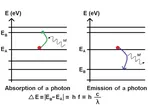
  Principle of absorption and emission of a photon
  The Femtosecond Laser: From Ultra-Short Time to Extreme Power
  The World of Color
  The secret of the speed of light: electromagnetic runaway
  Rainbow: formation, colors and types of arcs explained
  Photoelectric effect: Einstein, photons and electrons
  The Nature of Light
  Plasma Lamp and Field Concept
  What is Vantablack?
  Michelson-Morley Experiment
  Redshift calculation (z)
  All the Light of the Electromagnetic Spectrum
  Solar Pillars: Celestial Mirages and Light Phenomena
  The Speed of Light: A Universal Constant
  The incredible precision of the second
  Aberration of Light: The Great Gathering, Blueshift, and Dazzling
  Why do elementary particles have no mass?
  Polar Auroras: Light, Magnetism and Solar Activity
  Gravitational Lenses: When Spacetime Becomes a Mirage
  Optical Illusions: Deceptions and Mysteries of Visual Perception
  Traveling Light: How a Photon Leaves the Sun to Reach Earth?
  Bioluminescence of living organisms
  Laser light
  We do not see with our eyes but with our brain
  Zodiacal Light: Reflection of Interplanetary Dust
  The Antitwilight Arch: Earth's Shadow
  How many photons to heat a cup of coffee?
  Biosignatures: Presence of Life in the Universe
  Spectroscopy: A Key to Analyzing the Invisible World
  Field concept in physics
  Why is Cherenkov light blue? Explanations and physical phenomenon
  The lights of the Sun
  What is a Wave?
  Planck's equation and black body light