


Polar Auroras: Light, Magnetism and Solar Activity
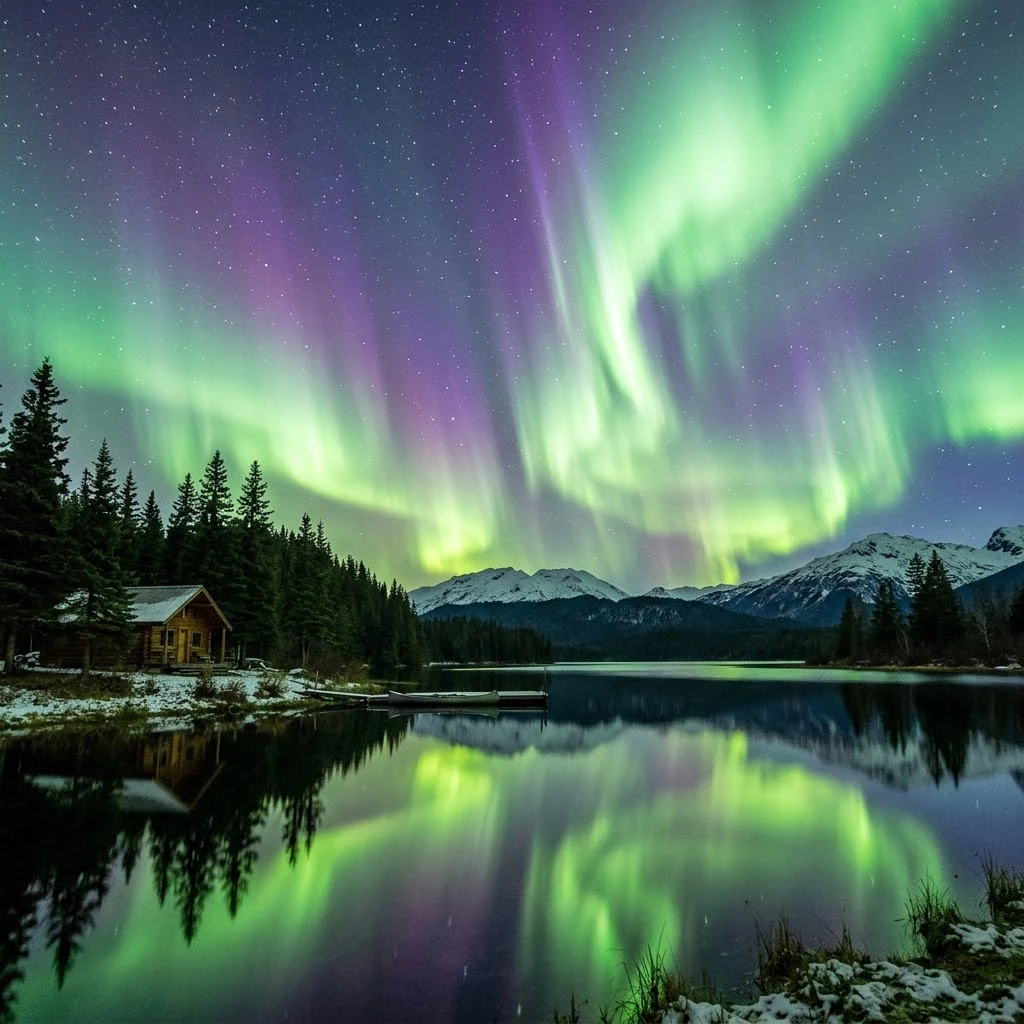
Aurora borealis blazing over the peaceful waters of Bear Lake, Alaska.
Image source: astronoo.com (new window) — AI-generated image, public domain.
Scientific Summary
Astronoo's article explores polar auroras, those spectacular luminous phenomena at high latitudes. It details their origin in the interaction between the solar wind and Earth's magnetic field, which guides charged particles toward the ionosphere. Collisions with oxygen and nitrogen atoms produce light emissions in various colors (green, red, blue, violet). The article also covers the different types of auroras, their dependence on solar activity (Kp index), and the underlying physical mechanisms, offering a clear synthesis of current knowledge about this cosmic phenomenon.
What causes polar auroras and what are their physical mechanisms?
This article is dedicated to polar auroras, those fascinating dancing lights that illuminate the skies near the poles. But what causes this celestial spectacle and what are the physical mechanisms at play? The answer lies in the complex dynamics between the Sun and Earth. The solar wind, a continuous stream of charged particles, carries the interplanetary magnetic field with it. When these particles encounter Earth's magnetosphere, they are deflected by the magnetic shield, but some are channeled toward the polar regions by the field lines. Upon entering the ionosphere, these electrons and protons collide with atoms and molecules in the atmosphere (oxygen, nitrogen), exciting them to higher energy levels. The return to the ground state is accompanied by the emission of photons, producing the characteristic colors of auroras. The intensity and shape of these phenomena depend on solar activity, particularly flares and coronal mass ejections, which increase the particle flux and can extend the visibility of auroras to lower latitudes. By exploring these interactions, the article reveals the keys to a phenomenon that is not only aesthetic but also a valuable indicator of our star's activity and space weather.
Also worth exploring
Continue your exploration of the Universe with these topics:
Origin of polar auroras
Solar wind and magnetosphere
The solar wind is a continuous stream of charged particles: mainly electrons, protons, and helium nuclei (alpha particles), ejected by the solar corona at speeds between 400 and 800 km/s. This interplanetary plasma carries the interplanetary magnetic field with it. As it approaches Earth, this flow encounters the protective shield of Earth's magnetosphere. This is defined by the balance between the dynamic pressure of the solar wind and Earth's internal magnetic pressure. The interaction manifests as a bow shock on the dayside, followed by a magnetopause, a thin layer where pressures balance. Magnetic reconnection between the interplanetary field and Earth's field enables efficient transfer of energy and momentum, opening a window through which solar particles can enter the magnetosphere.
Guidance of particles toward the poles
Once inside the magnetosphere, the charged particles are trapped and drift under the effect of field gradients. They are then channeled by Earth's magnetic field lines, which converge toward the polar regions. This guidance causes them to precipitate into Earth's atmosphere, primarily in an annular zone between 60 and 75 degrees latitude, called the auroral oval. Upon entering the upper atmosphere (or ionosphere), between 80 and 300 km altitude, these energetic electrons and protons (reaching several tens of keV) collide with oxygen and nitrogen atoms and molecules. These impacts excite these atmospheric constituents to metastable electronic states. The return to the ground state is accompanied by the emission of photons, the wavelength of which depends on the excited species and altitude, thus producing the luminous phenomenon observable from the ground. Local acceleration mechanisms, such as Alfvén waves, can further increase particle energy, enhancing the intensity and variety of auroras.
Physical mechanisms
Collisions and atomic excitation
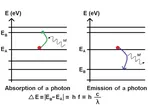
When electrons and protons from the solar wind enter the ionosphere, they collide with oxygen and nitrogen atoms. These collisions raise the electrons of the atoms to an excited state.
When these electrons return to their ground state, they emit photons whose wavelengths determine the color of the aurora, with green being the most common. The density and energy of the solar particles influence the intensity and height of the auroras.
- Green (approximately 557.7 nm) is mainly emitted by oxygen atoms (O) at an altitude of 100 to 150 km.
- Red (630.0 nm) is also produced by oxygen (O2), but at altitudes above 200 km.
- Blue (427.8 nm) comes from ionized nitrogen molecules (N2+).
- Violet or purple (390–420 nm) is emitted by neutral nitrogen (N2), usually during intense solar activity.
Types of auroras and variations
Auroral morphology
The visual appearance of auroras is not fixed; it reflects the fine structure of particle precipitation and the local geometry of field lines. Curtains display vertical folds, like undulating draperies, stretching along magnetic field lines, reflecting a heterogeneous energy distribution of precipitating electrons. Arcs are homogeneous luminous ribbons, generally stable for several minutes, extending from east to west and materializing a zone of regular precipitation. In contrast, coronas form by a perspective effect when the observer is at the zenith of the auroral oval: the light rays, actually parallel, appear to converge at a central point, giving the illusion of a radial crown. Finally, spirals or swirling veils result from the dynamic evolution of the magnetosphere, often associated with rapid variations in the electric field or bursts of magnetic reconnection that twist field lines. These morphological transitions are a valuable indicator of the evolution of solar wind parameters and energy release processes in the magnetotail.
Influence of solar activity
The occurrence of auroras is intimately linked to the 11-year solar cycle, with frequency and intensity peaking during phases of maximum activity. The Kp index is the reference parameter for quantifying global geomagnetic disturbances. When solar flares or coronal mass ejections (CMEs) propel vast magnetized plasma clouds toward Earth, the transported energy can abruptly push the Kp index higher. It generally takes 18 to 48 hours between the observation of a CME and the arrival of its shock at the magnetosphere. A geomagnetic storm (Kp ≥ 5) makes auroras visible from much more southerly regions (such as the northern United States or central Europe). Conversely, coronal holes, sources of fast solar wind, generate recurrent auroras, more moderate but which can persist for several days, offering less intense but more predictable displays. The combination of these two sources of solar activity determines the richness and variability of observed auroral phenomena.
N.B.:
The Kp index is a scale from 0 to 9 that quantifies disturbances in Earth's magnetic field. A high Kp (≥ 5) indicates a geomagnetic storm conducive to auroras visible at mid-latitudes.
Classification of auroral forms according to geomagnetic conditions
This summary table cross-references observed morphologies (arcs, curtains, coronas, spirals) with the geomagnetic parameters that govern them, establishing a direct correlation between the visual appearance of auroras and the intensity of solar activity measured by the Kp index.
| Shape | Description | Typical altitude | Activity conditions |
|---|---|---|---|
| Arcs | Homogeneous, stable ribbons, generally east-west oriented | ~100 – 150 km | Low to moderate Kp (slow solar winds) |
| Curtains | Pleated vertical draperies with distinct light rays | 80 – 250 km | Moderate Kp (recurrent storms, coronal holes) |
| Coronas | Rays converging toward a central point (perspective effect at zenith) | 100 – 300 km | High Kp (observation at the heart of the oval) |
| Spirals / veils | Dynamic, evolving eddies, sign of active reconnection | 100 – 200 km | Very high Kp (impacting CME, strong magnetic activity) |
Comparative table of the main characteristics of auroras
The table below summarizes the fundamental physical parameters of polar auroras: altitude of the emission zone, characteristic wavelengths, typical duration of manifestations, and the influence of geomagnetic variability on their intensity and latitudinal extent.
| Characteristic | Description | Typical value | Comment |
|---|---|---|---|
| Altitude | Aurora formation zone | 80 to 300 km | Lowest auroras occur in the lower ionosphere, highest in the thermosphere |
| Colors | Photon emission depending on excited molecule type | Green, red, violet, blue | Green is the most common; red and violet appear during intense solar activity |
| Duration | Average persistence time of an aurora | A few minutes to several hours | Duration varies depending on solar wind stability and geomagnetic activity |
| Magnetic intensity | Influence of Earth's magnetic field on particle trajectories | Variable depending on geomagnetic storms | Intense geomagnetic storms cause auroras visible at lower latitudes |
References
FAQ: Everything you need to know about polar auroras
What exactly is a polar aurora?
A polar aurora is a natural luminous phenomenon observed in regions near Earth's magnetic poles. It occurs when charged particles from the solar wind are captured by Earth's magnetic field and precipitated into the upper atmosphere. These particles excite atoms and molecules (oxygen, nitrogen) which, upon de-excitation, emit visible light. Auroras borealis (Northern Hemisphere) and auroras australis (Southern Hemisphere) are symmetrical manifestations of the same process.
Why are auroras most often green?
The green color (wavelength ~557.7 nm) is the most common because it comes from the electronic transition of atomic oxygen at an altitude of about 100 to 150 km. This transition is particularly efficient and dominates under moderate solar activity conditions. Oxygen is abundant in this layer, and the lifetime of the excited state is long enough for the emission to be intense, which explains the predominance of green in most observed auroras.
Where and when can polar auroras be observed?
Auroras are visible mainly in auroral zones, rings around the magnetic poles at latitudes between 60° and 75°. The best sites are in Alaska, Canada, Scandinavia, Iceland, Russia, and Antarctica. The ideal period extends from September to March (Northern Hemisphere) and March to September (Southern Hemisphere), preferably during dark, moonless nights. Activity peaks follow the 11-year solar cycle, with maxima every 11 years or so.
Are polar auroras dangerous for humans?
No, auroras themselves pose no direct risk to people on Earth. They occur at altitudes between 80 and 300 km, well above the breathable atmosphere. However, the geomagnetic storms that accompany them can disrupt power grids, satellite communications, and GPS signals. Astronauts on the ISS may be exposed to slightly increased radiation during these events, but station protections shield them.
What is the difference between an aurora borealis and an aurora australis?
The difference is purely geographical: auroras borealis occur in the Northern Hemisphere (around the north magnetic pole), while auroras australis occur in the Southern Hemisphere (around the south magnetic pole). The physical mechanisms are identical, but local conditions (atmospheric density, magnetic field orientation) can slightly influence colors and shapes. Often, intense auroras in one hemisphere have their counterpart in the other, although observations are easier from populated areas in the North.
How can the appearance of auroras be predicted?
Aurora forecasting relies on monitoring solar activity and the solar wind. Satellites (such as SOHO, ACE, or DSCOVR) measure real-time parameters of the solar wind: speed, density, interplanetary magnetic field. The Kp index, calculated from ground-based magnetometer networks, provides short-term forecasts (a few hours) of geomagnetic activity. Apps and websites (NOAA, SpaceWeatherLive) provide updated forecasts, and alerts allow aurora chasers to prepare when conditions become favorable.
 Why does infrared pass through dust clouds?
  The Perception of Radiant Cold Explained by Physics
  Sprites and Cosmic Rays: The Ghostly Lightning of the Atmosphere
  Principle of absorption and emission of a photon
  The Femtosecond Laser: From Ultra-Short Time to Extreme Power
  The World of Color
  The secret of the speed of light: electromagnetic runaway
  Rainbow: formation, colors and types of arcs explained
  Photoelectric effect: Einstein, photons and electrons
  The Nature of Light
  Plasma Lamp and Field Concept
  What is Vantablack?
  Michelson-Morley Experiment
  Redshift calculation (z)
  All the Light of the Electromagnetic Spectrum
  Solar Pillars: Celestial Mirages and Light Phenomena
  The Speed of Light: A Universal Constant
  The incredible precision of the second
  Aberration of Light: The Great Gathering, Blueshift, and Dazzling
  Why do elementary particles have no mass?
  Polar Auroras: Light, Magnetism and Solar Activity
  Gravitational Lenses: When Spacetime Becomes a Mirage
  Optical Illusions: Deceptions and Mysteries of Visual Perception
  Traveling Light: How a Photon Leaves the Sun to Reach Earth?
  Bioluminescence of living organisms
  Laser light
  We do not see with our eyes but with our brain
  Zodiacal Light: Reflection of Interplanetary Dust
  The Antitwilight Arch: Earth's Shadow
  How many photons to heat a cup of coffee?
  Biosignatures: Presence of Life in the Universe
  Spectroscopy: A Key to Analyzing the Invisible World
  Field concept in physics
  Why is Cherenkov light blue? Explanations and physical phenomenon
  The lights of the Sun
  What is a Wave?
  Planck's equation and black body light