


The Perception of Radiant Cold Explained by Physics
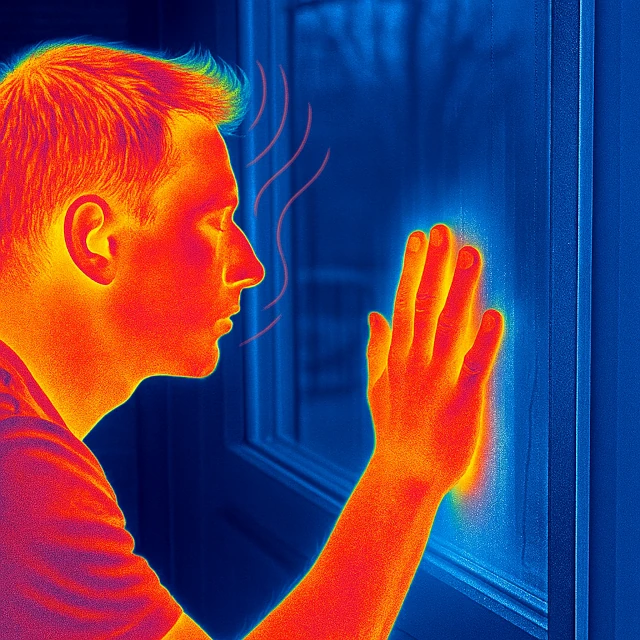
Thermal interaction between the human body and a cold surface.
The body emits infrared radiation absorbed by the wall.
The wall emits less radiation in return.
The net radiative flux leaving the body explains the feeling of cold.
Image source:
astronoo.com (new window)
Scientific Summary
The article explains the sensation of "radiant cold" felt near a window even in a heated room. This phenomenon is a sensory illusion because cold does not propagate: only heat moves. The human body (≈37°C) emits infrared radiation according to the Stefan-Boltzmann law (P = εσST⁴). Facing a colder surface (window, wall), the net radiative flux is directed outward: the body loses energy, which can reach several hundred watts on exposed areas. This loss creates an intense feeling of cold even if the ambient air temperature is comfortable. The phenomenon is based on an imbalance in the radiative field: cold surfaces absorb more infrared than surfaces at a temperature close to the body.
Why do we feel a sensation of cold when approaching a window even in a heated room?
This sensation, called "radiant cold," is a sensory illusion because cold does not propagate: in physics, only heat moves. The human body, at about 37°C, emits infrared radiation (Stefan-Boltzmann law, P = εσST⁴). When facing a colder surface (window, wall), the net radiative flux is directed outward: the body loses energy. This loss can reach several hundred watts on exposed areas, creating an intense feeling of cold even if the ambient air temperature is comfortable. The phenomenon is based on a radiative field imbalance: cold surfaces absorb more infrared than surfaces close to body temperature.
Also worth exploring
Continue your exploration of the Universe with these topics:
A Real Sensation for an Invisible Mechanism
Have you ever wondered why, on a cold winter day, you feel a distinct chill when approaching a large window, even if the room is well heated?
The so-called radiant cold sensation is often interpreted as cold returning from a surface. This perception is a sensory illusion, because cold does not spread. In reality, the phenomenon is based on a measurable energy exchange involving thermal radiation (energy exchange by emission and absorption of electromagnetic waves). When the human body is facing a colder surface, it loses energy in the form of infrared radiation.
N.B.:
In physics, cold does not spread.
There is no cold flow.
Only heat, i.e. thermal energy, is transferred from a body at a higher temperature to a body at a lower temperature, by conduction, convection, or radiation.
The sensation of cold corresponds to a loss of energy from the body, not the arrival of a cold agent.
Infrared Radiation from the Human Body
Thermal Emission from the Skin
Any body whose temperature is above absolute zero (theoretical minimum temperature corresponding to the lowest possible thermal energy state, equal to 0 kelvin) emits electromagnetic radiation. For human skin, this radiation is mainly in the far infrared. If the ambient temperature is lower than that of the body, the net radiative flux is directed outward, causing continuous energy loss.
The Stefan-Boltzmann Law
The power radiated by a body is given by the Stefan-Boltzmann law:
\( P = \varepsilon \sigma S T^4 \).
The parameter T is the absolute temperature of the skin (in kelvins).
Since it is raised to the fourth power, even small temperature differences between the body and a cold surface result in a much greater energy loss than one might expect.
The other parameters are:
- P: radiated power (in watts, W)
- \(\varepsilon\): emissivity of the skin (~0.97)
- \(\sigma\): Stefan-Boltzmann constant, \(5.67 \times 10^{-8} \, \text{W·m}^{-2}\text{·K}^{-4}\)
- S: exposed skin area (in m²)
Impact on the Feeling of Cold
The net radiative flux depends on the difference between the skin temperature and that of the environment. For example, facing a very cold wall, the body can lose several hundred watts instantly on exposed areas, which explains the intense feeling of cold, even though the overall body temperature drops very slowly due to metabolism.
Why Cold Surfaces Feel Cold Even Without Drafts
Temperature Differences and Perception of Cold
The feeling of cold is stronger when the body is exposed to surfaces at different temperatures. A wall or window can be materially homogeneous, but they are often colder than the ambient air. This is explained by their contact with the outside and their ability to store or release heat more slowly than air.
Absorption of Radiation and Heat Flux
These cold surfaces absorb some of the infrared radiation emitted by the body. They change the way the body's heat escapes around the person. Instead of the energy being evenly distributed in all directions, a large part of the heat is captured by these cold walls. The body then perceives this imbalance as a more intense cold coming from these surfaces.
A Metaphor to Visualize the Phenomenon
Imagine your body as a heat lamp placed in the center of a room. The heat it emits spreads in all directions, but the cold walls absorb more of this energy. The heat flux will naturally "follow" these surfaces, because the thermal gradients are stronger where it is colder. It's a bit like if the body's heat were water on a slope. Cold surfaces are like deeper holes. Conversely, in directions toward warmer surfaces or those close to your temperature, the body loses less heat (the heat flux is "slower").
Even without drafts, this imbalance in heat flux gives the sensation that the cold is coming mainly from the cold surfaces in front of you, such as the wall or window.
Physical and Historical Foundations
Thermal Conduction
Thermal conduction was formalized in the early 19th century by Joseph Fourier (1768-1830). He laid the mathematical foundations for heat transfer by direct contact between materials.
Blackbody Radiation
Blackbody radiation was described by Max Planck (1858-1947) in 1900 CE, paving the way for a quantitative understanding of radiative exchanges. The work of Albert Einstein (1879-1955) reinforced the statistical interpretation of energy transfers between matter and radiation.
Note on the Radiative Field
N.B.:
Air temperature is not the only factor that influences thermal comfort.
Even if two environments have the same temperature, one can feel very different cold or comfort depending on how heat is distributed around the body.
This is called the radiative field: the set of surfaces and objects that absorb or reflect heat toward you.
An imbalance in this field, for example cold walls or windows, can amplify the feeling of cold, even without drafts.
Main Physical Mechanisms
| Mechanism | Physical Description | Effect on the Body | Reference |
|---|---|---|---|
| Radiation | Infrared emission proportional to \(T^4\), quantified by blackbody physics | Overall energy loss | Max Planck, 1900 CE and Albert Einstein (1905) |
| Conduction | Heat transfer by contact | Localized cooling | Joseph Fourier, 1822 CE |
| Convection | Heat transport by fluid | Secondary effect without drafts | Isaac Newton, 1701 CE |
Sources and References
- Sources: NIST, Thermophysical Properties (new window), ISO 7730, Ergonomics of the thermal environment (new window).
FAQ: Everything about the perception of radiant cold
Why do we say that "cold does not propagate" in physics?
In physics, there is no "cold flow." Only heat (thermal energy) propagates, always from the hotter body to the colder body, by conduction, convection, or radiation. The sensation of cold corresponds to a loss of energy from the body to the environment, not to the arrival of a cold agent. When you touch a cold object, it is your heat that leaves your hand to warm the object, not the other way around.
What is the Stefan-Boltzmann law and how does it explain the intensity of radiant cold?
The Stefan-Boltzmann law (P = εσST⁴) gives the power radiated by a body. For human skin (ε ≈ 0.97, T ≈ 310 K), even a small temperature difference with a cold surface generates significant energy loss because temperature is raised to the fourth power. Facing a window at 0°C (273 K), the radiative contrast is maximal, and the body can lose several hundred watts instantly on exposed areas, hence the intense feeling of cold.
What is the "radiative field" and why is it important for thermal comfort?
The radiative field refers to all surfaces and objects that absorb or return heat toward the body. Even if two environments have the same air temperature, thermal comfort can be very different depending on the distribution of hot or cold surfaces around the person. An imbalance in this field (e.g., a cold wall on one side, a warm surface on the other) amplifies the feeling of cold on the cold side, even without drafts. This is why a well-heated room can feel cold near a large window.
 Why does infrared pass through dust clouds?
  The Perception of Radiant Cold Explained by Physics
  Sprites and Cosmic Rays: The Ghostly Lightning of the Atmosphere
  Principle of absorption and emission of a photon
  The Femtosecond Laser: From Ultra-Short Time to Extreme Power
  The World of Color
  The secret of the speed of light: electromagnetic runaway
  Rainbow: formation, colors and types of arcs explained
  Photoelectric effect: Einstein, photons and electrons
  The Nature of Light
  Plasma Lamp and Field Concept
  What is Vantablack?
  Michelson-Morley Experiment
  Redshift calculation (z)
  All the Light of the Electromagnetic Spectrum
  Solar Pillars: Celestial Mirages and Light Phenomena
  The Speed of Light: A Universal Constant
  The incredible precision of the second
  Aberration of Light: The Great Gathering, Blueshift, and Dazzling
  Why do elementary particles have no mass?
  Polar Auroras: Light, Magnetism and Solar Activity
  Gravitational Lenses: When Spacetime Becomes a Mirage
  Optical Illusions: Deceptions and Mysteries of Visual Perception
  Traveling Light: How a Photon Leaves the Sun to Reach Earth?
  Bioluminescence of living organisms
  Laser light
  We do not see with our eyes but with our brain
  Zodiacal Light: Reflection of Interplanetary Dust
  The Antitwilight Arch: Earth's Shadow
  How many photons to heat a cup of coffee?
  Biosignatures: Presence of Life in the Universe
  Spectroscopy: A Key to Analyzing the Invisible World
  Field concept in physics
  Why is Cherenkov light blue? Explanations and physical phenomenon
  The lights of the Sun
  What is a Wave?
  Planck's equation and black body light