


The Different Types of AI Learning
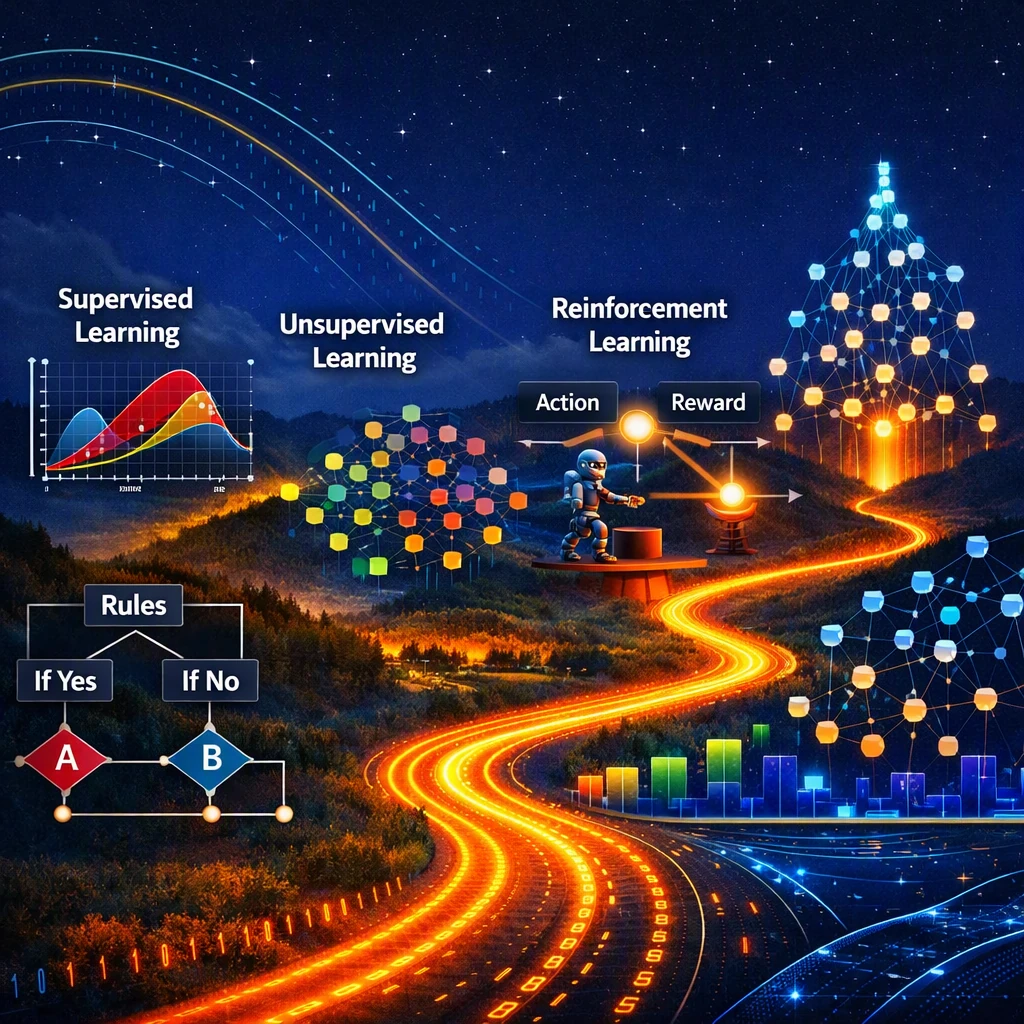
Illustration of an AI landscape where data curves, neural networks, and decision diagrams represent the main types of learning: supervised, unsupervised, reinforcement, and deep. The image suggests a path from simple rules toward complex architectures capable of processing massive volumes of data.
Image source: astronoo.com (new window) — AI-generated image, public domain.
Scientific Abstract
This Astronoo article presents the main types of learning used in artificial intelligence, from the simplest to the most complex. Machine learning rests on the idea that a machine can adjust its parameters from data to improve its performance on a task. A distinction is made between supervised learning, where examples are labeled, unsupervised learning, which looks for hidden structures, reinforcement learning, based on rewards, and self-supervised learning, where the data itself provides the expected answer. Deep learning designates less a method than a family of architectures (multi-layer neural networks), which can be combined with each of the previous approaches.
Each type is illustrated by a concrete example, with two complementary viewpoints: what humans do (prepare the data, define the objective) and what the machine does (adjust its parameters). A chapter is devoted to large language models (LLMs), such as ChatGPT, Claude, or Gemini, which combine three successive learning stages: self-supervised, supervised, and then reinforcement.
Why talk about types of learning?
For a long time, a human wrote detailed rules that the machine executed. With machine learning, examples are provided and the algorithm itself adjusts its parameters from the data.
The types of learning differ in how data is presented and the objective is defined: labeled examples (supervised), raw data in which to look for structures (unsupervised), rewards and penalties (reinforcement), or questions and answers drawn from the data itself (self-supervised). Deep learning is not a fifth type: it is an architecture of multi-layer neural networks, which can be trained according to each of these approaches, and often by combining them.
Also worth exploring
Continue your exploration of the Universe with these topics:
Overview of the main types of AI learning
From the simplest to the most complex
The table below presents the main types of AI learning, from the simplest to the most complex, with a concrete example, a perspective on how a human actor can organize the learning, and a synthetic description of how the machine goes about it.
| Type of learning | Concrete example | Human organization of data and objectives | Machine learning mechanism |
|---|---|---|---|
| Supervised learning | Classifying galaxy images into spirals or ellipticals, from already labeled images (for example by volunteers of the citizen science project Galaxy Zoo). | Constitution of annotated datasets, with astronomers or volunteers indicating the correct class of each image. | Minimization of a loss function between the model's predictions and the labels, by adjusting parameters via algorithms such as gradient descent. |
| Unsupervised learning | Grouping thousands of stellar spectra into families, without knowing in advance how many families exist. | Collection of large databases without labels, choice of variables to compare, then interpretation of the groups obtained. | Search for hidden structures, for example with clustering or dimensionality reduction algorithms that bring similar objects together. |
| Reinforcement learning | Learning to play Go by playing millions of games against itself (AlphaGo, AlphaZero). In astronomy, the same logic is studied to plan telescope observations. | Definition of a reward function (+1 for a win, −1 for a loss; or a gain for each useful observation and a penalty for each idle time). | Interaction with an environment, trial and error, then updating an action policy to maximize cumulative reward, alternating exploration and exploitation. |
| Self-supervised learning | Hiding the last word of a sentence and asking the model to guess it: "The Milky Way is a … galaxy" → "spiral". | Gathering of very large corpora of texts, images, or sounds. No manual annotation is necessary, because the expected answer is already in the data. | The model predicts a masked or missing part of the data, then compares its prediction to the actual content. This task forces it to learn useful representations. |
| Deep learning | Spotting exoplanets in the light curves of the Kepler telescope. A neural network thus helped identify Kepler-90 i, the eighth planet of its system, announced in late 2017. | Organization of large databases, choice of a suitable network architecture, and definition of performance criteria. | Propagation of information through many layers of neurons, then adjustment of weights by backpropagation to extract increasingly abstract features. |
| Transfer learning | Reusing a model already trained on millions of images to analyze those of a new telescope, or specializing a generalist LLM on astronomy articles. | Choice of a pretrained model, then constitution of a small dataset specific to the new task. | Preservation of parameters learned on a source task, then fine-tuning on the target task with far less data. |
| Online learning | Continuously updating an alert filter (supernovae, asteroids, variable objects) as sky surveys send new data. | Definition of regular update procedures and monitoring of a data stream arriving in real time. | Progressive adaptation of parameters as new observations come in, without retraining the model from scratch. |
| Large language models (LLMs) | A conversational assistant (ChatGPT, Claude, Gemini, Mistral…) that answers a question about black holes. | Constitution of a gigantic text corpus, writing of examples of good answers by annotators, then ranking of competing answers by human evaluators. | Three successive learning stages: prediction of the next word (self-supervised), imitation of model answers (supervised), then optimization of a human preference score (reinforcement). |
Detailed examples: from concept to practice
Supervised learning
In supervised learning, each example is associated with a label indicating the correct answer. A classic example is image classification: the machine is provided with images of galaxies, each annotated as spiral or elliptical. The goal is for the model to learn to predict the correct class (spiral or elliptical) for new images.
- On the human side: organizing this learning consists in constituting annotated datasets, defining performance criteria (correct answer rate, precision), and monitoring label quality.
- From the machine's viewpoint: learning is done by minimizing a loss function that measures the gap between predictions and labels, by adjusting the model's parameters (weights, biases to minimize the loss function) through optimization methods (algorithms such as gradient descent).
- Concrete example: a model receives images of galaxies and learns to automatically distinguish spirals from ellipticals by adjusting its parameters as annotated examples come in.
Unsupervised learning
In unsupervised learning, the data has no labels: the machine does not know in advance which categories or structures it must find. The goal is to discover natural groupings, hidden patterns, or relevant dimensions in the data. A classic example is the analysis of stellar spectra to automatically identify families of behavior without prior indication.
- On the human side: organizing this learning consists in collecting large unlabeled databases, choosing relevant variables, and defining exploratory objectives (groupings, anomaly detection, dimensionality reduction).
- From the machine's viewpoint: learning relies on algorithms that look for internal structures in the data, such as grouping nearby points or extracting principal components, without a supervised loss function.
- Concrete example: a model analyzes thousands of stellar spectra and automatically groups those presenting similar signatures, revealing astrophysical families without human intervention.
Reinforcement learning
In reinforcement learning, an agent interacts with an environment and receives rewards or penalties depending on the actions it performs. The goal is not to predict a label, but to learn an action policy that maximizes the cumulative reward. A classic example is the control of a robotic telescope that must choose which targets to observe in order to optimize observation time.
- On the human side: organizing this learning consists in defining a reward function (measure of the quality of actions), specifying the rules of the environment, and ensuring that the agent does not develop undesirable strategies.
- From the machine's viewpoint: the agent explores different actions, observes the rewards obtained, and updates its policy to maximize the cumulative reward, thanks to sequential optimization algorithms (such as Q-learning or policy gradient methods).
- Concrete example: an agent controls an automated telescope and learns, through trials, to select the most interesting targets while minimizing unnecessary movements, in order to optimize the quality and quantity of observations.
Self-supervised learning
In self-supervised learning, the machine creates its own labels from raw data. Instead of receiving a correct answer provided by a human, the model must predict a missing or masked part of the input. This approach makes it possible to exploit vast sets of unlabeled data. A classic example is the prediction of masked words in scientific texts to learn language representations.
- On the human side: organizing this learning consists in preparing large unlabeled corpora, defining an internal task (masking words, predicting the continuation of a sequence), and controlling the quality of the data used to avoid biases.
- From the machine's viewpoint: the model learns by solving an artificial task generated from the data itself, such as predicting masked tokens or reconstructing part of an image, which allows it to extract useful internal representations.
- Concrete example: a model receives scientific texts in which certain words are masked and learns, by guessing them, to capture the relationships between terms, which subsequently improves its performance on real tasks.
Deep learning
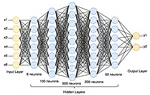
In deep learning, the machine uses multi-layer neural networks capable of extracting increasingly complex features from data. Each layer transforms the information to reveal patterns invisible to classical methods. This approach is particularly effective for processing images, sounds, or texts. A common example is the analysis of images of nebulae to automatically identify structures that are difficult to distinguish with the naked eye.
- On the human side: organizing this learning consists in gathering large image databases, choosing a suitable network architecture (CNN, transformers), defining performance criteria, and having sufficient computing resources.
- From the machine's viewpoint: the network learns by adjusting millions of parameters across several layers, each layer extracting more abstract patterns. Optimization is done by minimizing a loss function through optimization methods (such as gradient descent).
- Concrete example: a neural network analyzes images of nebulae and learns to automatically recognize filaments, bubbles, or emission zones, by refining its parameters layer after layer.
N.B.:
In modern neural networks, depth remains moderate: architectures generally count between about twenty and a few hundred layers. On the other hand, the total number of neurons can reach millions, or even hundreds of millions in the most advanced models. This difference explains why a network can be "deep" without having thousands of layers: it is the thousands of neurons per layer, multiplied by dozens of layers, that yield models of colossal size.
Case study: how does a large language model learn?
One model, three successive learning stages
Large language models (LLMs) illustrate well the combination of approaches. Their training takes place in several stages, each corresponding to a different type of learning. This is what allows a conversational assistant to go from a simple word predictor to an interlocutor capable of following instructions.
Stage 1: self-supervised pretraining
The model reads immense quantities of texts and learns to predict the next word (more precisely the "token"). In the sentence "The Sun is a type … star", it must guess "G-type" or a plausible continuation. No human annotates these texts: the answer is the text itself. This is self-supervised learning, and it is the most costly stage in terms of data and computation. Models such as BERT use automatic token masking: an algorithm randomly hides certain words, which the model must then predict.
Stage 2: supervised fine-tuning on instructions
The pretrained model knows how to extend a text, but not necessarily how to answer a question. Human annotators write instructions and answers, while computer tools automatically prepare this data for training. The model is then adjusted to imitate these examples: this is supervised learning applied to a dataset much smaller than the initial corpus.
Stage 3: reinforcement from human feedback
To refine the quality of answers, evaluators are asked to rank several model answers. These rankings serve to train a reward model, which assigns a score to an answer. The LLM is then optimized to obtain high scores. This is the principle of RLHF (Reinforcement Learning from Human Feedback), described in particular for InstructGPT in 2022. Since then, simpler methods have been proposed, such as preference optimization, where the model learns to favor answers judged better by humans. Some laboratories also use automatically verifiable rewards — for example the correct resolution of a mathematics problem or the success of computer tests — to train so-called "reasoning" models.
What about "in-context learning"?
When two or three examples are provided in a question, the model seems to "learn" the task: it reproduces the pattern shown in the prompt. In reality, this is a temporary adaptation. The model's internal parameters are not modified, and once the conversation is over, nothing is retained in the weights. The model therefore only exploits the examples provided at the moment, without real learning in the sense of the previous stages.
For example, if one writes:
"2 + 3 = 5"
"4 + 6 = 10"
and then asks "7 + 8 = ?", the model answers "15" not because it performs an addition, but because this sequence is statistically the most probable in the texts it has seen. It simply extends a familiar pattern, without acquiring a lasting skill in calculation.
Synthesis: the many faces of AI learning
The table below summarizes the different approaches, the signal that guides learning, and their practical uses.
| Type of learning | Principle | Source of the signal | Common uses |
|---|---|---|---|
| Supervised learning | Prediction from annotated examples. | Labels provided by humans. | Vision, pattern recognition, classification, medical diagnosis. |
| Unsupervised learning | Discovery of hidden structures. | Internal properties of the data. | Exploration, compression, segmentation, and anomaly detection. |
| Reinforcement learning | Optimization of an action policy. | Rewards and penalties. | Robotics, games, sequential control, alignment of LLMs. |
| Self-supervised learning | Prediction of masked or missing parts of the data. | Automatic masking and the structure of the data itself. | Pretraining of most language models and many image models. |
| Deep learning | Extraction of features at several levels of abstraction. | Depending on use: labels, the data itself, or rewards. | Processing of images, sounds, and texts, prediction of protein structures. |
| Large language models (LLMs) | Chain of three learning stages on a deep network. | Raw text, then examples annotated by humans, then optimization of human preferences. | Conversational assistants, translation, summarization, programming assistance. |
The central role of humans and their tools
AI learning is not an autonomous process: it rests on close collaboration between humans and a panoply of computer tools. Models do not "discover" on their own what to learn, nor how to do it. It is human teams that organize, orient, and control each stage, relying on technical infrastructures capable of processing gigantic volumes of data.
The central role of humans
Humans intervene in all critical stages of the design and learning of models. Without them, an AI knows neither what to learn, nor how, nor why.
- They design the architectures (transformers, deep networks).
- They select and clean the data.
- They write the instructions and answers for supervised learning.
- They express their preferences to guide the models (RLHF, DPO).
- They define the objectives, metrics, limits, safeguards.
- They evaluate quality, correct drifts, adjust methods.
Without humans, a model has no framework: it has no explicit goal, no success criteria, no reliable signal to orient its learning.
The indispensable role of tools
Computer tools make large-scale learning possible. They automate repetitive tasks, structure data, and exploit considerable hardware resources. Without them, modern AI learning would be materially impossible.
- They automatically mask tokens for self-supervised learning.
- They prepare the data (formatting, validation, deduplication).
- They distribute the work to thousands of annotators.
- They automatically verify certain rewards (mathematics problems, computer tests).
- They train the models on hundreds of GPUs.
- They optimize human preferences at scale.
The volumes of data are too large, the models too heavy, and the tasks too numerous to be managed manually. AI learning is therefore the result of an alliance: human intention and judgment, amplified by powerful computer tools.
References
- Wikipedia – Machine learning (new window)
- Wikipedia – Supervised learning (new window)
- Wikipedia – Unsupervised learning (new window)
- Wikipedia – Reinforcement learning (new window)
- Wikipedia – Deep learning (new window)
- LeCun, Y., Bengio, Y., Hinton, G. – "Deep learning", Nature, vol. 521, 2015 (new window)
- Sutton, R. S., Barto, A. G. – "Reinforcement Learning: An Introduction", 2nd ed., MIT Press, 2018 (new window)
- Ouyang, L. et al. – "Training language models to follow instructions with human feedback", NeurIPS, 2022 (arXiv:2203.02155) (new window)
- Devlin, J., Chang, M.-W., Lee, K., Toutanova, K. – "BERT: Pre-training of Deep Bidirectional Transformers for Language Understanding", NAACL, 2019 (arXiv:1810.04805) (new window)
FAQ: Everything you need to know about the types of AI learning
What are the main types of AI learning?
The main types of AI learning are supervised learning, unsupervised learning, reinforcement learning, and self-supervised learning. Each corresponds to a different way of presenting data and defining the algorithm's objective. Deep learning is not a type of the same nature: it designates the use of multi-layer neural networks, which can be trained according to each of these approaches.
What is supervised learning?
Supervised learning consists in training a model on annotated examples. Each input is associated with a label indicating the correct answer. The model learns to predict these labels for new inputs by minimizing a loss function.
What is unsupervised learning?
Unsupervised learning works on data without labels. The algorithm looks for hidden structures, such as groups or patterns. It is used for clustering, dimensionality reduction, and anomaly detection.
What is reinforcement learning?
Reinforcement learning features an agent that interacts with an environment. The agent receives rewards or penalties depending on its actions and learns a policy that maximizes the cumulative reward. This approach is used in robotics, games, and sequential control, as well as to align language models with human preferences.
What is deep learning?
Deep learning uses multi-layer neural networks to process complex data. These networks learn internal representations that capture regularities in the data. Deep learning is at the heart of recent advances in vision, language processing, and pattern recognition.
Why do we speak of self-supervised learning?
Self-supervised learning creates internal tasks from the data itself. For example, parts of a text are masked and the model is asked to predict them. This approach makes it possible to learn useful representations without external labels, which is particularly important for language models.
How does a model like ChatGPT, Claude, or Gemini learn?
A large language model learns in several stages. It is first pretrained in a self-supervised manner to predict the next word on immense text corpora. It is then adjusted in a supervised manner on examples of instructions and answers written by humans. Finally, it is refined by reinforcement learning, from rankings of answers established by evaluators or automatically verifiable rewards.
How do machines go about learning?
Machines learn by adjusting internal parameters to reduce a gap between their predictions and a reference signal. This signal can be a label, a hidden structure, a reward, or a self-supervised task. Optimization algorithms, such as gradient descent, update the parameters to progressively improve performance.
 The Different Types of AI Learning
  Agentic AI: When Machines Become Autonomous
  What AI Cannot Do
  Artificial Intelligence and Astronomy: Understanding the Role of AI Assistants
  AI Tools: How to Choose?
 Generative AI vs AGI: Where does imitation end and consciousness begin?
  Artificial networks vs biological networks: Two systems, one common architecture
  Human Brain and Artificial Intelligences: Similarities and Differences
  AlphaGo vs AlphaGo Zero: A Revolution in Artificial Intelligence
  The Next Step for Intelligent Machines
  The First Step Towards the Emergence of Life
  From Biological Neuron to Formal Neuron: Simplifying the Brain
  Artificial intelligence: the explosion of gigantism
  When AI models train on their own data, they go mad!
  How machines become intelligent
  Artificial intelligence: real threat or opportunity for humanity?
  How do machines understand, interpret and generate language in a similar way to humans?
  How does an artificial neural network work?