


Artificial Intelligence and Astronomy: Understanding the Role of AI Assistants

AI Assistants interacting with a researcher in a virtual environment dedicated to astronomy: this is not science fiction, but a concrete reality being established in astronomy laboratories worldwide.
Real-time data, simulations, and predictive models converge to create a new way of exploring the Universe.
Image source: Astronoo / AI Generation (new window)
Scientific Summary
This article explains the revolution brought by artificial intelligence assistants (AI) in the field of astronomy. From modeling complex phenomena to creating immersive metaverses for data visualization. Astronomers are no longer content to look at data on flat screens. They can literally "dive" inside to manipulate it in three dimensions. We examine how systems like LLM (large Language Model) (Large Language Models) enable interaction with colossal astronomical databases, how digital twins of Earth or exoplanets aid research, and what the ethical and technical challenges of this convergence between AI and virtual reality are. The article draws on recent work from DeepMind, the ESA (european Space Agency), and NASA (national Aeronautics and Space Administration) to provide an overview of current and future advances.
What is an AI Assistant?
An AI assistant is a computer system that uses an artificial intelligence model as its reasoning engine, but adds an environment enabling it to perform more complex tasks. The model forms the cognitive core of the system, while the assistant provides the context, rules, memory, and means of action. This makes it possible to move from simple question-answering to interaction with files, databases, software, or online services.
The difference is fundamental. A language model can generate a response based on information present in its context. An assistant can additionally search for information, read a document, analyze a database, perform a calculation, call a function, or transmit a task to another system. The assistant is therefore not necessarily a new AI model: it is more of a software architecture built around the model.
Also worth exploring
Continue your exploration of the Universe with these topics:
What AIs Cannot Do (Alone)... and What Assistants Do for Them
Despite their impressive performance, fundamental AI models (LLMs) have structural limitations. They do not reason, do not understand, do not have long-term memory, and possess no model of the real world. They are statistical machines that generate text by predicting the most probable word. AI assistants, on the other hand, compensate for these shortcomings through an engineering layer that transforms the raw model into a functional tool (persistent memory, access to real-time data...).
In summary, the AI model is the (statistical) brain, but the AI assistant is the body, arms, and legs that allow it to act in the real world. It is this architecture that makes AI assistants so powerful in laboratories, metaverses, and research environments.
Expert Systems vs. LLMs vs. AI Assistants
- Expert System: "I know everything that man coded for me, but that's all I can do."
- LLM alone: "I generate text, and that's it."
- AI Assistant: "I am a small augmented LLM by a software layer that gives me tools, memory, and action capabilities."
Example of Reading a PDF with a Standalone LLM (GPT, Mistral, Gemini)
The user has access to a standalone LLM (like ChatGPT, Mistral, or Gemini). This model can only generate text. It has no access to files, folders, or execution tools. The user must do all the work manually: open folders, copy texts, paste them, and re-read the summaries to verify their accuracy. The LLM only generates text based on what the user provides.
Example of Reading a PDF with an AI Assistant (Complete System)
The user has access to an LLM (e.g., ChatGPT, Mistral, Gemini) via a prompt interface. This LLM is connected to a complete AI assistant (expert system + tools) that can act in the real world. The user only sees the LLM. It is the LLM that, behind the scenes, calls the assistant to execute actions. The user never interacts directly with the assistant. Everything is transparent to them.
Artificial Intelligence: A New Partner for Scientists
Artificial intelligence is no longer limited to automated tasks. Today, AI assistants are capable of conversing in natural language, generating hypotheses, simulating complex scenarios, and even suggesting experimental protocols. In astronomy, where data volumes are colossal (terabytes per night of observation), these tools are becoming indispensable. They allow researchers to focus on interpretation and conceptualization, while the AI handles background noise and detects patterns imperceptible to the human eye.
Concurrently, the emergence of metaverses and virtual environments offers a new dimension to scientific visualization. No longer need to settle for 2D graphs or 3D models on a screen: astronomers can now dive into their data, navigate through galaxy clusters, or observe the birth of a star as if they were there. This immersion, coupled with conversational AI assistants, creates an unprecedented synergy between human intellect and machine computing power.
AI Assistants at the Service of Astronomy
Exploring Massive Data
Modern telescopes, such as the VLT (very Large Telescope) or the JWST (james Webb Space Telescope), produce continuous data streams. Manual analysis is impossible. AI assistants, trained on billions of parameters, can identify rare events (like supernovae or gamma-ray bursts), classify celestial objects, or even correct instrumental artifacts.
Predictive Modeling
Numerical simulations are at the heart of modern astrophysics. However, they remain resource-intensive. Generative AIs, such as GANs (generative Adversarial Networks) (Generative Adversarial Networks) or diffusion models, make it possible to create digital twins of astrophysical phenomena.
Here are some concrete examples of the application of these models:
- Simulation of astrophysical phenomena: The evolution of an accretion disk around a black hole or the dynamics of a galaxy cluster can be simulated in minutes, where a classical supercomputer would take days. Once validated, these models become real assistants for researchers, who can test hundreds of scenarios in parallel.
- Formation of planetary systems: Researchers at the University of Bern (Y. Alibert, J. Davoult, and S. Marques) have developed, using a Transformer architecture, an AI model capable of calculating the architecture of planetary systems in seconds, compared to several weeks of computation on a supercomputer for the classical Bern model it is inspired by — a gain of about a factor of one million. This model can predict the presence of yet undetected planets and help prioritize observation targets.
- Ultra-fast cosmological simulations: The Effort.jl tool, developed by an international collaboration including INAF, the University of Parma, and the University of Waterloo, uses a neural network to emulate the calculations of the Effective Field Theory of Large-Scale Structure (EFTofLSS). Where a classical simulation can take several hours on a supercomputer, Effort.jl evaluates the power spectrum in a few microseconds on a single CPU core, with full Bayesian convergence in a few minutes on a laptop. This performance paves the way for a much broader exploration of cosmological parameters for surveys like DESI and Euclid.
Scientific Metaverses: Immersion at the Service of Discovery
Visualizing the Invisible
One of the major challenges of astronomy is representing objects or phenomena that escape our sensory perception. Black holes, interstellar magnetic fields, or gravitational waves are abstract concepts. Scientific metaverses (immersive virtual environments) offer a setting where these notions become tangible. Using virtual reality headsets and real-time 3D engines, the user can manipulate force fields, observe the curvature of spacetime, or track the path of a photon from its emission to its detection.
Examples of Immersive Tools Used in Astronomy
- OpenSpace: Developed by the AMNH (american Museum of Natural History) (American Museum of Natural History), this open-source software visualizes the entire known Universe. It is used by researchers to visualize data from missions like Artemis or Gaia, as well as by planetariums and the general public for immersive experiences.
- SpaceEngine: This 3D simulator combines real data and scientifically accurate procedural generation. Available on Steam, it allows anyone to explore the farthest galaxies from their couch, with regular updates improving planet and star generation.
- iDaVIE: This open-source virtual reality software, developed notably by the Inter-University Institute for Data Intensive Astronomy (IDIA, South Africa) and INAF, immerses astronomers in the heart of their data cubes (notably radio, from MeerKAT or ASKAP). It has already been used to refine source detection masks and identify gaseous structures missed in HI surveys.
The integration of AI assistants in these environments allows for enriched interaction: the researcher can ask questions in natural language ("Show me the most active star-forming regions in this galaxy") and receive an immediate visual and contextual response.
Remote Collaboration
Metaverses are not just visualization tools; they are also spaces for synchronous collaboration. International teams can meet in a virtual room, around a 3D projection of a galactic survey, and interact with the data as if they were in the same lab. This social and collaborative dimension, amplified by AI assistants that translate, synthesize, and annotate discussions in real-time, promises to bring scientific communities closer and accelerate discoveries.
Reliability of Generative Models
While AIs are capable of producing spectacular results, they remain subject to biases and hallucinations. A generative model can invent galactic structures that do not exist, or propose physically impossible interpretations. The scientific community must therefore develop robust validation protocols, where each result from an AI is confronted with real data or established physical models. Algorithm transparency and experiment reproducibility are major issues for the future of AI-assisted research.
Concrete Examples of Biases and Hallucinations Encountered in Astronomy:
- Hallucination of galactic structures: An AI model trained on images of spiral galaxies "invented" additional spiral arms in elliptical galaxies, where there were none. The AI had generalized from its training data and created non-existent patterns, misleading astronomers analyzing these images.
- Bias in exoplanet detection: An exoplanet detection algorithm trained mainly on data from the Kepler telescope exhibited a selection bias: it detected large planets (Jupiter-like) more easily than small rocky planets (Earth-like). This bias led to an overestimation of the frequency of gas giants in early catalogs, before researchers corrected the algorithm.
- False positives in radio bursts: An AI system designed to detect FRBs (fast Radio Burst) (Fast Radio Bursts) confused terrestrial interference (mobile phone signals, radars) with genuine cosmic signals. For several weeks, astronomers thought they had discovered new FRBs, only to realize they were AI hallucinations.
- Physically impossible interpretation: A generative model proposed a black hole formation scenario violating Kepler's third law (orbital period incompatible with distance). Only after verification by astrophysicists was the error detected, reminding that AI does not understand physical laws, it only imitates them statistically.
Data Sovereignty
The most powerful AI assistants are trained on phenomenal amounts of data, often held by large private companies. This raises the question of equitable access to these tools for public laboratories or developing countries. Initiatives like the European Open Science Cloud or the NASA Transform to Open Science (TOPS) program attempt to promote open and collaborative models, where data and models are shared according to FAIR (findable, Accessible, Interoperable, Reusable) principles.
Table: Applications of AI Assistants in Space Sciences
| Application Domain | AI Assistant Used | Concrete Example | Impact on Research |
|---|---|---|---|
| Exoplanet Detection | Convolutional Neural Networks | Analysis of Kepler light curves | Automation of sorting thousands of transit candidates |
| Cosmological Simulation | Neural Network Emulators (e.g., Effort.jl) | Emulation of Effective Field Theory of Large-Scale Structure | Calculation in microseconds vs. several hours on supercomputer |
| Conversational Research Assistant | LLM(large Language Model) | Natural language querying of astronomical archives | Easier access to data for young researchers |
| Prediction of Planetary Architecture | Transformer-type Generative Model | Model trained on the "Bern model" (Alibert, Davoult, Marques) | Calculation in seconds vs. several weeks of classical simulation |
References
- Google DeepMind – Research (new window)
- ESA Φ-lab (Phi-Lab) – Earth Observation innovation lab (new window)
- NASA – Open Science at NASA (Transform to Open Science) (new window)
- NASA Science – Artificial Intelligence for Science (new window)
- Alibert, Y., Davoult, J. & Marques, S. (2025), « A transformer-based generative model for planetary systems », Astronomy & Astrophysics, 701, A149, DOI: 10.1051/0004-6361/202452297 (new window)
- Bonici, M., D'Amico, G., Bel, J. & Carbone, C. (2025), « Effort.jl: a fast and differentiable emulator for the Effective Field Theory of the Large Scale Structure of the Universe », Journal of Cosmology and Astroparticle Physics, 2025(09), 044, DOI: 10.1088/1475-7516/2025/09/044 (new window)
- Sivitilli, A. et al., « iDaVIE v1.0: A virtual reality tool for interactive analysis of astronomical data cubes » (new window)
FAQ: Your Questions About AI Assistants and Metaverses in Astronomy
Can AI assistants replace astronomers?
No. AI is a decision-support and exploration tool, not a substitute for human intuition. Astronomers bring conceptual understanding, the ability to ask the right questions, and sensitivity to biases that machines lack. AI excels at massive data processing and pattern detection, but physical interpretation and theoretical model building remain within the human domain.
What is a digital twin in astronomy?
A digital twin is a virtual replica of a real system, constantly updated with observational data. For example, one can create a digital twin of the Sun that integrates data from solar probes (SolO (solar Orbiter), PSP (parker Solar Probe)) and allows real-time simulation of the evolution of its magnetic activity. This helps predict solar flares and their effects on Earth's satellites.
Are scientific metaverses accessible to the general public?
Yes, increasingly so. Platforms like SpaceEngine or Universe Sandbox are available to the public, although their scientific versions are more complex. Public observatories and planetariums are starting to offer immersive experiences based on real data, allowing everyone to explore the Universe like an astronomer. The AI assistant integrated into these environments plays a role as an educational guide, making science more accessible.
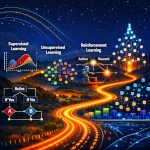 The Different Types of AI Learning
  Agentic AI: When Machines Become Autonomous
  What AI Cannot Do
  Artificial Intelligence and Astronomy: Understanding the Role of AI Assistants
  AI Tools: How to Choose?
 Generative AI vs AGI: Where does imitation end and consciousness begin?
  Artificial networks vs biological networks: Two systems, one common architecture
  Human Brain and Artificial Intelligences: Similarities and Differences
  AlphaGo vs AlphaGo Zero: A Revolution in Artificial Intelligence
  The Next Step for Intelligent Machines
  The First Step Towards the Emergence of Life
  From Biological Neuron to Formal Neuron: Simplifying the Brain
  Artificial intelligence: the explosion of gigantism
  When AI models train on their own data, they go mad!
  How machines become intelligent
  Artificial intelligence: real threat or opportunity for humanity?
  How do machines understand, interpret and generate language in a similar way to humans?
  How does an artificial neural network work?