


Why is water wet?
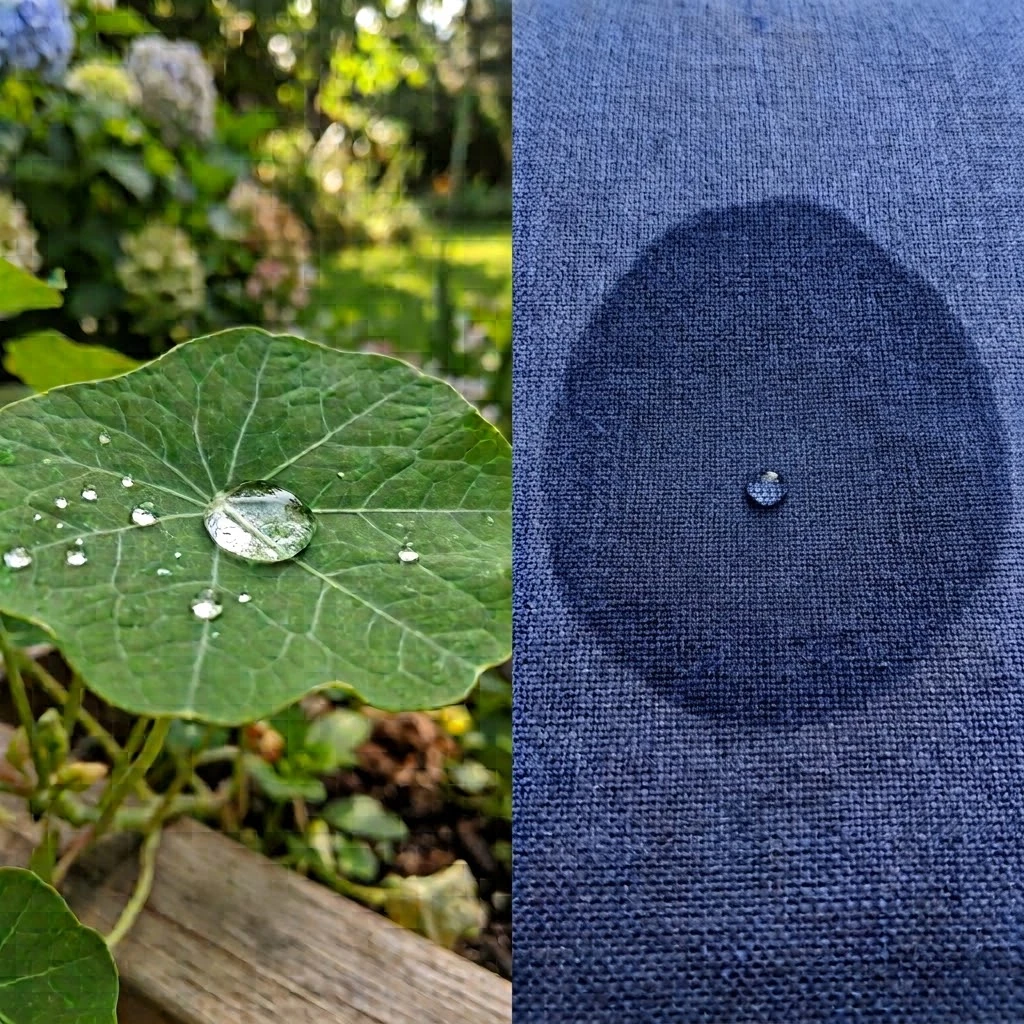
Drops of water on a leaf: some stay as beads, others spread out. It all depends on the surface.
Image source: astronoo.com (new window) — AI-generated image, public domain.
Scientific summary
This Astronoo article explains why water wets things. Water is made of tiny grains called molecules, which attract one another: that is cohesion. When water touches an object, its molecules can also cling to the surface of that object: that is adhesion. If the grip on the surface is strong, the water spreads out and the object is wet. If it is weak, the water stays in more or less large round drops and the object stays dry, like a duck's feather. Our skin has no special sensor for "wetness": our brain guesses that we are wet by combining cold and touch.
Why is water wet?
Because water's tiny grains, its molecules, love to cling to the things they touch. When you dip your hand in water, a thin layer of molecules stays stuck to your skin: that layer is what you feel and call "wet". But water does not cling to everything in the same way: that is why a towel gets soaked quickly, while a duck's feathers stay dry.
Water is made of tiny grains
The water molecule: a little Mickey Mouse face
If we could zoom millions of times into a drop of water, we would see billions of tiny grains, all identical: water molecules. Each one is made of one big oxygen atom and two small hydrogen atoms, which is why it is called H2O. The two small atoms sit off to the sides, a bit like Mickey's ears.
A molecule with a "plus" side and a "minus" side
The water molecule is a bit like a tiny magnet: one side is slightly charged with positive electricity (the "ears" side), the other side slightly charged with negative electricity. These little "magnets" attract each other, and they are also attracted to many other materials.
N.B.:
Scientists say the water molecule is polar. The bonds that form between two neighboring water molecules are called hydrogen bonds. They are much weaker than the bonds that hold atoms together inside a molecule, but there are very many of them and they constantly form again.
Two forces compete: clinging to yourself or clinging to others
Cohesion: water clings to itself
Water molecules hold on to one another, like children holding hands in a circle. That is cohesion. It is what forms round drops and what lets certain insects, water striders, walk on the surface of a pond: at the surface, the molecules squeeze together and form a very thin kind of "skin", called surface tension.
Adhesion: water clings to other materials
When water touches an object, its molecules can also cling to what they touch: that is adhesion. If this grip is stronger than the one between water molecules, the water prefers to spread over the object rather than stay in a ball. The object is then wet.
Wetting is therefore the result of a match: cohesion versus adhesion. If adhesion wins, the water spreads out. If cohesion wins, the water stays in beads.
Why do some things get wet and others not?
| Surface | What the water does | Who wins? |
|---|---|---|
| Clean glass | It spreads into a thin layer | Adhesion |
| Cotton towel | It enters the fibers and soaks them | Adhesion |
| Skin | It spreads a little, in flat drops | A draw |
| Plastic, candle wax | It forms round drops | Cohesion |
| Duck feather | It rolls into beads and slides off | Cohesion |
| Lotus leaf | It forms little balls that carry away the dust | Cohesion, by far |
The duck's secret
The duck has two tricks. It spreads over its feathers a fatty substance made by its body. And its feathers are so fine and so tightly packed that they form a surface full of tiny hollows that hold air. The drops of water sit on top, as if on a mattress of tiny air cushions, and they roll off without wetting.
The towel's mystery
A towel is made of thousands of tiny threads, and between these threads there are very small tubes. Water loves to cling to the walls of these tubes and climbs up them all by itself: that is capillarity. That is why a towel absorbs water, and why plants manage to pull water up from the soil to their leaves.
Your turn: three little experiments
1. Drops on a coin
Place a coin on the table. With a spoon or a dropper, place drops of water on it one by one, counting as you go. You will see the drop grow and form a dome without spilling over, held by cohesion. How many drops can you place before it overflows?
2. The pepper that runs away
Fill a deep plate with water and sprinkle a little pepper on the surface. Touch the water with the tip of a finger: nothing happens. Then touch it with a finger dipped in dishwashing liquid: the pepper suddenly moves apart. The soap weakens the water's "skin", and the pepper is pulled toward the edges, where the skin has stayed strong.
3. Wet or not wet?
Place a drop of water on a sheet of waxed paper or a tree leaf, then on a piece of paper towel. Watch the difference: the drop stays round on one, it spreads out on the other.
N.B.:
Do these experiments with an adult, at a table you can wipe. Never drink water mixed with soap.
What does soap do when we wash?
Grease, on the other hand, does not get wet: water alone leaves it in place. Soap has two ends: one end that loves water and one end that loves grease. It grabs the greasy dirt on one side and the water on the other, and the water can then carry everything away. Soap also helps water spread and wet laundry and dishes better, because it weakens the grip between water molecules.
How do we know we are wet?
Surprisingly, our skin has no special sensor for feeling water. Your brain guesses that something is wet by combining several pieces of information: coolness (water is often colder than skin, and it carries heat away as it evaporates) and touch (fabric sticking to you, pressure). Researchers have shown that we can be wrong: a cold but dry object can feel a little wet.
Is water itself wet?
This is a question even adults like to debate. If "being wet" means being covered with water, then water is not wet: it is what wets other things. If "being wet" only means being in contact with water, then every water molecule touches other water molecules, and you could say yes. In science, we prefer to say that water wets a solid surface: it all depends on the definition you choose.
Wetting in everyday life
- Waterproof clothing: its fabric is treated so that water forms beads and slides off, like on a duck's feathers.
- The car windshield: when it is dirty, water spreads out and blocks your view. Some products make it water-repellent, and the drops roll off in beads.
- Plants: water rises from the soil up to the leaves thanks to the adhesion and cohesion of its molecules.
- Mercury: this liquid metal does not wet the skin, because its atoms attract each other much more strongly than water. It stays in shiny beads. It is toxic: we never touch it.
References
Frequently asked questions: everything about water that wets
Why is water wet?
Because its molecules cling to the surfaces they touch. When this grip is stronger than the one between water molecules, the water spreads over the object and wets it.
Why don't ducks get wet?
Their feathers are covered with a fatty substance and have such a fine structure that it holds air. Drops of water stay in beads and slide off instead of spreading.
Why does a towel dry up water?
It is made of tiny threads that leave very small gaps between them. Water clings to their walls and climbs up on its own: that is capillarity.
What does soap do for wetting?
Soap reduces the attraction between water molecules. Water spreads better, soaks into fabrics, and can carry away greasy dirt that water alone cannot catch.
How do we feel that we are wet?
There is no "wet" sensor in the skin. The brain combines the sensation of coolness and the sensation of touch to guess that we are wet.
 Why does waiting take so long?
  Why is water wet?
  Twinkling stars, steady planets: what's the difference?
  Why do we see lightning before hearing thunder?
  Why Can Telescopes See So Far?
  The Rainbow of Planets: Why Do They Have Colors?
  When You Look at the Stars, You Travel Through Time!
  When Earth Tilts, the Seasons Change!
  Floating
Life: The Daily Routine of Astronauts on the Space Station
Floating
Life: The Daily Routine of Astronauts on the Space Station  Eclipse: The Great Game of Shadow and Light Between the Moon and the Sun
  Shooting
Stars: The Celestial Tears That Grant Wishes
Shooting
Stars: The Celestial Tears That Grant Wishes  The Metaverse:
A Virtual World
The Metaverse:
A Virtual World  Quantum Physics, Simply!
  Why Are There Rings Around the Giant Planets?
  Why Does the Sun Shine?
  What is a Supernova?
  Why does emptiness not exist?
  What is the equivalence principle in physics?
  Incredible Phenomena of the World
  What is Time?
  What is Matter?
  Why is the sky blue?
  The Benefits of Fuse Beads for Children's Creativity
  Our Milky Way
  How to measure distances in the Universe?
  How did the Moon form?
  What is a black hole?
  Why are stars different colors?
  Why don't we feel that the Earth is rotating?
  How to properly observe the stars in the sky?
  How stars work
  What are the inner and outer layers of the Earth?
  January Sky, Orion Constellation
  February sky, Auriga constellation
  March sky, constellation of Gemini
  April sky, Bouvier constellation
  May sky, constellation Leo
  June sky, constellation Virgo
  July sky, Cygnus constellation
  August sky, constellation of the Eagle
  September sky, Corona Borealis Constellation
  October sky, constellation Pegasus
  November sky, Andromeda constellation
  December sky, Perseus constellation