


Celestial Exploration for Children: Leo in May
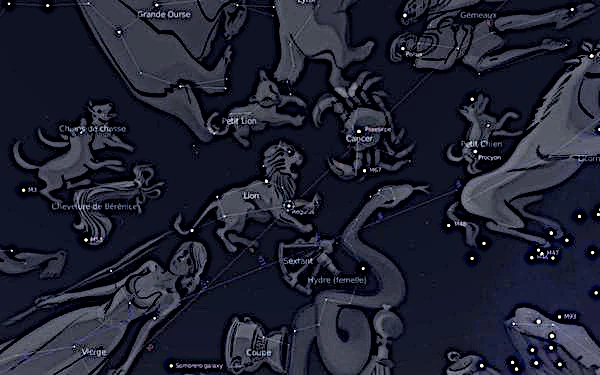
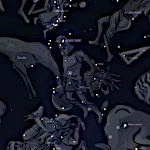
Constellation Leo. Image reworked from Open Source Stellarium software.
May sky for children, constellation Leo
Today we are going to explore another fascinating constellation: the constellation Leo. This constellation is located in the northern hemisphere and is visible during the spring months. It is easy to spot because it contains several bright stars that form an inverted "Y" shape.
In Greek mythology, the constellation Leo is associated with the famous hero Heracles, who had to confront and kill a ferocious lion to accomplish one of his tasks. The constellation Leo is also associated with the king of the jungle, the lion, due to its distinctive shape.
The constellation Leo contains many interesting stars. The brightest star in the constellation is called Regulus, which means "little king". Regulus is a very hot and bright star, which shines 4 times brighter than our Sun. It is also known to be surrounded by a binary star system.
Another interesting star in the constellation Leo is Denebola, which means "tail of the lion". Denebola is a blue and white star, more than twice the size of our Sun. It is also located at a distance of 36 light years from Earth.
The constellation Leo also contains several star clusters, such as the Crèche cluster and the M44 cluster. The Crèche cluster is a group of bright, young stars that look like a nativity scene in the sky, while the M44 cluster contains more than 200 stars, some of which are visible to the naked eye.
By exploring the constellation Leo, you can learn more about the universe and discover all the wonders it has to offer. So the next time you look up at the night sky, try to spot the constellation Leo and all the bright stars within it.
Who knows, maybe you can even come up with a fascinating new story involving this star king!
 Why Can Telescopes See So Far?
  The Rainbow of Planets: Why Do They Have Colors?
  When You Look at the Stars, You Travel Through Time!
  When Earth Tilts, the Seasons Change!
  Floating Life: The Daily Routine of Astronauts on the Space Station
  Eclipse: The Great Game of Shadow and Light Between the Moon and the Sun
  Shooting Stars: The Celestial Tears That Grant Wishes
  The Metaverse: A Virtual World
  Quantum Physics, Simply!
  Why Are There Rings Around the Giant Planets?
  Why Does the Sun Shine?
  What is a Supernova?
  Why does emptiness not exist?
  What is the equivalence principle in physics?
  Incredible Phenomena of the World
  What is Time?
  What is Matter?
  Why is the sky blue?
  The Benefits of Fuse Beads for Children's Creativity
  Our Milky Way
  How to measure distances in the Universe?
  How did the Moon form?
  What is a black hole?
  Why are stars different colors?
  Why don't we feel that the Earth is rotating?
  How to properly observe the stars in the sky?
  How stars work
  What are the inner and outer layers of the Earth?
  January Sky, Orion Constellation
  February sky, Auriga constellation
 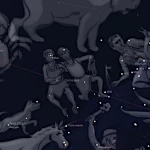 March sky, constellation of Gemini
  April sky, Bouvier constellation
 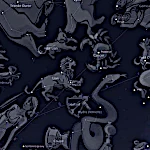 May sky, constellation Leo
 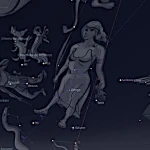 June sky, constellation Virgo
 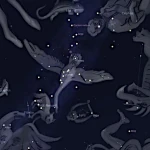 July sky, Cygnus constellation
  August sky, constellation of the Eagle
  September sky, Corona Borealis Constellation
  October sky, constellation Pegasus
  November sky, Andromeda constellation
  December sky, Perseus constellation