


The 5 Strangest Objects in Our Galaxy: From Zombie Stars to Diamond Planets
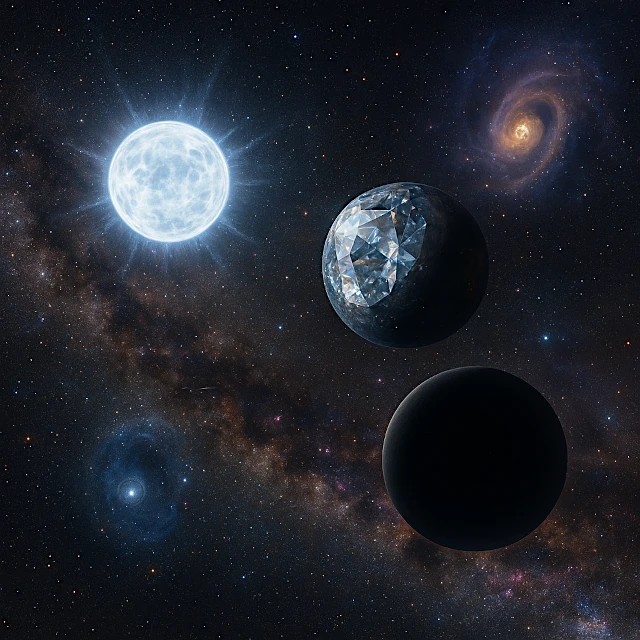
A journey through the most unusual objects in the Milky Way.
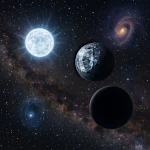
It features a zombie star (a white dwarf being reanimated), a planet with diamond reflections, a dark exoplanet absorbing light, and other enigmatic cosmic phenomena.
Image source: astronoo.com (new window)
Scientific Summary
This article explores five celestial objects in our galaxy that push the boundaries of known physics: zombie stars, white dwarfs in binary systems that explode in recurrent novae after their thermonuclear death; diamond planets, like 55 Cancri e, whose carbon-rich composition may have crystallized into diamond under extreme pressures; rogue planets, ejected from their natal systems and wandering alone in interstellar space; magnetars, neutron stars with a magnetic field 10¹⁵ times that of Earth, whose "starquakes" release cataclysmic gamma-ray bursts; and WASP-12b, a hot Jupiter so dark that it absorbs 94% of incident light.
What are these 5 strange objects in the Milky Way that defy physics?
Our galaxy hosts extreme phenomena: 1) zombie stars (white dwarfs that explode in novae after their theoretical death), 2) diamond planets (carbon-rich exoplanets like 55 Cancri e, potentially composed of diamond), 3) rogue planets (wandering alone without a star, perhaps outnumbering stars), 4) magnetars (neutron stars with a magnetic field 10¹⁵ times Earth's, causing "starquakes"), and 5) the exoplanet WASP-12b (a hot Jupiter so dark it reflects less than 6% of light, blacker than coal).
Also worth exploring
Continue your exploration of the Universe with these topics:
A Galaxy Full of Surprises: The Extreme Fates of Matter
Our Milky Way, a vast spiral housing hundreds of billions of stars, is much more than a simple collection of suns and planets. It is a cosmic laboratory where the laws of physics are pushed to the extreme, giving rise to objects so strange that they sometimes defy physics. From stellar corpses that come back to life to worlds made of pure diamond, the Milky Way hides phenomena whose strangeness borders on the fantastic.
Through these five extraordinary objects, the entire cosmic cycle of matter is revealed: genesis, violent end, transmutation of matter, and recycling.
1. Zombie Stars: An Apparent Rebirth
The term "zombie star" dramatically refers to a type of star that seems to come back to life after its theoretical death. These are usually neutron stars or white dwarfs, the ultra-dense remnants of stars like our Sun. The object is dynamically dead (end of nuclear fusion), but energetically reactivated by accretion or magnetic fields.
Their spectacular resurrection occurs in a binary system. If the white dwarf is close enough to a companion star, its intense gravity can "steal" matter from it. When this accumulated matter on its surface reaches a critical mass (about 1.4 solar masses), a cataclysmic nuclear fusion reaction is triggered. This is a neutron star, or even a nova where the "dead" star suddenly shines with prodigious intensity, sometimes visible to the naked eye from Earth, before returning to calm. This explosive cycle can even repeat.
2. Diamond Planets: The Jewels of Space
Imagine a world whose crust and mantle are not made of silicate rocks like on Earth, but of pure diamond. The existence of these diamond planets is no longer science fiction.
They form from the remains of massive carbon-rich stars. When certain intermediate-mass stars evolve, they convert helium into carbon in their cores, but never reach the temperatures needed to fuse this carbon into oxygen. By expelling their outer layers, they enrich the interstellar medium with carbon, but not with oxygen. Planets that form from this material can therefore be exceptionally rich in carbon and poor in oxygen. After a cataclysm, extreme pressures and temperatures can crystallize the carbon into diamond. Exoplanets like 55 Cancri e are suspected to be largely composed of carbon in the form of diamond and graphite, around an iron core. Such a planet, with a radius twice that of Earth, could contain several times the Earth's mass in diamond.
3. Rogue Planets: The Orphans of the Dark
Unlike all the planets we know, rogue planets (or interstellar planets) do not orbit any star. They wander alone in the black and cold immensity of interstellar space.
They can have two origins: either they formed alone, like failed stars too low in mass to ignite fusion and become brown dwarfs, or they were violently ejected from their natal planetary system by gravitational interactions. Astronomers estimate that they could be extremely numerous, perhaps even outnumbering the stars in the galaxy.
Current planetary formation models suggest that the protoplanetary disk of the young Sun gave rise to a hundred major planetary embryos competing in the inner and outer solar system. Some as massive as Mars or Mercury formed and coexisted unstably. The giant collisions that shaped our system, such as the one that created the Moon, testify to this violent period when the number of "candidates" for planet status was at least ten times greater than the final result.
4. Magnetars: The Most Powerful Magnets in the Universe
Magnetars are a type of neutron star, whose hyper-dense remnant (a teaspoon of matter weighs billions of tons) comes from a massive star that exploded as a supernova. Magnetars possess a magnetic field of unimaginable power, billions of billions (1015) times stronger than Earth's.
In neutron stars, the layer of nuclear matter is so compact that it behaves like a solid of extraordinary rigidity. The magnetic field is so intense that it causes "starquakes" (star tremors analogous to earthquakes). These quakes release colossal bursts of gamma and X-rays, visible across the galaxy.
A magnetar at the distance of the Moon would make Earth uninhabitable in minutes, without even exploding. A gamma-ray burst would turn the event into an instant global extinction.
5. The "Black as Coal" Exoplanet
The exoplanet WASP-12b is a hot Jupiter, a gas giant orbiting so close to its star that its surface temperature exceeds 2500°C. WASP-12b is one of the darkest planets ever discovered.
It reflects less than 6% of the light it receives, making it exceptionally dark for a planet, darker than asphalt and close to the reflectivity of coal. This property contrasts sharply with that of Jupiter, which reflects more than 50% of sunlight. Scientists attribute this darkness to an atmosphere rich in titanium and vanadium hydroxides, chemical compounds that absorb almost all visible light. The extreme heat (over 1,000°C) also prevents the condensation of reflective clouds. What we observe from Earth is not the reflection of the star, but the faint intrinsic glow of its superheated atmosphere.
N.B.:
WASP-12b in brief
Discovered in 2008, WASP-12b is a hot Jupiter orbiting so close to its star that it completes a revolution in 26 hours.
Its albedo of less than 0.06 makes it one of the darkest known planets.
Its shape is deformed by tidal forces and its atmosphere is actively evaporating under intense stellar radiation.
5 Celestial Curiosities That Defy Physics
| Object | Type / Category | Main Feature | Known Example / Location |
|---|---|---|---|
| Zombie Star | White dwarf in a binary system accreting matter | Repeated thermonuclear explosions (novae) after its "death" | RS Ophiuchi, T Coronae Borealis (recurrent) |
| Diamond Planet | Carbon-rich terrestrial exoplanet | Dominant composition of diamond and graphite | 55 Cancri e (at ~41 light-years) |
| Rogue Planet | Interstellar planet or low-mass brown dwarf | Does not orbit any star, wanders in space | CFBDSIR 2149-0403 (potential, at ~100 light-years) |
| Magnetar | Neutron star with hyper-powerful magnetic field | Magnetic field ~1015 times stronger than Earth's | SGR 1806-20 (in the constellation Sagittarius) |
| Black Exoplanet | Ultra-hot Jupiter | Extremely low albedo (<6%), absorbs almost all light | WASP-12b (at ~1410 light-years) |
- Source: Data compiled from NASA/ESA archives, publications in the Astrophysical Journal, and observations from the Hubble, Spitzer, TESS, and James Webb space telescopes.
FAQ: Everything about the 5 strangest objects in our galaxy
What exactly is a "zombie star"?
A zombie star is a white dwarf (ultra-dense stellar corpse) that, as part of a binary system close to a companion star, "steals" matter from it through accretion. When the accumulated matter reaches a critical mass (about 1.4 solar masses), a cataclysmic thermonuclear explosion (nova) triggers. The "dead" star then suddenly shines with prodigious intensity before returning to calm, and this cycle can even repeat.
How can a diamond planet form?
Diamond planets form from the remains of massive carbon-rich stars. Some intermediate-mass stars transform helium into carbon in their cores but never reach the temperatures needed to fuse this carbon into oxygen. By expelling their outer layers, they enrich the interstellar medium in carbon (but not oxygen). Planets that later form from this material are exceptionally carbon-rich. After a cataclysm, extreme pressures and temperatures can crystallize carbon into diamond. The exoplanet 55 Cancri e is a serious candidate.
What is a magnetar and why is it so dangerous?
A magnetar is a type of neutron star resulting from the explosion of a massive star in a supernova. It possesses an unimaginably powerful magnetic field: about 10¹⁵ times stronger than Earth's. This intense field causes "starquakes" that release colossal bursts of gamma rays and X-rays visible across the galaxy. A magnetar at the distance of the Moon would render Earth uninhabitable within minutes, even without exploding.
 The Milky Way Is Not a Flat Disk: It Dances Like a Cosmic Wave
  JWST and Early Galaxies: When the Universe Defies Our Models
  Fermi Bubbles: When the Milky Way's Black Hole Awakens
  The Great Attractor: The Celestial Fountain Pulling Us into the Abyss
  The 5 Strangest Objects in Our Galaxy: From Zombie Stars to Diamond Planets
  Why Is It So Hard to See the Milky Way?
  What Is a Galaxy? Journey to the Land of Billions of Stars
  Galaxies from the Depths: Light from the Primordial Universe
  At the center of the Milky Way: a monster of 4 million suns
  JWST and Protogalaxies: Exploring the First Cosmic Structures
  Giant galaxies: collisions, mergers and absorption
  The upcoming merger between our Galaxy and the Sagittarius Galaxy
  Differences between the Milky Way and the Andromeda Galaxy
  Why are Galaxies, Unlike Stars, So Close to Each Other?
  Galaxies of the Local Group
  The hidden galaxy, one of Euclid's first images
  The Virgo Cluster spans approximately three Full Moons
  Where did the dark matter in our Galaxy go?
  Galaxy Mergers: From Encounter to Coalescence
  Gravitational Lenses: When Spacetime Bends Light
  Cartwheel Galaxy: A Wheel of Fire in the Universe
  From Dust to Stars: The Composition of Galaxies
  Galaxy Merger NGC 6745: A Traversal of One by the Other
  Extreme Shock Waves in the Universe: Impact on the Evolution of Cosmic Structures
  Gould Belt: The Mystery of the Milky Way's Tilted Ring
  Zoom on Our Galaxy: Journey to the Center of the Milky Way
  One Galaxy, Two Hearts: The Mystery of Andromeda's Double Nucleus
  Tinker Bell's Gravitational Flight: A Merger of Three Galaxies
  Coma or Berenice’s Hair: The Cosmic Colossus
  Bullet Cluster: Cosmic Collision and Direct Proof of Dark Matter
  El Gordo: The Cosmic Giant That Challenges Our Models of the Universe
  Einstein Rings: When Gravity Draws Cosmic Rings
  The Cigar Galaxy: A Smoke of Stars in the Night
  The Hubble Sequence: The Secret Code of Galactic Shapes
  Dance of the Stars: The Arms of the Milky Way
  At the Heart of Galaxies: When Shape Tells the Story of the Universe
  Ancient Galaxies and Cosmic Evolution: A Deep Look Back in Time
  MOND Theory and Dark Matter: Why MOND Fails in Cluster Collisions
  Laniakea, our supercluster of galaxies
 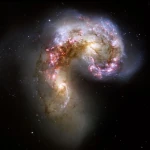 The Antennae Galaxies: An Ongoing Cosmic Collision
 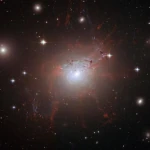 NGC 1275: A Turbulent Galaxy in the Perseus Cluster
 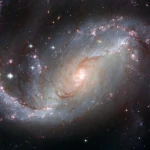 NGC 1672: A Barred Spiral Galaxy in Full Activity