


The Great Attractor: The Celestial Fountain Pulling Us into the Abyss
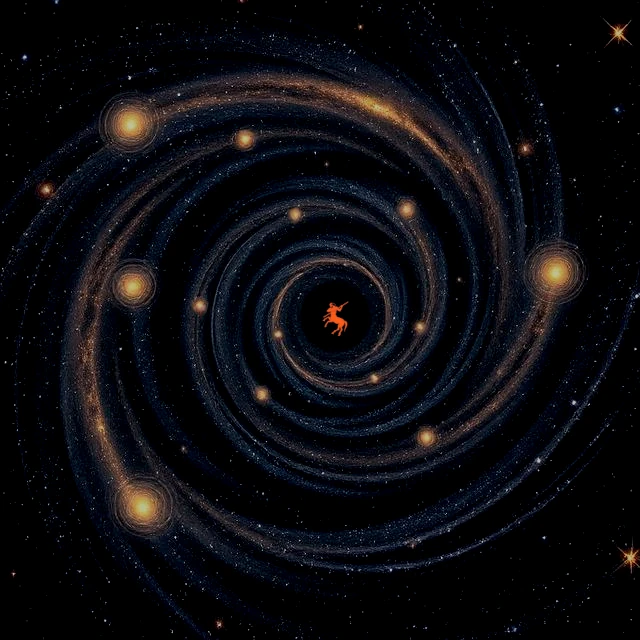
Like rivers flowing toward a watershed, thousands of galaxies converge toward a massive, dark central region located in the southern hemisphere, in the direction of the Centaurus constellation.
This cosmic choreography is the gravitational manifestation of the Great Attractor.
Image source: astronoo.com (new window)
Scientific Summary
The Great Attractor is a colossal concentration of mass (>10¹⁶ solar masses) located 200 million light-years away. Discovered in the 1970s-80s, it pulls our galaxy and thousands of others at over 600 km/s, defining the dynamic center of the Laniakea supercluster. Its observation is obscured by the plane of the Milky Way (Zone of Avoidance). This article synthesizes the hierarchy of cosmic structures, from Laniakea to the Shapley Supercluster, and highlights the key role of dark matter in this attraction, part of which remains unexplained by visible mass.
What is the Great Attractor, this "celestial fountain" pulling us toward the unknown?
The Great Attractor is a colossal concentration of mass (over 10¹⁶ solar masses) located about 200 million light-years away, towards the constellations of Centaurus and Norma. Discovered in the 1970s-80s, it exerts such strong gravitational pull that it drives our Milky Way and thousands of other galaxies at over 600 km/s, beyond the normal expansion of the Universe. It is the dynamical heart of our galaxy supercluster, named Laniakea ("immense heavens" in Hawaiian). The Great Attractor remains difficult to observe because it hides behind the dusty plane of our own galaxy (the Zone of Galactic Avoidance).
Also worth exploring
Continue your exploration of the Universe with these topics:
The Celestial Fountain: A Gravitational Current in the Cosmic Ocean
Imagine all the galaxies around us, including our own Milky Way (our galaxy, the Milky Way, is a vast spiral structure containing hundreds of billions of stars.), being carried away in a vast cosmic river, drawn toward an unknown destination. This is not science fiction, but the reality discovered in the 1970s and 1980s. Astronomers have measured that our galaxy and its great neighbor, Andromeda (the Andromeda Galaxy (M31) is the closest large spiral galaxy to the Milky Way, located about 2.5 million light-years away.), are moving at a dizzying speed of over 600 kilometers per second, not due to the general expansion of the universe, but because of a colossal gravitational pull from a region of space in the direction of the Centaurus (the Centaurus constellation, in the southern hemisphere, is rich in star clusters and is home to the presumed direction of the Great Attractor.) constellation. This mysterious force has been named the Great Attractor.
The Great Attractor acts as a celestial fountain, a point of convergence where gravity (the fundamental force of attraction between all masses in the universe, described by Einstein's General Theory of Relativity.) shapes the large-scale flow of matter. Its discovery revolutionized our understanding of cosmic structure, revealing that galaxies are not randomly distributed but organized into filaments, walls, and immense clusters, with "voids" in between. The Great Attractor represents one of the greatest observational challenges in modern astrophysics, as it hides behind the dusty plane of our own galaxy, an area called the Zone of Galactic Avoidance (a region of the sky obscured by the dust and stars of our galaxy's bulge, making it very difficult to observe distant objects.).
Behind the Dust of the Milky Way: The Great Attractor
For decades, the nature of the Great Attractor remained mysterious because it hides behind the dusty plane of our galaxy, in the "Zone of Galactic Avoidance." This region, impenetrable to optical telescopes, was finally probed using multi-wavelength astronomy (astronomy using radio, infrared, X-ray, etc. waves.). Radio observations (Parkes Observatory) and X-ray observations (ROSAT satellite) revealed that the Great Attractor is not a single object, but the center of gravity of a massive concentration of matter, including the Centaurus Cluster (a cluster of galaxies is a structure containing hundreds or even thousands of galaxies bound by gravity.).
Our Galactic Continent: Laniakea
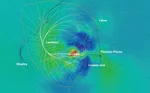
In 2014, astronomers Richard Brent Tully (1943-) and Hélène Courtois (1970-) mapped the movements of thousands of galaxies to define our supercluster: Laniakea ("immense heavens" in Hawaiian). This structure, spanning 520 million light-years, has the Great Attractor as its dynamic center of gravity. All the galaxies in Laniakea, including ours, converge toward it like rivers toward a watershed.
Beyond the Great Attractor: A Gravitational Cascade
This attraction does not stop at Laniakea. The entire structure is itself being pulled toward an even more massive concentration of mass: the Shapley Supercluster (the largest concentration of mass in the nearby universe.). Thus, a gravitational cascade is outlined: our Local Group → the Great Attractor (heart of Laniakea) → the Shapley Attractor. This hierarchy is driven by the distribution of dark matter, which forms the "cosmic web" along which all visible matter flows.
Comparison with Other Cosmic Attractors
The universe is structured by a hierarchy of mass concentrations. The Great Attractor is not unique; it is part of a network of overdensities that, at different scales, shape the movements of galaxies.
| Structure | Approximate distance | Estimated mass | Dynamic role |
|---|---|---|---|
| Virgo Cluster | 55 million light-years | ˜ 1015 solar masses | Local attraction of the Local Group |
| Great Attractor | 200 million light-years | >1016 solar masses | Convergence of the Laniakea supercluster |
| Shapley Supercluster | 650 million light-years | >1017 solar masses | Gravitational influence on a very large scale |
| Cold Spot in the Cosmic Microwave Background | ˜ 7 to 10 billion light-years (line of sight) | Not directly measurable | Thermal anomaly potentially linked to a supervoid or primordial fluctuations |
| Hercules-Corona Borealis Great Wall | ˜ 10 billion light-years | >1018 solar masses (order of magnitude) | Giant filamentary structure, limit of known gravitational correlations |
- Sources: Dressler et al., Astrophysical Journal (1987); Tully et al., Nature (2014); Clowes et al., Monthly Notices of the Royal Astronomical Society (2013); Planck Collaboration, Astronomy & Astrophysics (2016); NASA Extragalactic Database.
What Remains to Be Discovered?
Despite progress, the Great Attractor retains some of its mystery. The total amount of visible matter (galaxies, gas) in the Great Attractor region does not seem sufficient to fully explain the measured amplitude of the attraction. This suggests the presence of colossal amounts of dark matter distributed in a vast halo, or perhaps enormous structures not yet mapped behind the Zone of Galactic Avoidance.
Future instruments, such as the Square Kilometer Array (SKA) radio telescope and large spectroscopic surveys like those of the Vera C. Rubin Observatory, will map the distribution of matter, both visible and invisible, with unprecedented precision using weak gravitational lensing (the distortion of light from distant galaxies by the gravity of matter (visible and dark) located between them and us, allowing the mapping of mass distribution.). They will probe deeper into the Zone of Galactic Avoidance and measure galaxy movements with great finesse.
The Great Attractor is a beacon that illuminates the filamentary structure of our universe, the hierarchical dance of galaxies, and the overwhelming predominance of gravity and dark matter. By pulling us toward the unknown, it forces us to look beyond our local horizon and contemplate the grand architecture of the cosmos as a whole.
FAQ: Everything about the Great Attractor
Why was the Great Attractor so difficult to discover?
The main difficulty is that it hides behind the dusty plane of the Milky Way, in a region called the Zone of Galactic Avoidance. This zone is filled with gas, dust, and stars that absorb and scatter visible light, making optical observation impossible. Only with multi-wavelength astronomy (radio, X-rays, infrared) were astronomers able to probe this region and reveal the nature of the Great Attractor.
What is the Laniakea supercluster and its link to the Great Attractor?
Laniakea (meaning "immense heavens" in Hawaiian) is the galaxy supercluster that contains our Milky Way, spanning about 520 million light-years. Mapped in 2014 by astronomers Tully and Courtois, it is defined by the coherent motions of its thousands of galaxies. The Great Attractor is its dynamical center of gravity: all galaxies in Laniakea converge toward it, like rivers toward a watershed.
What lies beyond the Great Attractor?
Gravitational attraction does not stop at the Great Attractor. The entire Laniakea supercluster itself is being pulled toward an even more gigantic concentration of mass: the Shapley Supercluster (about 650 million light-years away, mass >10¹⁷ solar masses). This reveals a gravitational cascade: our Local Group → the Great Attractor (heart of Laniakea) → the Shapley Attractor. This hierarchy is driven by the distribution of dark matter.
 The Milky Way Is Not a Flat Disk: It Dances Like a Cosmic Wave
  JWST and Early Galaxies: When the Universe Defies Our Models
  Fermi Bubbles: When the Milky Way's Black Hole Awakens
  The Great Attractor: The Celestial Fountain Pulling Us into the Abyss
  The 5 Strangest Objects in Our Galaxy: From Zombie Stars to Diamond Planets
  Why Is It So Hard to See the Milky Way?
  What Is a Galaxy? Journey to the Land of Billions of Stars
  Galaxies from the Depths: Light from the Primordial Universe
  At the center of the Milky Way: a monster of 4 million suns
  JWST and Protogalaxies: Exploring the First Cosmic Structures
  Giant galaxies: collisions, mergers and absorption
  The upcoming merger between our Galaxy and the Sagittarius Galaxy
  Differences between the Milky Way and the Andromeda Galaxy
  Why are Galaxies, Unlike Stars, So Close to Each Other?
  Galaxies of the Local Group
  The hidden galaxy, one of Euclid's first images
  The Virgo Cluster spans approximately three Full Moons
 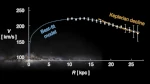 Where did the dark matter in our Galaxy go?
  Galaxy Mergers: From Encounter to Coalescence
  Gravitational Lenses: When Spacetime Bends Light
  Cartwheel Galaxy: A Wheel of Fire in the Universe
  From Dust to Stars: The Composition of Galaxies
  Galaxy Merger NGC 6745: A Traversal of One by the Other
  Extreme Shock Waves in the Universe: Impact on the Evolution of Cosmic Structures
  Gould Belt: The Mystery of the Milky Way's Tilted Ring
  Zoom on Our Galaxy: Journey to the Center of the Milky Way
  One Galaxy, Two Hearts: The Mystery of Andromeda's Double Nucleus
  Tinker Bell's Gravitational Flight: A Merger of Three Galaxies
  Coma or Berenice’s Hair: The Cosmic Colossus
  Bullet Cluster: Cosmic Collision and Direct Proof of Dark Matter
  El Gordo: The Cosmic Giant That Challenges Our Models of the Universe
  Einstein Rings: When Gravity Draws Cosmic Rings
  The Cigar Galaxy: A Smoke of Stars in the Night
  The Hubble Sequence: The Secret Code of Galactic Shapes
  Dance of the Stars: The Arms of the Milky Way
  At the Heart of Galaxies: When Shape Tells the Story of the Universe
  Ancient Galaxies and Cosmic Evolution: A Deep Look Back in Time
  MOND Theory and Dark Matter: Why MOND Fails in Cluster Collisions
  Laniakea, our supercluster of galaxies
  The Antennae Galaxies: An Ongoing Cosmic Collision
  NGC 1275: A Turbulent Galaxy in the Perseus Cluster
  NGC 1672: A Barred Spiral Galaxy in Full Activity