


When a Star Dies: Birth of a Black Hole
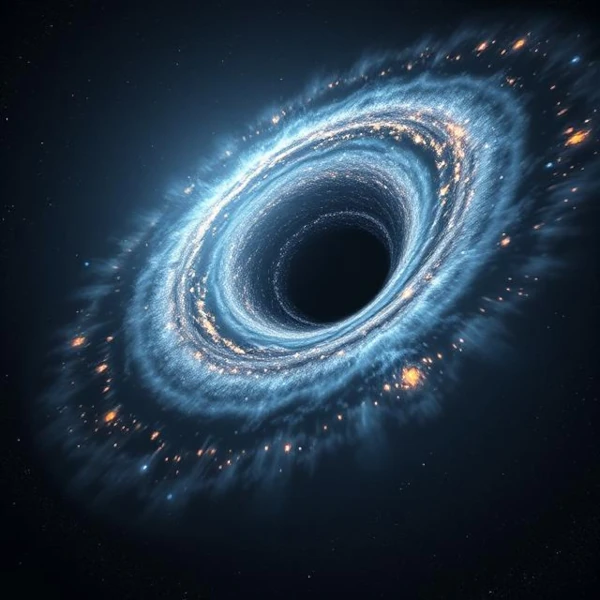
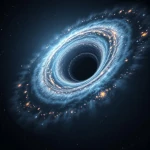
Birth of a black hole from a supermassive star. Image source: astronoo.com (new window)
When the star dies
A star lives in a precarious balance between gravitational pressure that tends to contract it and thermal pressure from nuclear reactions that tends to make it explode. When fusion reactions stop in the core of a massive star (more than 20 times the mass of the Sun), gravity takes over without opposition. This situation marks the beginning of a catastrophic collapse: the core collapses on itself, forming a gravitational singularity (a stellar black hole).
The event horizon: the point of no return
A black hole is defined by its event horizon, a spherical surface around the singularity where the escape velocity equals that of light. Nothing, not even a photon, can escape from it. To an outside observer, the star appears to freeze and darken as it approaches this horizon, slowly disappearing from the visible universe.
An invisible but detectable transformation
Although the black hole is invisible, its presence is betrayed by its gravitational interactions with its environment. For example, when it sucks matter from a nearby star, the accretion disk surrounding it can emit intense X-rays. This is how the first black holes in our galaxy, such as Cygnus X-1, were detected.
Table: From massive star to black hole
| Phase | Main Mechanism | Typical Duration | Physical Consequence |
|---|---|---|---|
| Fusion Phase (stellar life) | Fusion H → He → heavy elements | Millions of years | Energy production and hydrostatic equilibrium |
| Core Collapse | Gravity >Degenerate Pressure | A few seconds | Core implosion into singularity |
| Horizon Formation | Spherical limit where $v_{lib} = c$ | Instantaneous | The star becomes invisible to the outside |
| Indirect Emissions | X-rays, gravitational waves | Intermittent (accretion or fusion) | Possible detection of black holes |
- References:
- • Chandrasekhar S., On Massive Stars, The Astrophysical Journal, 1931.
- • Oppenheimer J. R., Snyder H., On Continued Gravitational Contraction, Physical Review, 1939.
- • Misner, Thorne, Wheeler, Gravitation, W. H. Freeman, 1973.
- • NASA, ESA, Black Holes (new window) (2024).
 Scholz's Star: When a Red Dwarf Grazed the Sun 70,000 Years Ago
  Carbon Stars: Dying Stars that Sow the Seeds of Life
  Magnetars: When a Neutron Star Becomes a Magnetic Bomb
  The Immortals of the Cosmos: When the Universe Goes Dark, They Will Still Shine
  Antikythera Mechanism: The Gears of the Cosmos
  The Stars, Legacy of a Golden Age: Arabic Astronomy
  Stars: Cosmic Forges of Chemical Elements
  Adaptive Optics and Laser Guide Stars
  Habitable Zones: The Sweet Spot for Living Near Stars
  Pulsar: A Beating Stellar Heart
  Giants of the Milky Way: Top of the Most Massive, Largest, and Brightest Stars
  The First Minerals of Stellar Systems
  What is a Collapsar?
  The life of the stars: From the collapse of the nebula to the cataclysmic explosion
  When a Star Dies: Birth of a Black Hole
  Neutron Stars: When Atoms No Longer Exist
  Blue Giant Stars and Red Supergiants: The Fate of Massive Stars
  Gravitational Collapse: Formation and Birth of Stars
  Gamma-Ray Bursts: The Ultimate Sigh of Giant Stars
  White Dwarfs: Stars at the End of Their Life
  Brown Dwarfs: Between Stars and Giant Planets
  The Wind of Stars: Interaction between Light and Cosmic Dust
  Top 50 Brightest Stars in the Sky
  The Cigar Explosion
  Escape velocity of small objects from black holes
  The Death of Stars: How Their Mass Decides Their Final Fate
  Blue, white, yellow, orange stars
  The Pleiades: The Seven Sisters and Hundreds of Stars
  The Star Fomalhaut: The Mouth of the Fish
  Yellow Dwarfs: The Sun and Its Stellar Cousins
  Star Clusters: Jewels of the Deep Sky
  Cepheids: Why Does Their Luminosity Vary So Regularly?
  Betelgeuse: Over 900 Times the Sun, the Star That Will Explode as a Supernova
  Bright Planets, Twinkling Stars: The Art of Recognizing Them
  U Camelopardalis: The Carbon Star Losing Its Envelope
  Red Dwarfs: The Smallest Stars
  V838 Monocerotis: The Star That Lit Up Like a Supernova Without Collapsing
  The Stars Next Door: The Top Closest Stars to the Sun
  Supernova: The Explosion That Shapes the Universe
  Coatlicue, the star at the origin of our Sun