


The Immortals of the Cosmos: When the Universe Goes Dark, They Will Still Shine
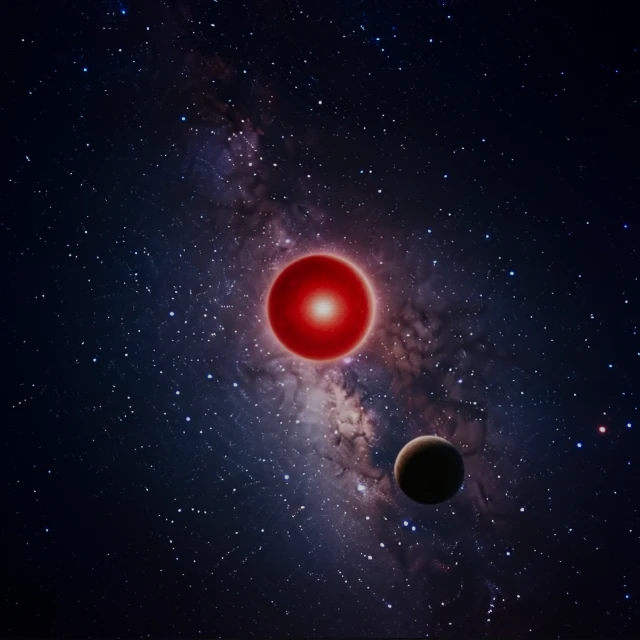
The low luminosity of a red dwarf gives it an almost eternal lifespan.
It reminds us that we live in the first age of stars, an age when most of them still shine.
In trillions of years, only these frugal immortals will remain, silent witnesses to a Universe in which they will have seen all other lights born, radiate, and die.
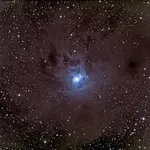
Image source: astronoo.com (new window)
Scientific Summary
Red dwarfs, very low-mass stars (0.1 to 0.4 solar masses), are the "immortals" of the cosmos. Their hydrogen consumption is extremely slow because their luminosity scales as the fourth power of their mass (L ∝ M⁴). A red dwarf of 0.1 solar mass can thus live for over 6,000 billion years, a thousand times the current age of the Universe. Fully convective, they exploit nearly all of their hydrogen reserves. Their end will be unspectacular: a slow contraction into a white dwarf, then into a theoretical black dwarf.
What are these immortal stars that will outlive all others?
They are red dwarfs, very low-mass stars (about 0.1 to 0.4 solar masses). Their hydrogen consumption is extremely slow because their luminosity increases as the 4th power of their mass (L ∝ M⁴). A red dwarf of 0.1 solar mass can live for more than 6,000 billion years – a thousand times the current age of the Universe. They will still shine long after all other stars have gone out.
Also worth exploring
Continue your exploration of the Universe with these topics:
Why Will Some Stars Still Be Alive in a Trillion Years?
The Universe is about 13.8 billion years old. This is already an astonishing figure, but it pales in comparison to the potential lifespan of certain stars. While blue giants blaze brightly and die out in a few million years, another family of stars can achieve immortality. How is this possible? The answer lies in the very engine of stars: nuclear fusion.
A star lives as long as it converts hydrogen into helium in its core. The mass of the star dictates the pace of this combustion. The more massive a star, the greater its internal pressure, and the faster and more violent the fusion. Conversely, the lightest stars, red dwarfs (low-mass stars, less than 0.5 solar masses), consume their fuel with extreme frugality. Their lifespan can thus reach thousands of billions of years, a thousand times the current age of the Universe.
How Long Do Stars Really Live?
Astrophysical models of stellar structure, based on the work of Subrahmanyan Chandrasekhar (1910-1995) and refined by simulation codes like MESA, estimate that a red dwarf with 0.1 solar mass can burn peacefully for more than 6,000 billion years. This result comes from a simple but formidable relationship: the lifespan of a star (t) is proportional to its fuel reserves (its mass M) divided by the rate at which it consumes them (its luminosity L): \( t \sim \frac{M}{L} \)
The luminosity of a star increases very rapidly with its mass, according to the empirical relation \( L \propto M^4 \). Combining these, we get: \( t \propto \frac{M}{M^4} = M^{-3} \)
A star ten times less massive than the Sun would therefore live about \( 10^3 = 1,000 \) times longer, already placing its lifespan in the thousands of billions of years. Adding the fact that red dwarfs are fully convective, thus using almost all of their hydrogen reserves—whereas the Sun consumes only a fraction—we easily reach factors of 1,000 to 10,000 compared to the Sun's lifespan.
| Stellar type | Mass (M☉) | Lifespan (years) | Example star | Particularity |
|---|---|---|---|---|
| Blue giant | ~ 20 | ~ 8 million | Rigel (β Orionis) | One of the brightest stars in the sky, though distant. |
| Blue giant | ~ 15 | ~ 15 million | Spica (α Virginis) | Massive binary star whose primary component is very hot. |
| Blue giant | ~ 10 | ~ 30 million | Alnilam (ε Orionis) | Central star of Orion's Belt, it will end as a supernova. |
| Massive star | ~ 8 | ~ 100 million | Naos (ζ Puppis) | O-type star, extremely hot and luminous. |
| Intermediate star | ~ 3 | ~ 500 million | Mintaka (δ Orionis) | Multiple star, whose mass is still sufficient for a relatively short life. |
| Yellow-white star | ~ 1.8 | ~ 2 billion | Sirius A (α Canis Majoris) | The brightest star in the night sky, more massive than the Sun. |
| Yellow star | ~ 1 | ~ 10 billion | Sun | Our star, the reference for all comparisons. |
| Orange dwarf | ~ 0.7 | ~ 25 billion | Alpha Centauri B | Companion of the Sun's nearest neighbor, with a longer life than our star. |
| Red dwarf | ~ 0.4 | ~ 200 billion | Gliese 581 | Famous for its planetary system, including Gliese 581c. |
| Red dwarf | ~ 0.12 | ~ 6,000 billion | Proxima Centauri (GJ 551) | The closest star to the Sun (4.22 ly), very active despite its low mass. |
N.B.: Below the threshold (0.08 M☉), the object does not have sufficient internal pressure and temperature to sustain hydrogen fusion into helium. It is then a brown dwarf, sometimes called a "failed star."
What Next? The Fate of the Almost Eternal Stars
What will become of these frugal stars at the end of their lives, in a future so distant that all other stars will have long since gone out? Their end will be uneventful: they will slowly contract, without explosion, without outburst.
As their hydrogen is depleted, they will transform into helium white dwarfs (degenerate star composed mainly of helium, the final stage of red dwarfs), stellar corpses that will no longer produce any energy through fusion. These stellar corpses will radiate their residual heat into the void, cooling until they become black dwarfs: cold, dense, and invisible objects, whose existence remains purely theoretical to this day, as the Universe is not yet old enough to have produced a single one.
FAQ: Everything about immortal stars (red dwarfs)
Why does a less massive star live much longer?
A star's lifespan is proportional to its mass divided by its luminosity (t ∼ M/L). However, luminosity increases very rapidly with mass, following the relation L ∝ M⁴. A star ten times less massive than the Sun therefore lives about 10³ = 1,000 times longer. Moreover, red dwarfs are fully convective, thus using almost all of their hydrogen reserves.
What is the difference between a red dwarf and a brown dwarf?
The threshold is around 0.08 solar masses (8% of the Sun's mass). Below this limit, the object does not reach sufficient internal pressure and temperature to initiate and sustain hydrogen fusion into helium. It is then a brown dwarf, sometimes called a "failed star," which is not a true star.
What happens to red dwarfs at the end of their lives?
Their end is unspectacular: they slowly contract and transform into helium white dwarfs, stellar corpses that no longer produce energy through fusion. They then radiate their residual heat until becoming black dwarfs, cold, dense, and invisible objects. However, the Universe is not yet old enough (13.8 billion years) for a single black dwarf to have formed.
 Scholz's Star: When a Red Dwarf Grazed the Sun 70,000 Years Ago
  Carbon Stars: Dying Stars that Sow the Seeds of Life
  Magnetars: When a Neutron Star Becomes a Magnetic Bomb
  The Immortals of the Cosmos: When the Universe Goes Dark, They Will Still Shine
  Antikythera Mechanism: The Gears of the Cosmos
  The Stars, Legacy of a Golden Age: Arabic Astronomy
  Stars: Cosmic Forges of Chemical Elements
  Adaptive Optics and Laser Guide Stars
  Habitable Zones: The Sweet Spot for Living Near Stars
  Pulsar: A Beating Stellar Heart
  Giants of the Milky Way: Top of the Most Massive, Largest, and Brightest Stars
  The First Minerals of Stellar Systems
  What is a Collapsar?
  The life of the stars: From the collapse of the nebula to the cataclysmic explosion
  When a Star Dies: Birth of a Black Hole
  Neutron Stars: When Atoms No Longer Exist
  Blue Giant Stars and Red Supergiants: The Fate of Massive Stars
  Gravitational Collapse: Formation and Birth of Stars
  Gamma-Ray Bursts: The Ultimate Sigh of Giant Stars
  White Dwarfs: Stars at the End of Their Life
  Brown Dwarfs: Between Stars and Giant Planets
  The Wind of Stars: Interaction between Light and Cosmic Dust
  Top 50 Brightest Stars in the Sky
  The Cigar Explosion
  Escape velocity of small objects from black holes
  The Death of Stars: How Their Mass Decides Their Final Fate
 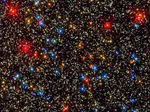 Blue, white, yellow, orange stars
 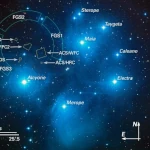 The Pleiades: The Seven Sisters and Hundreds of Stars
 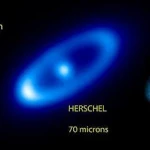 The Star Fomalhaut: The Mouth of the Fish
 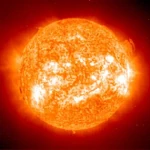 Yellow Dwarfs: The Sun and Its Stellar Cousins
  Star Clusters: Jewels of the Deep Sky
  Cepheids: Why Does Their Luminosity Vary So Regularly?
  Betelgeuse: Over 900 Times the Sun, the Star That Will Explode as a Supernova
  Bright Planets, Twinkling Stars: The Art of Recognizing Them
  U Camelopardalis: The Carbon Star Losing Its Envelope
  Red Dwarfs: The Smallest Stars
  V838 Monocerotis: The Star That Lit Up Like a Supernova Without Collapsing
  The Stars Next Door: The Top Closest Stars to the Sun
  Supernova: The Explosion That Shapes the Universe
  Coatlicue, the star at the origin of our Sun