


Stars: Cosmic Forges of Chemical Elements
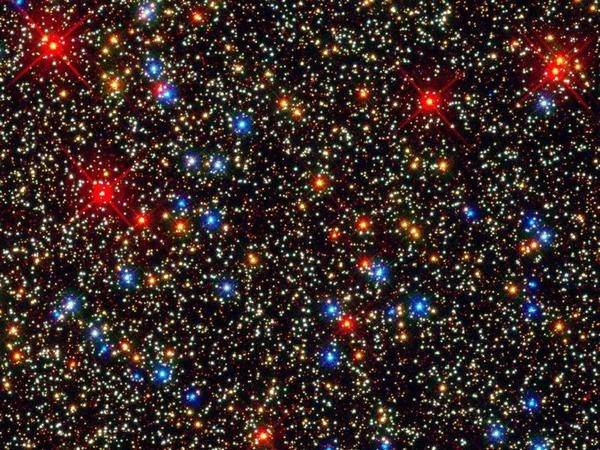
Image from the Hubble Space Telescope (2009) - Wide Field Camera 3 (WFC3).
Image source: NASA, ESA, and the Hubble SM4 ERO Team (new window).
Scientific Summary
This article traces the origin of chemical elements, from the primordial nucleosynthesis of the Big Bang (H, He, Li) to stellar nucleosynthesis, which forges heavier nuclei through fusion (proton-proton chain, CNO cycle, triple-alpha process). It details the formation of elements up to iron in the cores of massive stars, and the creation of heavier elements (gold, platinum, uranium) via the r and s processes in supernovae and AGB stars. Observational evidence (spectroscopy, carbonaceous meteorites like Murchison) confirms this scenario, theorized by Margaret Burbidge, Geoffrey Burbidge, William A. Fowler, and Fred Hoyle in 1957.
How do stars create the chemical elements that make up matter and life?
Not all atoms around us have the same origin. Hydrogen and helium, which together make up almost all the ordinary matter in the universe, appeared during the Big Bang, 13.8 billion years ago, in just three minutes of primordial nucleosynthesis. All heavier elements, however, come from stars. In their cores, nuclear fusion gradually transforms hydrogen into helium, then into carbon, nitrogen, and oxygen via the proton-proton chain and the CNO cycle. When a star becomes a red giant, the triple-alpha process fuses helium into carbon, as predicted by Fred Hoyle in 1954. Massive stars continue fusion up to iron, beyond which fusion no longer releases energy. Even heavier elements, such as gold, platinum, or uranium, require extreme conditions: they are born during the explosion of supernovae (r-process, rapid neutron capture) or in dying giant stars of the AGB type (s-process, slow capture). Each generation of stars thus enriches the interstellar medium, allowing the formation of rocky planets and, ultimately, the atoms that make up life.
Also worth exploring
Continue your exploration of the Universe with these topics:
The Big Bang: Origin of the First Elements
The first chemical elements appeared during the Big Bang (cosmological model describing the origin of the universe), about 13.8 billion years ago. During the first three minutes, the temperature and density conditions allowed the formation of light nuclei:
- Hydrogen (\(^1H\) (hydrogen isotope composed of one proton and one electron)): 75% of baryonic matter
- Deuterium (\(^2H\) (hydrogen isotope with an additional neutron)): trace amounts
- Helium-4 (\(^4He\) (nucleus composed of 2 protons and 2 neutrons)): 25% of baryonic matter
- Lithium-7 (\(^7Li\) (element with atomic number 3)): 10-9 of hydrogen abundance
These proportions, predicted by the theory of primordial nucleosynthesis (theory describing the formation of atomic nuclei in the primordial universe), were confirmed by observations of the cosmic microwave background by the COBE (1989-1993) and Planck (2009-2013) satellites.
Stellar Nucleosynthesis: The Alchemy of Stars
Stars are the main sites for the production of elements heavier than lithium. This process, called stellar nucleosynthesis (formation of heavier atomic nuclei through nuclear fusion in stars), was theorized by Fred Hoyle (1915-2001), William Fowler (1911-1995), Geoffrey Burbidge (1925-2010), and Margaret Burbidge (1919-2020) in their foundational 1957 paper.
In the cores of stars, nuclear fusion reactions gradually transform lighter elements into heavier ones:
- Proton-proton chain (solar-type stars): 4 \(^1H\) → \(^4He\) + energy
- CNO cycle (more massive stars): catalyzed by carbon, nitrogen, and oxygen
- Helium fusion (red giant phase): 3 \(^4He\) → \(^{12}C\) (triple-alpha process)
- Carbon and oxygen fusion (massive stars): \(^{12}C\) + \(^4He\) → \(^{16}O\), etc.
Details on Stellar Alchemy
Proton-Proton Chain (PP)
Solar-type stars, T ≈ 10–15 × 106 K: 4 \(^1H\) → \(^4He\) + 2 \(e^+\) + 2 νe + 26.7 MeV.
Mechanism:
- \(^1H + ^1H\) → \(^2H + e^+ + ν_e\) (slow reaction, 109 years for the Sun).
- \(^2H + ^1H\) → \(^3He + γ\).
- \(^3He + ^3He\) → \(^4He + 2 ^1H\).
Example: 90% of the Sun's energy comes from this chain.
CNO Cycle
More massive stars, T >15 × 106 K. Catalyzed by carbon, nitrogen, and oxygen (main loop): \(^{12}C + ^1H\) → \(^{13}N + γ\) → \(^{13}C + e^+ + ν_e\) → \(^{14}N + ^1H\) → \(^{15}O + γ\) → \(^{15}N + e^+ + ν_e\) → \(^{12}C + ^4He\).
Characteristics:
- Dominant for stars >1.3 M☉ (e.g., Rigel (blue star in the constellation Orion, 20 M☉)).
- Strongly dependent on temperature (∝ T15–20, vs T4 for the PP chain).
- Produces neutrons via \(^{13}C(α,n)^{16}O\), important for the s (slow neutron capture) process.
Helium Fusion
Red giant phase, T ≈ 100–200 × 106 K.
- Triple-alpha process: 3 \(^4He\) → \(^{12}C + γ\) (predicted by Fred Hoyle in 1954).
- Secondary reaction: \(^{12}C + ^4He\) → \(^{16}O + γ\).
- Products: Carbon and oxygen (90% of the mass of 1–8 M☉ stars at the end of their life).
- Example: AGB stars (e.g., Mira (carbon star in the constellation Cetus)) enrich the interstellar medium with \(^{12}C\).
Carbon and Oxygen Fusion
Massive stars, T ≈ 600 × 106–1 × 10⁹ K.
- Carbon fusion: \(^{12}C + ^{12}C\) → \(^{20}Ne + ^4He\) or \(^{23}Na + p\) or \(^{23}Mg + n\).
- Oxygen fusion: \(^{16}O + ^{16}O\) → \(^{28}Si + ^4He\) or \(^{31}P + p\).
- Duration: A few hundred to thousand years (e.g., 600 years for a 20 M☉ star).
- Key products: \(^{20}Ne\), \(^{24}Mg\), \(^{28}Si\), \(^{32}S\), and traces of \(^{26}Al\) (radioactive).
Supernovae: Factories of Heavy Elements
Elements heavier than iron (atomic number 26) can only be synthesized under extreme conditions:
- Process r (rapid neutron capture): in core-collapse supernovae (e.g., SN 1987A (supernova observed in 1987))
- Process s (slow neutron capture): in AGB (dying giant stars) stars (e.g., stars like Aldebaran (red giant star in the constellation Taurus))
- Explosive fusion: during the collapse of a supernova's core (e.g., formation of gold and platinum)
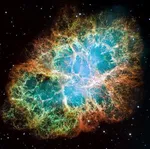
A typical supernova like SN 1054 (supernova observed in 1054 that formed the Crab Nebula) can disperse several solar masses of newly formed elements into interstellar space, enriching the interstellar medium for future generations of stars and planets.
Observational Evidence: Spectroscopy and Meteorites
Spectral analysis of starlight reveals the presence of chemical elements through their characteristic absorption lines. For example:
- Hydrogen lines (Balmer series) at 410, 434, 486, and 656 nm
- Ionized calcium lines (H and K) at 393 and 397 nm
- Neutral iron lines around 500 nm
Carbonaceous chondrites (carbon-rich meteorites containing presolar grains), such as the Murchison (meteorite that fell in Australia in 1969) meteorite, contain presolar grains whose isotopic composition reveals their specific stellar origin.
Process of Chemical Element Formation
| Element(s) | Formation Process | Production Location | Example Star or Event | Relative Abundance (Si=106) |
|---|---|---|---|---|
| H, He, Li | Primordial nucleosynthesis | Big Bang (first 3 minutes) | Primordial Universe | H: 1.00 × 10¹² He: 8.50 × 10¹⁰ |
| C, N, O (partial) | CNO cycle | Core of stars >1.3 M☉ | Rigel(star in the constellation Orion) (M >20 M☉) | C: 1.01 × 10⁷ O: 2.38 × 10⁷ |
| O, Ne, Mg, Si | Helium and carbon fusion | Massive stars (>8 M☉) | Betelgeuse(red supergiant in Orion) | O: 2.38 × 10⁷ Si: 1.00 × 10⁶ |
| Fe, Ni | Silicon fusion | Core of supergiants (final stages) | Progenitor of SN 1604(kepler's Supernova observed in 1604) | Fe: 9.00 × 10⁵ |
| Cu, Zn, Au, Pt, U | r and s processes | Supernovae and AGB stars | SN 1987A(supernova observed in 1987) and Mira(carbon star in the constellation Cetus) | Au: 0.0045 U: 0.0009 |
Applications and Implications for Life
Understanding these processes has major implications:
- Origin of elements essential to life (C, N, O, P, S)
- Formation of terrestrial planets and their composition
- Dating cosmic events via radioactive isotopes (e.g., \(^{26}Al\) to date young stars)
- Understanding the chemical evolution of the galaxy (increasing metallicity)
As Carl Sagan (1934-1996) pointed out: "We are all made of star stuff," reminding us that the atoms making up our bodies were forged in the hearts of stars billions of years ago.
References
FAQ: Everything You Need to Know About Stars and the Formation of Chemical Elements
Which elements come from the Big Bang and which come from stars?
The Big Bang only produced the lightest elements: hydrogen (75% of baryonic matter), helium-4 (25%), and trace amounts of deuterium and lithium-7. These proportions, predicted by primordial nucleosynthesis, were confirmed by the COBE and Planck satellites. All elements heavier than lithium, from carbon to uranium, were later forged in stars through nuclear fusion and then dispersed into space upon their death.
How are elements heavier than iron, such as gold and platinum, formed?
Beyond iron, nuclear fusion consumes energy rather than releasing it, so it can no longer produce heavier elements inside a stable star. These elements (gold, platinum, uranium) are formed by neutron capture on existing nuclei. The r-process (rapid capture) occurs in just a few seconds during the core collapse of a supernova, while the s-process (slow capture) takes place over thousands of years in dying giant stars of the AGB type.
How do we know that stars are indeed the source of these elements?
Two types of evidence converge. Spectroscopy reveals, in the light of stars, characteristic absorption lines for each element (hydrogen, calcium, iron). Additionally, the analysis of carbonaceous chondrites, such as the Murchison meteorite that fell in 1969, shows presolar grains whose isotopic composition betrays a precise stellar origin, predating the formation of the Solar System.
 Scholz's Star: When a Red Dwarf Grazed the Sun 70,000 Years Ago
  Carbon Stars: Dying Stars that Sow the Seeds of Life
  Magnetars: When a Neutron Star Becomes a Magnetic Bomb
  The Immortals of the Cosmos: When the Universe Goes Dark, They Will Still Shine
  Antikythera Mechanism: The Gears of the Cosmos
  The Stars, Legacy of a Golden Age: Arabic Astronomy
  Stars: Cosmic Forges of Chemical Elements
  Adaptive Optics and Laser Guide Stars
  Habitable Zones: The Sweet Spot for Living Near Stars
  Pulsar: A Beating Stellar Heart
  Giants of the Milky Way: Top of the Most Massive, Largest, and Brightest Stars
  The First Minerals of Stellar Systems
  What is a Collapsar?
  The life of the stars: From the collapse of the nebula to the cataclysmic explosion
  When a Star Dies: Birth of a Black Hole
  Neutron Stars: When Atoms No Longer Exist
  Blue Giant Stars and Red Supergiants: The Fate of Massive Stars
  Gravitational Collapse: Formation and Birth of Stars
  Gamma-Ray Bursts: The Ultimate Sigh of Giant Stars
  White Dwarfs: Stars at the End of Their Life
  Brown Dwarfs: Between Stars and Giant Planets
  The Wind of Stars: Interaction between Light and Cosmic Dust
  Top 50 Brightest Stars in the Sky
  The Cigar Explosion
  Escape velocity of small objects from black holes
  The Death of Stars: How Their Mass Decides Their Final Fate
  Blue, white, yellow, orange stars
  The Pleiades: The Seven Sisters and Hundreds of Stars
  The Star Fomalhaut: The Mouth of the Fish
  Yellow Dwarfs: The Sun and Its Stellar Cousins
  Star Clusters: Jewels of the Deep Sky
  Cepheids: Why Does Their Luminosity Vary So Regularly?
  Betelgeuse: Over 900 Times the Sun, the Star That Will Explode as a Supernova
  Bright Planets, Twinkling Stars: The Art of Recognizing Them
  U Camelopardalis: The Carbon Star Losing Its Envelope
  Red Dwarfs: The Smallest Stars
  V838 Monocerotis: The Star That Lit Up Like a Supernova Without Collapsing
  The Stars Next Door: The Top Closest Stars to the Sun
  Supernova: The Explosion That Shapes the Universe
  Coatlicue, the star at the origin of our Sun