


Coatlicue: The Mother Nebula of the Sun and the Solar System
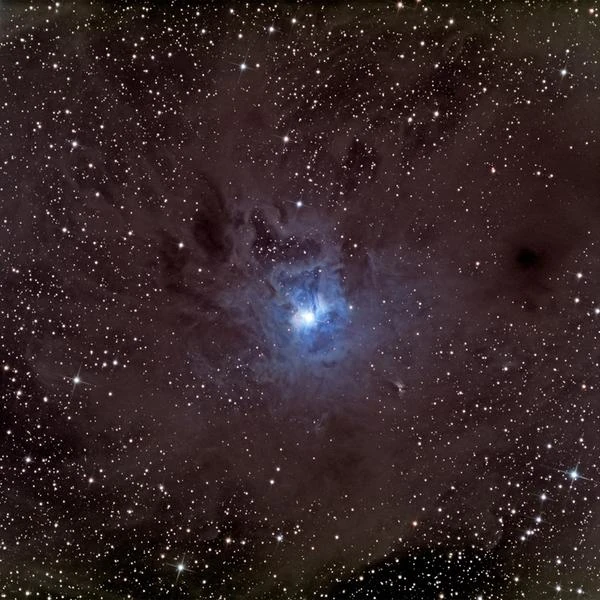
The death of a star – The shell of cold gas appears in blue about 30 light-years from the invisible dying star located at the center of the bubble. It is in this gas shell that many stars like our Sun will be born. © CNRS-Image.
The Genesis of the Sun: A Dive into the Primordial Nebula
The Sun is thought to have emerged in a giant molecular cloud about 4.5 billion years ago following the explosion of a supernova at least 30 times the mass of the Sun.
A star generated the gas and dust cloud from which we originate. This gigantic star is named Coatlicue, the mother of the Sun in Aztec mythology, as well as the goddess of fertility, Earth, fire, life, death, rebirth—essentially, everything!
The Coatlicue star likely formed within a giant molecular cloud containing tens of thousands of stars, some of which exploded as supernovae in just a few million years. Then, a second generation of a few thousand stars was born from the dust and gas compressed by the first supernovae. At this point, Coatlicue would have emerged and later exploded, enveloped in a shell of dense matter and gas, sustained for millions of years by the winds of the dying star. It is within this matter-rich shell that many stars, including our Sun, would have formed.
The Sun's Sisters
In just a few tens of millions of years, three generations of stars succeeded one another, giving birth to our now isolated solar system somewhere on the outskirts of the Milky Way.
The so-called 'cognate' stars of the Sun, meaning those that share a common origin, were born from the same molecular cloud about 4.6 billion years ago. Although galactic dynamics have dispersed these originally co-formed stars, stellar chemistry techniques today allow us to identify some. HD 162826, in the constellation Hercules, exhibits a spectral signature compatible with a common origin with our Sun.
Unfortunately, there is no chance of finding the many stars that formed through the same process and at the same time as our Sun because, over 4.5 billion years, at a speed of 217 km/s, we have completed at least 18 orbits around the Milky Way, separating us from the Sun's sisters.
The Death of a Star: A Cosmic Cataclysm
A star's death can be gentle or violent, depending on its mass.
- Below 1.4 times the mass of the Sun: The star fades away very slowly and serenely.
- Between 1.4 and 5 times the mass of the Sun: The star's radius shrinks to about 10 km. The final density is enormous, nuclei can no longer withstand the pressure, and the star's core becomes a gigantic neutron core. The collapse triggers a massive explosion, propelling the star’s outer layers into space, shining as a supernova.
- Above 5 times the mass of the Sun: The collapse is extremely violent and rapid, becoming unstoppable. The star's core turns into a black hole. The violence of the collapse also triggers a gigantic explosion, ejecting the outer layers into space.
N.B.:
The violence of a star's collapse produces a massive explosion that ejects its outer layers into space, playing a crucial role in the history of life.
During a supernova explosion, the star releases the chemical elements it synthesized over its lifetime and during the explosion itself.
These elements travel into interstellar space, spreading throughout the cosmos.
A supernova expands, seeding interstellar space with heavy elements formed during the star’s life and explosion.
These heavy elements are the building blocks of terrestrial planets like our Earth.
 The Eagle Nebula: Stellar Nursery and Pillars of Creation
  Composition of Interstellar Dust
  Heart and Soul Nebulae: Giant H II Regions
 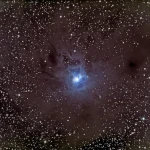 Interstellar Clouds: The Dark Forests of the Galaxy
 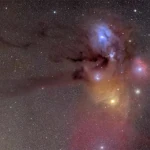 The Black River: Dark Silhouette of the Milky Way
 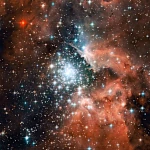 Nebula NGC 3603: One of the Largest Massive Star Factories
 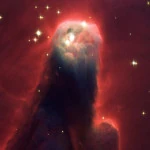 The Cone Nebula and the Christmas Tree Cluster: A Stellar Nursery in the Making
 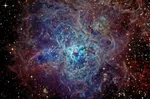 The Tarantula Nebula: A Cosmic Jewel
 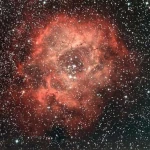 The Rosette Nebula: A Stellar Nursery in Full Bloom
 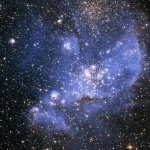 NGC 346: A Stellar Nursery in the Small Magellanic Cloud
 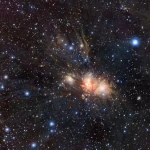 Nebula NGC 2170: A Kaleidoscope of Dust and Light
 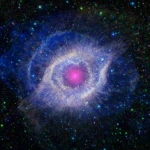 The Helix Nebula: When a Star Dies
 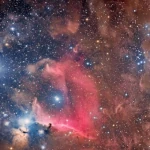 Nebulas: Journey to the Heart of Stellar Cradles
 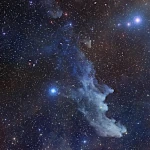 The Witch Head Nebula: Phantom of the Cosmos
 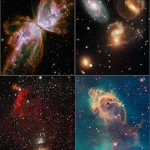 Diffuse, Dark, and Planetary Nebulae: A Physical Classification
 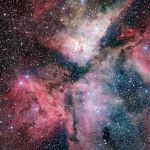 Carina: A Nebula More Active than the Horsehead and Orion Combined?
 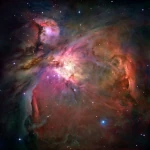 The Orion Nebula: A Stellar Nursery
 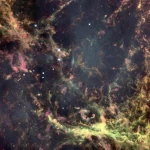 The Crab Nebula M1: Remnant of a Historical Supernova
 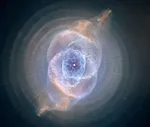 Planetary nebulae
  Dark Nebulas: What do the black patches of the cosmos reveal?
  Coatlicue: The Mother Nebula of the Sun and the Solar System