


Antikythera Mechanism: The Gears of the Cosmos
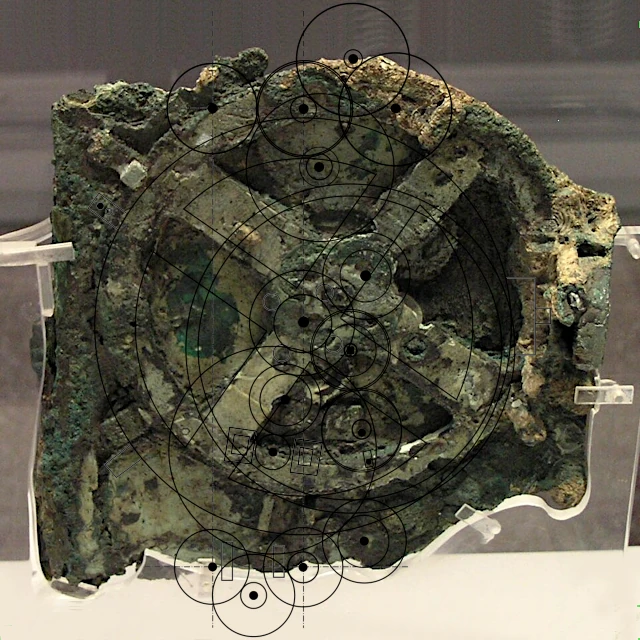
Main fragment of the Antikythera Mechanism (c. 89 BCE) with the mechanism diagram superimposed.
The mechanism consists of a system of 32 bronze gears and plates, used for maritime navigation.
This machine is a mechanism for calculating time based on the movements of the sun, moon, planets, and other stars.
The machine was found in a shipwreck off the island of Antikythera.
Image source: National Archaeological Museum of Athens, room 38.
Scientific Summary
The article presents the Antikythera Mechanism, an astronomical analog computer dating from around 89 BCE, discovered in a Roman shipwreck off the Greek island of Antikythera. This gear mechanism, of unprecedented sophistication for Antiquity, could calculate and predict the positions of the Sun and Moon, lunar phases, eclipses (Saros cycle), and model the Moon's irregular elliptical orbit using a differential gear train, a technology believed to have been invented in the 16th century. It also incorporates the Metonic cycle (19 years) and the Callippic cycle (76 years). Its existence proves that a tradition of complex astronomical clockwork existed long before the Renaissance, challenging our view of ancient Greek technology.
What is the Antikythera Mechanism and why is it an exceptional discovery?
The Antikythera Mechanism is an ancient analog astronomical computer dated to around 89 BCE, discovered in a Roman shipwreck off the Greek island of Antikythera. This gear mechanism, of unparalleled sophistication for antiquity, was able to calculate and predict the positions of the Sun and Moon, lunar phases, eclipses (Saros cycle), and even model the elliptical, irregular orbit of the Moon using a differential gear train (technology thought to have been invented in the 16th century). It also incorporates the Metonic cycle (19 years) and the Callippic cycle (76 years). Its existence proves that a tradition of complex astronomical clockwork existed well before the Renaissance, challenging our understanding of ancient Greek technology.
Also worth exploring
Continue your exploration of the Universe with these topics:
A Deep-Sea Discovery
In 1901, sponge divers accidentally discovered, off the Greek island of Antikythera, the wreck of a Roman ship that sank around 60-70 BCE. Among the marble statues and amphorae, they recovered a strange, corroded bronze mass, seemingly shapeless. It was only decades later, thanks to X-rays and then scanners, that the world discovered with astonishment that it was the most sophisticated mechanism ever found from antiquity.
The Gears of the Sky
The Antikythera Mechanism, dated around 89 BCE, is not just a clock but a true mechanism that allowed the calculation and prediction of a multitude of celestial cycles. By turning a crank, the user could track the phases of the Moon, predict solar and lunar eclipses, and even visualize the positions of the Sun and Moon in the zodiac.
An Unsuspected Level of Technology
What is most fascinating is the precision and miniaturization of its components. Some gears are less than 2 mm thick and are cut with very fine triangular teeth. The mechanism uses a differential gear train (a gear train where the transmission ratio results from the combination of several gears, allowing complex ratios to be obtained.) to model the irregular elliptical orbit of the Moon (lunar anomaly), a technology believed to have been invented in the 16th century.
For the physicist and historian of science Derek de Solla Price (1922-1983), who conducted the first in-depth studies, this artifact completely overturned our understanding of Greek technology. He wrote that it was "worth more, for our understanding of the ancient Greeks, than all the marble statues combined." He suggested a possible link with the school of Archimedes (c. 287-212 BCE), whose ancient texts mention mechanized celestial spheres.
N.B.:
The Metonic cycle, named after the Greek astronomer Meton (5th century BCE), lasts 19 solar years, or almost exactly 235 lunar months. It was crucial for establishing accurate calendars and is perfectly integrated into the mechanism.
A Persistent Mystery
The machine raises profound questions. Who designed and built it? For what exact purpose (educational, astrological, calendrical)? Was it a unique object or evidence of a broader, now lost, technical tradition? Its existence proves that a tradition of complex astronomical clockmaking existed in the Hellenistic world, long before the Renaissance.
Current research, using X-ray tomography and high-resolution 3D imaging, continues to reveal new inscriptions and mechanical subtleties. Each digitized fragment brings us a little closer to understanding the user manual and the extent of the knowledge encapsulated in this "bronze book."
| Calculated Cycle | Period / Function | Mechanism Precision | Use / Context |
|---|---|---|---|
| Phase and position of the Moon | Synodic month (≈29.5 days) | Extremely high | Calendar, tides, eclipses |
| Metonic cycle | 19 solar years (235 lunar months) | Perfect (19/235 gear) | Harmonization of lunar/solar calendars |
| Callippic cycle | 4 Metonic cycles (76 years) | Integrated | Refinement of the Metonic cycle |
| Eclipses (Saros) | 18 years 11 days cycle | Prediction with time and type | Observation, possibly divination |
| Panhellenic Games | 4-year cycle (e.g., Olympics) | Specific dial | Social and religious agenda |
FAQ: Everything about the Antikythera Mechanism
How was the Antikythera Mechanism discovered and identified?
In 1901, sponge divers discovered a Roman shipwreck dating from around 60-70 BCE off the Greek island of Antikythera. Among the statues and amphorae, they brought up a corroded bronze mass, seemingly shapeless. It was only several decades later, using X-rays and then modern scanners (tomography), that physicist and science historian Derek de Solla Price revealed it to be a gear mechanism of astonishing complexity, proving that the ancient Greeks mastered an unsuspected precision technology.
What astronomical cycles could the Antikythera Mechanism calculate?
The Antikythera Mechanism was a true analog computer capable of modeling multiple celestial cycles. It calculated lunar phases and position (synodic month), Sun's positions in the zodiac, solar and lunar eclipses via the Saros cycle (about 18 years and 11 days), the Metonic cycle (19 solar years equaling 235 lunar months), the Callippic cycle (4 Metonic cycles, i.e., 76 years), and even the calendar of the Panhellenic Games (Olympiads, every 4 years). It used a differential gear train to model the elliptical, irregular orbit of the Moon.
Why is the Antikythera Mechanism considered an object out of its time?
Its miniaturization and precision are exceptional for its era: some gears are less than 2 mm thick, with finely cut triangular teeth. It uses a differential mechanism to correct the lunar anomaly (the Moon's elliptical orbit), a technology believed to have been invented only in the 16th century. For over a thousand years after its construction, no civilization produced a mechanical instrument of such complexity. It proves the existence of a tradition of sophisticated astronomical clockwork in the Hellenistic world, of which all traces were lost until the Renaissance. Physicist Derek de Solla Price wrote that it was worth "more than all the marble statues combined" for our understanding of the ancient Greeks.
 Scholz's Star: When a Red Dwarf Grazed the Sun 70,000 Years Ago
  Carbon Stars: Dying Stars that Sow the Seeds of Life
  Magnetars: When a Neutron Star Becomes a Magnetic Bomb
  The Immortals of the Cosmos: When the Universe Goes Dark, They Will Still Shine
  Antikythera Mechanism: The Gears of the Cosmos
  The Stars, Legacy of a Golden Age: Arabic Astronomy
  Stars: Cosmic Forges of Chemical Elements
  Adaptive Optics and Laser Guide Stars
  Habitable Zones: The Sweet Spot for Living Near Stars
  Pulsar: A Beating Stellar Heart
  Giants of the Milky Way: Top of the Most Massive, Largest, and Brightest Stars
  The First Minerals of Stellar Systems
  What is a Collapsar?
  The life of the stars: From the collapse of the nebula to the cataclysmic explosion
  When a Star Dies: Birth of a Black Hole
  Neutron Stars: When Atoms No Longer Exist
  Blue Giant Stars and Red Supergiants: The Fate of Massive Stars
  Gravitational Collapse: Formation and Birth of Stars
  Gamma-Ray Bursts: The Ultimate Sigh of Giant Stars
  White Dwarfs: Stars at the End of Their Life
  Brown Dwarfs: Between Stars and Giant Planets
  The Wind of Stars: Interaction between Light and Cosmic Dust
  Top 50 Brightest Stars in the Sky
  The Cigar Explosion
  Escape velocity of small objects from black holes
  The Death of Stars: How Their Mass Decides Their Final Fate
  Blue, white, yellow, orange stars
  The Pleiades: The Seven Sisters and Hundreds of Stars
  The Star Fomalhaut: The Mouth of the Fish
  Yellow Dwarfs: The Sun and Its Stellar Cousins
  Star Clusters: Jewels of the Deep Sky
  Cepheids: Why Does Their Luminosity Vary So Regularly?
  Betelgeuse: Over 900 Times the Sun, the Star That Will Explode as a Supernova
  Bright Planets, Twinkling Stars: The Art of Recognizing Them
  U Camelopardalis: The Carbon Star Losing Its Envelope
  Red Dwarfs: The Smallest Stars
  V838 Monocerotis: The Star That Lit Up Like a Supernova Without Collapsing
  The Stars Next Door: The Top Closest Stars to the Sun
  Supernova: The Explosion That Shapes the Universe
  Coatlicue, the star at the origin of our Sun