


Carbon Stars: Dying Stars that Sow the Seeds of Life
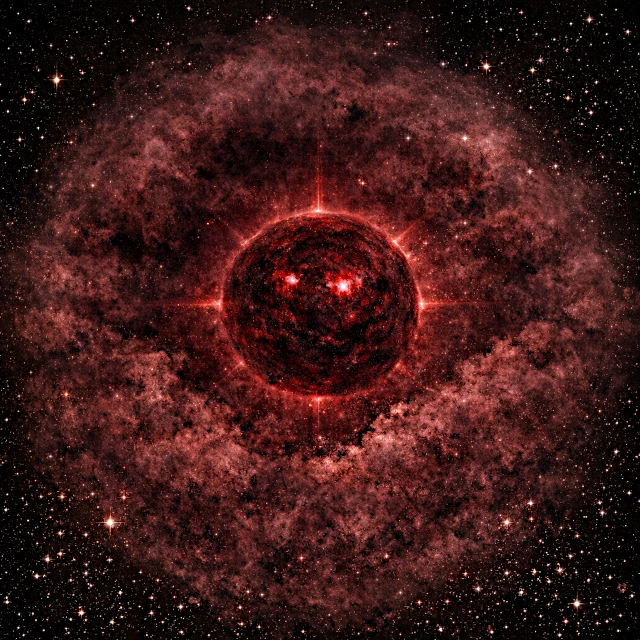
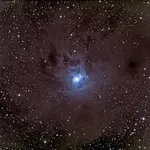
A dying carbon star, wrapped in a thick cocoon of carbon dust and organic molecules.
Its reddish light, filtered by clouds of cosmic soot, illuminates one of the most prolific chemical factories in the Universe.
It is in these stifling atmospheres that the first bricks of interstellar carbon are formed, distant precursors to the chemistry of life.
Image source: astronoo.com (new window)
Scientific Summary
Carbon stars are evolved red giants whose atmospheres contain more carbon than oxygen. This imbalance, resulting from the "dredge-up" of carbon produced by nuclear fusion in the core, transforms their chemistry and color. They are important cosmic factories that synthesize complex organic molecules (HCN, C2H2, polycyclic aromatic hydrocarbons) and produce carbon and silicon carbide dust. These materials, expelled into space, enrich the interstellar medium with the chemical building blocks essential for forming new stars, planets, and potentially the emergence of life.
Why are carbon stars so remarkable?
Because they represent a rare and striking stage of stellar evolution in which carbon produced in the core rises to the surface and alters the star’s atmospheric composition. These bright red stars release carbon‑rich dust into space, contributing to the formation of complex molecules and future generations of stars and planets. They act as cosmic factories forging the building blocks of life.
Also worth exploring
Continue your exploration of the Universe with these topics:
What is a carbon star?
In the vast stellar menagerie, carbon stars occupy a unique place. They are cool giants or supergiants whose atmospheres have more carbon than oxygen. This chemical imbalance, seemingly trivial, completely disrupts the star's composition. When oxygen is dominant, it captures all available carbon to form carbon monoxide (CO). The stellar atmosphere then remains relatively clear. When carbon prevails, free carbon molecules accumulate, giving the star a deep red hue and making it one of the most important sources of organic matter in the cosmos.
Their characteristic ruby color, visible even to the naked eye for some stars like CW Leonis, betrays the presence of pure carbon in the form of microscopic soot. But behind this glowing appearance lies an even more fascinating process: the spontaneous formation of complex organic molecules, the same building blocks that, when assembled, could lead to life.
Carbon stars: a tiny fraction of the total stellar population
Carbon (Z=6) is lighter than oxygen (Z=8). One might therefore expect it to be synthesized in greater quantities and earlier in the star. In this logic, carbon is the exception, oxygen is the rule.
Oxygen dominates because nuclear physics in stellar cores acts as a "carbon trap": as soon as a carbon atom appears, it is immediately transformed into oxygen. Achieving a carbon surplus on the surface (C/O >1) requires very specific conditions of mass, temperature, and timing, making carbon stars quite rare.
| Order | Element | Main reaction |
|---|---|---|
| 1 | Hydrogen → Helium | Proton-proton fusion or CNO cycle |
| 2 | Helium → Carbon | Triple alpha: \( 3\,^{4}\text{He} \rightarrow \,^{12}\text{C} \) |
| 3 | Carbon → Oxygen | Alpha capture: \( ^{12}\text{C} + \,^{4}\text{He} \rightarrow \,^{16}\text{O} \) |
| 4 | Oxygen → Neon, Magnesium... | Successive alpha captures |
The birth of a carbon star
A carbon star is at an advanced evolutionary stage reached by intermediate-mass stars (between about 1 and 8 solar masses) when they become asymptotic giants (or AGB). At this stage, the star has two active fusion shells: a hydrogen shell and a helium shell, both surrounding a degenerate carbon-oxygen core.
These two shells do not burn continuously. The helium shell periodically ignites in violent thermonuclear episodes called thermal pulses. During each pulse, a wave of convection plunges into regions enriched with carbon-12 formed by the triple fusion of helium (triple alpha reaction: \(3\,^4\text{He} \rightarrow\, ^{12}\text{C} + \gamma\)) and brings this carbon to the star's outer layers. This phenomenon is called dredge-up. Over repeated episodes, the C/O ratio in the atmosphere gradually increases. When this ratio exceeds unity, the star officially becomes a carbon star.
The transition is visible: its color turns deep red, sometimes brownish-orange, because C2, CN, and CH molecules preferentially absorb the blue wavelengths of the visible spectrum. These stars are thus among the reddest objects visible to the naked eye, such as the famous R Leporis, nicknamed the "Crimson Star" by astronomer John Russell Hind (1823-1895), who discovered it in 1845.
A chemistry of extraordinary richness
The atmosphere of a carbon star is a chemical laboratory without equal. Under the combined effect of temperature (between 2,000 and 3,500 K on the surface), radiation fields, and convective dynamics, a multitude of molecules form, assemble, and disassemble constantly. Dozens of molecular species are found there, many of which are organic.
- carbon monoxide (CO)
- acetylene (C2H2)
- cyanogen (C2N2)
- hydrogen cyanide (HCN)
- diacetylene (C4H2)
- triacetylene (C6H2)
- cumulenes of type CnH
- polycyclic aromatic hydrocarbon molecules (PAHs).
- amorphous carbon
- graphite
- silicon carbide (SiC)
- nanodiamonds
Once expelled into space, these molecules serve as catalytic surfaces for the formation of new complex molecules in cold interstellar clouds. They have also been found in primitive meteorites, fossilized witnesses of the stellar wind from dead stars long before the birth of the Sun.
Table of Major Carbon Stars
| Name | Constellation | Subtype | Temperature (K) | Period (days) | Notable feature |
|---|---|---|---|---|---|
| R Leporis (Crimson Star) | Hare | C7,6e (Mira) | ~2,290 | ~432 | One of the reddest stars in the sky, with an intense crimson color. |
| W Orionis | Orion | C5,4 (semi-regular) | ~2,850 | ~212 | Bright carbon star, well-studied circumstellar envelope. |
| TX Piscium | Pisces | C7,2 (irregular) | ~3,015 | irregular | Major source of interstellar carbon in the solar neighborhood. |
| CW Leonis | Leo | C9,5 (Mira) | ~2,200 | ~630 | Brightest carbon star in the northern sky in infrared. Giant envelope of 1 light-year. |
| La Superba | Canes Venatici | C7,4 (semi-regular) | ~2,760 | ~158 | Remarkably bright for a carbon star, visible to the naked eye, spectacular color. |
| V Hya | Hydra | C9 (semi-regular) | ~2,650 | ~530 | Losing mass at an exceptional rate, transitioning to a planetary nebula. |
Prebiotic molecules in stellar envelopes?
Carbon stars could seed the Universe with chemical precursors of life. The organic molecules detected in their envelopes (HCN, C2H2, carbon chains) have been found in comets like 67P/Churyumov-Gerasimenko. Silicon carbide (SiC) grains formed in these stars have been identified in primitive meteorites (Murchison, Allende), proving that this matter reaches rocky bodies. Finally, the amino acids present in some carbonaceous meteorites bear the signature of synthesis in carbon-rich environments, compatible with those of AGB stars. Life did not originate in a carbon star, but its organic chemistry owes much of its cosmic origin to them.
From Carbon Dust to Habitable Planets
The grains of amorphous carbon and graphite dust produced by these stars play an essential role in the evolution of galaxies. They form the basis of giant molecular clouds, protect interstellar chemistry from ultraviolet radiation, and provide catalytic surfaces for the formation of molecular hydrogen (H2) and water. Without these cosmic factories, young planetary systems would be much poorer in heavy elements and organic compounds.
Recent simulations, conducted by Lucia Podio's team (1978–) at INAF, show that up to 70% of the carbon dust in early solar systems comes from carbon stars on the asymptotic giant branch.
This means that our own Earth, and probably the prebiotic molecules that led to the emergence of life, contain carbon atoms that once passed through the ruby atmosphere of a carbon giant.
We are literally stardust... of carbon.
Key takeaways: Carbon stars, silent artisans of life
Carbon stars embody the incredible ability of the Universe to generate complexity. Far from the spectacular explosions of supernovae, these discreet red giants patiently weave, over hundreds of thousands of years, the long molecular chains that will become amino acids, sugars, and nucleic bases. Every carbon atom in your DNA has likely traveled through the atmosphere of a carbon star, billions of years ago. In this sense, these cosmic factories are the forgers of our chemical heritage, the silent alchemists who enabled the emergence of life.
FAQ – Carbon Stars
What defines a carbon star?
It has more carbon than oxygen in its atmosphere, altering its color, spectrum, and chemical behavior.
How do carbon stars produce carbon?
Carbon is created through nuclear fusion in the core and then carried to the surface by convective processes.
Why are carbon stars red?
Their carbon‑rich atmospheres absorb blue light strongly, giving them a deep red appearance.
What role do they play in cosmic evolution?
They release carbon‑rich dust into space, contributing to the formation of new stars and planetary systems.
Are carbon stars rare?
Yes, they represent a short evolutionary phase and only a small fraction of red giants become carbon stars.
 Scholz's Star: When a Red Dwarf Grazed the Sun 70,000 Years Ago
  Carbon Stars: Dying Stars that Sow the Seeds of Life
  Magnetars: When a Neutron Star Becomes a Magnetic Bomb
  The Immortals of the Cosmos: When the Universe Goes Dark, They Will Still Shine
  Antikythera Mechanism: The Gears of the Cosmos
  The Stars, Legacy of a Golden Age: Arabic Astronomy
  Stars: Cosmic Forges of Chemical Elements
  Adaptive Optics and Laser Guide Stars
  Habitable Zones: The Sweet Spot for Living Near Stars
  Pulsar: A Beating Stellar Heart
  Giants of the Milky Way: Top of the Most Massive, Largest, and Brightest Stars
  The First Minerals of Stellar Systems
  What is a Collapsar?
  The life of the stars: From the collapse of the nebula to the cataclysmic explosion
  When a Star Dies: Birth of a Black Hole
  Neutron Stars: When Atoms No Longer Exist
  Blue Giant Stars and Red Supergiants: The Fate of Massive Stars
  Gravitational Collapse: Formation and Birth of Stars
  Gamma-Ray Bursts: The Ultimate Sigh of Giant Stars
  White Dwarfs: Stars at the End of Their Life
  Brown Dwarfs: Between Stars and Giant Planets
  The Wind of Stars: Interaction between Light and Cosmic Dust
  Top 50 Brightest Stars in the Sky
  The Cigar Explosion
  Escape velocity of small objects from black holes
  The Death of Stars: How Their Mass Decides Their Final Fate
  Blue, white, yellow, orange stars
  The Pleiades: The Seven Sisters and Hundreds of Stars
  The Star Fomalhaut: The Mouth of the Fish
  Yellow Dwarfs: The Sun and Its Stellar Cousins
  Star Clusters: Jewels of the Deep Sky
  Cepheids: Why Does Their Luminosity Vary So Regularly?
  Betelgeuse: Over 900 Times the Sun, the Star That Will Explode as a Supernova
  Bright Planets, Twinkling Stars: The Art of Recognizing Them
  U Camelopardalis: The Carbon Star Losing Its Envelope
  Red Dwarfs: The Smallest Stars
  V838 Monocerotis: The Star That Lit Up Like a Supernova Without Collapsing
  The Stars Next Door: The Top Closest Stars to the Sun
  Supernova: The Explosion That Shapes the Universe
  Coatlicue, the star at the origin of our Sun