


Magnetars: When a Neutron Star Becomes a Magnetic Bomb
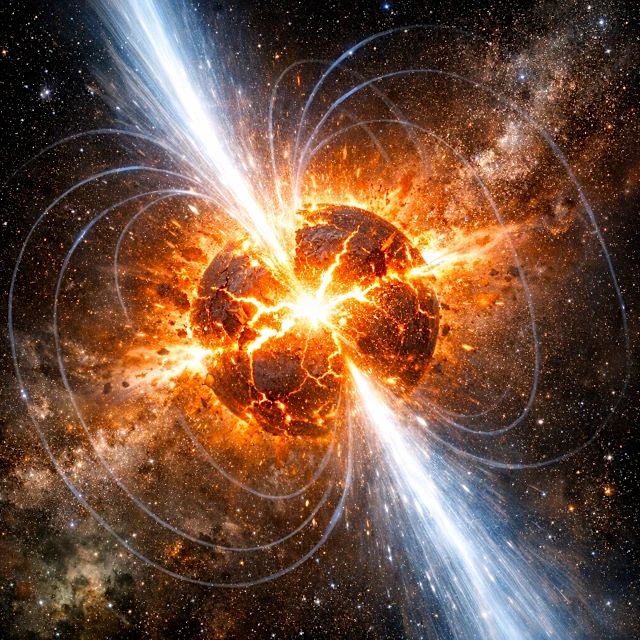
Artist's view of a magnetar in outburst, releasing in a few tenths of a second an energy comparable to that radiated by the Sun over several hundred thousand years.
The stellar crust, deformed by a magnetic field of several hundred billion teslas, fractures in a cosmic earthquake that illuminates the Galaxy with X-rays and gamma rays.
Image source: astronoo.com (new window)
What is a magnetar?
Among all the objects in the Universe, magnetars are undoubtedly some of the most violent. They are neutron stars with a magnetic field so intense that it surpasses that of any other star by several orders of magnitude. A magnetar can reach \(10^{11}\) teslas, about 1.5 quadrillion times the Earth's magnetic field (25 to 65 microteslas, or 0.25 to 0.65 gauss).
At such extreme intensities, the magnetic field is no longer just a physical property. It alters the structure of atomic orbitals, polarizes the quantum vacuum, and, according to quantum electrodynamics, can give the vacuum birefringence, allowing it to deflect light according to its polarization. At such energy levels, the very stability of matter is called into question: atoms stretch into thin cylinders aligned along the field lines, losing all resemblance to their usual configuration.
How is a magnetar born?
The collapse of a massive star
The birth of a magnetar is closely linked to that of neutron stars. When a massive star, with an initial mass of about eight to twenty solar masses, exhausts its nuclear fuel, its core collapses in a fraction of a second. Matter is compressed to extreme densities: a single teaspoon of this matter could weigh nearly a billion tons. From this collapse, a neutron star is born, an object about 20 kilometers in diameter but containing more mass than the Sun.
Why do some neutron stars become magnetars?
However, not all neutron stars become magnetars. A question remains: why do some develop such an intense magnetic field? Two main mechanisms are currently proposed by astrophysicists.
The dynamo effect mechanism
The first relies on the dynamo effect. At the moment of collapse, if the progenitor star's core spins fast enough, the merging matter enters a regime of intense turbulent convection. These movements of conductive matter, combined with rapid rotation, exponentially amplify the initial magnetic field within tens of milliseconds. Simulations conducted by Robert Duncan and Christopher Thompson since 1992 have shown that this process, under certain initial rotation conditions, can generate magnetic fields on the order of \(10^{11}\) teslas, consistent with observations.
The magnetic legacy of the progenitor star
The second, more recent mechanism suggests that the magnetar's exceptional magnetic field may partly originate from the progenitor star. Some massive stars, called Ap magnetic stars, already possess unusually powerful magnetic fields. The conservation of magnetic flux during the core collapse, combined with the drastic reduction in the object's radius (from hundreds of thousands of kilometers to about twenty), would be enough to amplify this initial field by a factor of about \((R_{\text{star}}/R_{\text{neutron}})^2\), or roughly \(10^{10}\).
Bursts and eruptions: the signature of magnetars
It is through their energetic manifestations that magnetars reveal themselves to our instruments. Several types of events are distinguished.
Soft gamma repeaters (SGRs) are brief, recurrent emissions of relatively low-intensity X-rays and gamma rays. They indicate sustained magnetic activity, linked to crustal readjustments or deformations of field lines in the magnetosphere.
Giant eruptions are the most spectacular events. Three have been detected to date in our Galaxy or its immediate neighbors. The most famous, which occurred on December 27, 2004, from SGR 1806-20, was powerful enough to partially ionize the Earth's upper atmosphere from a distance of about 50,000 light-years. Bryan Gaensler (1973-) and his collaborators estimated that this eruption released in 0.2 seconds an energy equivalent to that of the Sun over 250,000 years.
Finally, some magnetars have been associated with fast radio bursts. In 2020, the detection of FRB 200428 from the magnetar SGR 1935+2154, located in our own Galaxy, provided the first direct evidence that magnetars can produce such bursts.
Comparison of neutron stars: pulsars, magnetars, and isolated X-ray stars
Neutron stars come in several forms depending on their magnetic field and rotational activity. The following table compares their main properties.
| Type | Magnetic field (T) | Rotation period | Active lifespan | Example | Particularity |
|---|---|---|---|---|---|
| Radio pulsar(rapidly rotating neutron star emitting regular radio pulses) | \(10^7 - 10^9\) | 1.4 ms to several seconds | 10 to 100 million years | PSR B1919+21 | First pulsar discovered (1967), by Jocelyn Bell Burnell (1943-). |
| Millisecond pulsar(pulsar whose rotation period slows down very slowly, stable over long periods) | \(10^5 - 10^8\) | 1.4 ms to 30 ms | Several billion years | PSR J0437-4715 | Recycled by accretion from a companion star. |
| SGR (Soft Gamma Repeater)(soft Gamma Repeater: neutron star producing repetitive bursts of soft gamma rays) | \(10^{10} - 10^{11}\) | 2 to 12 seconds | 10,000 to 100,000 years | SGR 1806-20 | Giant eruption in 2004, the most energetic ever detected in our Galaxy. |
| AXP (Anomalous X-ray Pulsar)(anomalous X-ray Pulsar: magnetar detected mainly in X-rays without a visible companion) | \(10^{10} - 10^{11}\) | 5 to 12 seconds | 10,000 to 100,000 years | 1E 2259+586 | Emits persistent X-rays without requiring accretion from a companion. |
| INS (Isolated Neutron Star)(isolated Neutron Star: cold neutron star, without detected radio emission) | \(10^9 - 10^{10}\) | 3 to 11 seconds | Several million years | RX J1856.5-3754 | Detectable only in thermal X-rays, without radio or gamma emission. |
N.B.: SGRs and AXPs are now considered two observational manifestations of the same category of objects: magnetars. The historical distinction reflects the initial detection method rather than a fundamental physical difference. Active lifespans are very short on a cosmic scale, as the magnetic field dissipates rapidly, slowing the star until its activity ceases.
 Scholz's Star: When a Red Dwarf Grazed the Sun 70,000 Years Ago
  Carbon Stars: Dying Stars that Sow the Seeds of Life
  Magnetars: When a Neutron Star Becomes a Magnetic Bomb
  The Immortals of the Cosmos: When the Universe Goes Dark, They Will Still Shine
  Antikythera Mechanism: The Gears of the Cosmos
  The Stars, Legacy of a Golden Age: Arabic Astronomy
  Stars: Cosmic Forges of Chemical Elements
  Adaptive Optics and Laser Guide Stars
  Habitable Zones: The Sweet Spot for Living Near Stars
  Pulsar: A Beating Stellar Heart
  Giants of the Milky Way: Top of the Most Massive, Largest, and Brightest Stars
  The First Minerals of Stellar Systems
  What is a Collapsar?
  The life of the stars: From the collapse of the nebula to the cataclysmic explosion
  When a Star Dies: Birth of a Black Hole
  Neutron Stars: When Atoms No Longer Exist
  Blue Giant Stars and Red Supergiants: The Fate of Massive Stars
  Gravitational Collapse: Formation and Birth of Stars
  Gamma-Ray Bursts: The Ultimate Sigh of Giant Stars
  White Dwarfs: Stars at the End of Their Life
  Brown Dwarfs: Between Stars and Giant Planets
  The Wind of Stars: Interaction between Light and Cosmic Dust
  Top 50 Brightest Stars in the Sky
  The Cigar Explosion
  Escape velocity of small objects from black holes
  The Death of Stars: How Their Mass Decides Their Final Fate
  Blue, white, yellow, orange stars
  The Pleiades: The Seven Sisters and Hundreds of Stars
  The Star Fomalhaut: The Mouth of the Fish
  Yellow Dwarfs: The Sun and Its Stellar Cousins
  Star Clusters: Jewels of the Deep Sky
  Cepheids: Why Does Their Luminosity Vary So Regularly?
  Betelgeuse: Over 900 Times the Sun, the Star That Will Explode as a Supernova
  Bright Planets, Twinkling Stars: The Art of Recognizing Them
  U Camelopardalis: The Carbon Star Losing Its Envelope
  Red Dwarfs: The Smallest Stars
  V838 Monocerotis: The Star That Lit Up Like a Supernova Without Collapsing
  The Stars Next Door: The Top Closest Stars to the Sun
  Supernova: The Explosion That Shapes the Universe
  Coatlicue, the star at the origin of our Sun