


The Grand Tour: The Hidden Secrets of the Planets in Our Stellar Neighborhood

The "Grand Tour" is a concept of immersive space exploration.
Floating in the vastness, feeling the Sun's heat on your skin, brushing Saturn's rings, scanning Europa's hidden oceans: this is what the Grand Tour is, a journey experienced with all your senses.
Image source: astronoo.com (new window)
Scientific Summary
This article offers a complete immersion in the Solar System, exploring the planets, their moons, and the mysteries surrounding them. From the Sun to the Kuiper Belt, the article deciphers the latest discoveries and the challenges of space exploration in 2026. The "Grand Tour" is a scientific odyssey that combines astrophysics, planetology, and space engineering. We discuss iconic missions (Voyager, Cassini, Juno, Juice), spectacular phenomena (Jupiter's auroras, Enceladus' geysers, Saturn's hexagonal storms), and the prospects for human exploration. The article highlights the diversity of worlds that populate our Solar System and the technological advancements that allow us to study them.
Why is the "Grand Tour" a Captivating Scientific Adventure?
The "Grand Tour" is much more than a simple space journey. It is a scientific adventure that allows us to understand the origins and evolution of our Solar System. In 2026, space exploration is at a turning point: robotic missions like Juice (JUpiter ICy moons Explorer) and Europa Clipper promise major discoveries about Jupiter's icy moons, while space telescopes like James-Webb offer unprecedented views of gas giants and dwarf planets.
This immersive journey takes you to discover the planets, their atmospheres, their rings, and their moons. Each world reveals secrets about the formation of the Solar System, the conditions for the emergence of life, and extreme physical phenomena. The "Grand Tour" is an invitation to explore our cosmic neighborhood, to understand our place in the Universe, and to dream of future interplanetary travels.
Also worth exploring
Continue your exploration of the Universe with these topics:
The Sun: Standing Before the King of Fire
Facing a Colossal Furnace
Floating a few million kilometers from the Sun, you stand before a furnace so colossal it defies imagination. Before you, a sphere of fire 1.4 million kilometers in diameter—large enough to swallow more than a million Earths. The light that hits you didn't take eight minutes to travel; it's here now, dazzling, so intense it bleaches the space around it.
An Ocean of Incandescent Plasma
You cannot look directly at the Sun, but you feel its burning presence filtering through your spacesuit. A radiative heat passes through you, as if your suit vibrates under the star's pressure. The surface bubbling before your eyes is not solid: it's an ocean of incandescent plasma, stirred by gigantic convections, each granulation cell the size of a country. Here, the temperature reaches 5,500 °C, enough to vaporize any metal in an instant.
The Burning Mystery of the Corona
But the true mystery lies above. If you could look up at the corona, that fine halo that encircles the Sun, you would see a fascinating paradox: while the surface is at 5,500 °C, the corona reaches several million degrees. A phenomenon that astrophysicists still struggle to explain, but which you feel here, in this vastness, like a vibrant and electric presence.
The Sun in 2026: A Star in Full Activity
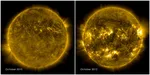
Right now, it is 2026, and the Sun is in a phase of moderate activity. The last maximum of Solar Cycle 25 was reached in October 2024, with a smoothed monthly sunspot number of 161 according to SIDC/SILSO. These spots, cooler than the rest of the surface, are areas where the magnetic field pierces the photosphere, creating storms that shake the entire Solar System.
The Dance of Solar Flares
Suddenly, you see it: a solar flare. A tongue of plasma hundreds of thousands of kilometers long erupts from the surface, dancing in space before falling back, as if the star itself were breathing. Billions of tons of matter are ejected, loaded with particles that will travel through interplanetary space at breakneck speeds, striking planets, satellites, perhaps even electrical grids on a small blue planet, far away, lost in the vastness.
The Engine of the Solar System
You understand, here, that the Sun is not just a distant star. It is the ceaseless engine of the System, the heartbeat of our cosmic neighborhood. Its light shapes the atmospheres of the planets, dictates their seasons, powers the solar winds that sweep everything in their path. Missions like Parker Solar Probe and Solar Orbiter dare to venture closer to this furnace to uncover its secrets, to understand how this ultimately ordinary star reigns as master over our world, which it will swallow in a few billion years, when its core, exhausted, swells into a red giant.
Facing the Incandescent Giant
You stay there, weightless, facing this incandescent giant. You feel your existence shrink to a point, tiny, but strangely soothing. The silence is absolute, but the Sun speaks: through its light, its heat, through this overwhelming presence that reminds you that you are but a grain of dust, dancing in the light of a star.
A Visual Journey Through the Solar System — NASA
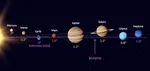
Before continuing your journey to the worlds of rock and metal, take a moment to embrace the vastness of the Solar System at a glance. Here is a visual overview, a true Grand Tour in fast-forward, that takes you from the flames of the Sun to the icy outskirts of Neptune.
The Terrestrial Planets: Worlds of Rock and Metal
As you gently move away from the Sun, the space around you grows darker, less scorching. You approach the worlds of rock and metal, the terrestrial planets. Each is a world in its own right, with its own history, geology, and atmosphere. The Sun's light, already less blinding, illuminates surfaces scarred by billions of years of cosmic bombardments.
Mercury: The Scorched World at the Edge of Fire
You float above Mercury, the smallest of the planets, just 58 million kilometers from the Sun. Here, the heat is stifling: during the day, the temperature rises to 430 °C, enough to melt lead. But at night, as you plunge into darkness, it drops to -180 °C. The cold of space clings to your back, a brutal contrast with the furnace burning your face. A 600-degree contrast, a violent thermal shock that cracks the surface, making it more fractured than a forgotten desert.
Beneath your feet, the ground is an ancient battlefield. Impact craters, some over 1,500 kilometers wide, pockmark the gray crust. The largest, the Caloris Basin, is a gaping scar, a testament to a cataclysm that shook the planet billions of years ago. Yet, in the deep shadows of the polar craters, water ice persists, shielded from the Sun, a secret that the BepiColombo mission (in orbit in 2026) is striving to uncover.
You observe this planet, slowed by the Sun's gravity, like a world that has seen too much, endured too much, but still keeps its mysteries well hidden beneath its stony skin.
Venus: Hell at the Gates of Paradise
Your spacecraft glides toward Venus, a world of pure white, shrouded in a veil of sulfuric acid clouds. It is called Earth's "twin sister," but as soon as you pierce its cloud layer, you understand the deception. The atmospheric pressure is 92 times greater than Earth's, equivalent to diving nearly a kilometer beneath the oceans. The average temperature? 460 °C, enough to liquefy lead and deform metals.
You cannot see the surface, but you feel it: a scorching ground, dotted with volcanoes, lava flows, and basalt plains. The atmosphere is so dense you could almost touch it. It is filled with carbon dioxide, trapping heat in an uncontrolled greenhouse effect, a harsh lesson for a humanity that watches with concern from Earth.
In 2026, the VERITAS (NASA) and EnVision (ESA) missions are in preparation, ready to probe this hostile world. But here, now, you do not want to linger. Venus is beautiful, fascinating, but it breathes death. You resume your journey, happy to float in the silent vastness of space.
Earth: The Blue Pearl, a Sanctuary in the Vastness
You leave the sulfurous hell of Venus, and your spacecraft glides silently through space. Then, around an orbit, it appears. Earth. A blue and white pearl, suspended in the icy darkness, like a fragile jewel placed on a black velvet case. You hold your breath: Earth, round and luminous, briefly evokes an intimate shape, almost uterine, as if space were returning the image of your own birth. Everything seems both familiar and alien, like a dream whose outlines you recognize without understanding its origin.
From here, hundreds of thousands of kilometers away, it seems so peaceful, so vulnerable. The oceans, which cover more than 70% of its surface, shimmer with a deep blue, reflecting the light of a now gentler Sun. White clouds, like silk sails, dance above the continents, swirling in majestic spirals under the effect of atmospheric currents. You glimpse coasts, ochre deserts, emerald forests, and dazzling white ice caps.
You know what lies beneath these clouds. Billions of living beings. Forests that breathe. Oceans teeming with life. Cities that shine at night like constellations fallen to Earth. Here, water flows in rivers, lakes, and seas. Here, a protective atmosphere, thin as a glass film, shelters all that lives.
Earth is a sanctuary, an oasis in the cosmic desert. You contemplate this planet, the only one we know capable of harboring life, and you become aware of its rarity, its beauty, its fragility. It rotates slowly on its axis, majestic, indifferent to the dramas unfolding on its surface, but you, you know. You know that this blue pearl is unique, and that every day, humanity is both its guardian and its gravedigger.
In 2026, hundreds of satellites orbit around it, scanning its atmosphere, oceans, ice, and forests. The International Space Station (ISS) is still inhabited, an outpost of humanity in the void, where astronauts of all nationalities live and work, orbiting Earth every 90 minutes. Missions like Plankton, Aerosol, Cloud, ocean Ecosystem (PACE) (NASA) and EarthCARE (ESA/JAXA) monitor the health of our planet, tracking climate change, pollution, and ice melt.
But from orbit, Earth does not seem sick. It is beautiful, serene, like a sleeping goddess. You float above the atmosphere, the protective layer so thin it could fit in an eggshell, and you realize that all of human history, all joy, all pain, all dreams and wars, have unfolded on this thin blue film.
You stay there, weightless, watching this wonder turn in silence, and you tell yourself that the Grand Tour is not just a journey to other worlds. It is also a journey to return to it, to see it as it truly is: our home, the only one we have.
Then, with regret, you look away. Mars awaits. But Earth, Earth remains etched in your heart, a blue light in the black vastness.
Mars: The Red Planet, a Memory of Life
You finally arrive before Mars. The red planet shines in the darkness, its ochres and rusts evoking an ancient world, a world that may once have been similar to Earth. Here, the Sun's light is gentle, the heat is bearable. You fly over giant canyons, the Valles Marineris as long as the United States, and dormant volcanoes, like Olympus Mons, the largest in the entire Solar System, three times taller than Everest.
Below, robots roam the surface. The Perseverance rover, with its Ingenuity helicopter, searches for traces of ancient life. Near the poles, white ice caps glisten, remnants of the water that once flowed across these arid lands. And beneath the surface, deposits of ice, perhaps even brines, offer hope for a future human colony.
The Mars Sample Return mission, a collaboration between NASA and ESA, plans to bring Martian soil samples back to Earth by 2031. As you float, you imagine these samples, fragments of this red world, about to reveal their secrets. Mars is not dead; it sleeps, and humanity is about to awaken it.
The Gas Giants: The Kings of the Solar System
You pass the asteroid belt, a sea of wandering rocks, and the landscape changes. The worlds become more imposing, more massive, wrapped in thick, colorful atmospheres. The gas giants welcome you with their immense sizes and cold beauty.
Jupiter: The Colossus with Auroras
You approach Jupiter, and you are struck by its immensity. It is a giant that could contain more than 1,300 Earths. Its cloud bands—red, brown, white, orange—twist and swirl like winds. And the Great Red Spot, an anticyclonic storm twice the size of our planet, seems to watch you, a fiery eye in an ocean of clouds.
In 2026, the Juno probe is still in orbit, diving repeatedly into Jupiter's atmosphere to probe its depths. It has revealed that its inner layers are more complex than imagined, with a diluted, blurry core, like a drop of ink falling into water.
But what fascinates you are the auroras. Polar lights, vast as continents, dance at the poles, powered by the planet's powerful magnetic field, the strongest in the Solar System. Jupiter's moons await you: Ganymede, larger than Mercury; Callisto, covered in craters; and above all, Europa, whose icy surface hides a salty ocean, perhaps conducive to life. The Juice and Europa Clipper missions, en route in 2026, promise to explore these hidden worlds, plunging their gaze into the icy abyss to search for signs of life.
Saturn: The Lord of the Rings
Saturn appears, and its ring system takes your breath away. Billions of particles of ice and rock, some microscopic, others as large as mountains, orbit the planet, stretching over more than 280,000 kilometers. You approach, and you can almost hear the silence of the thousands of fragments gliding in orbit, a silent and eternal ballet.
The moon Titan attracts you. With its dense, orange atmosphere, charged with nitrogen and methane, it harbors lakes, rivers, and seas of liquid hydrocarbons. A strange world, one of the most promising for the search for prebiotic chemistry. In 2026, the Dragonfly drone (NASA) is on its way, ready to land on Titan and explore its surface in search of these chemical signatures.
And then there is Enceladus. A small icy moon, but with astonishing activity. Geysers eject plumes of salty water and organic particles hundreds of kilometers into space, feeding Saturn's E ring. As you fly over Enceladus, you realize that space is not a graveyard; it is an ocean of potential life, sleeping beneath icy worlds.
Distant Worlds: Uranus, Neptune, and the Kuiper Belt
You leave Saturn and plunge into darkness. The Sun's light is now a mere glimmer, a bright point at the bottom of the vastness. The worlds here are icy, silent, almost forgotten. You approach Uranus, which spins on its side, like a drunken top, its blue-green atmosphere tinged with methane.
Further away, Neptune, the god of the seas, awaits you with the strongest winds in the Solar System, exceeding 2,000 km/h. A probe, Voyager 2, flew over these worlds in the 1980s, and since then, they have remained in the shadows. But in 2026, astronomers are scrutinizing these ice giants, tracking the mysteries of their interiors, rings, and amazing moons like Triton, which orbits in the opposite direction.
Beyond lies the Kuiper Belt, a field of icy debris, remnants of the Solar System's birth. The New Horizons probe flew over Pluto in 2015, revealing a complex world with mountains of water ice and a thin atmosphere. These distant worlds whisper that our Solar System does not end there. They are the gateway to an elsewhere immensely vaster.
Summary Table of the Worlds of the Solar System
| Planet | Type | Diameter (km) | Distance from the Sun (AU) | Immersive Feature |
|---|---|---|---|---|
| Mercury | Terrestrial | 4,879 | 0.39 | A world scorched and frozen, where light hits you like a hammer and night swallows you in one go. |
| Venus | Terrestrial | 12,104 | 0.72 | A veiled planet, beautiful and deadly, whose atmosphere crushes everything like a sea of molten lead. |
| Earth | Terrestrial | 12,756 | 1.00 | A living pearl, fragile and luminous, which echoes the intimate memory of your own origin. |
| Mars | Terrestrial | 6,792 | 1.52 | A red desert where an ancient wind blows, as if the planet whispers memories of lost water. |
| Jupiter | Gas | 142,984 | 5.20 | A colossus of storms, whose red eye watches you like an angry deity. |
| Saturn | Gas | 120,536 | 9.54 | A lord ringed with ice, where each fragment sparkles like a shard of eternity. |
| Uranus | Ice | 51,118 | 19.19 | A turquoise sphere lying on its side, rotating slowly like a strange and distant dream. |
| Neptune | Ice | 49,528 | 30.07 | A deep blue world where the fastest winds in the Solar System howl, like a furious ocean. |
- Sources:
- • NASA Solar System Exploration, https://solarsystem.nasa.gov/ (new window)
- • ESA Science & Technology, https://www.esa.int/Science_Exploration (new window).
The Grand Tour: An Adventure Within Everyone's Reach
The "Grand Tour" is not just a dream for scientists. Thanks to technological advancements, the general public can now explore the Solar System from their screens. Virtual reality (VR) applications allow you to walk on Mars or fly over Saturn's rings. Connected telescopes and citizen science platforms, like Zooniverse (new window), invite the public to participate in research projects, such as identifying craters or analyzing astronomical images.
The "Grand Tour" is an invitation to dream big
In 2026, space exploration is a collective adventure. Space agencies, researchers, and the general public are united in the quest for knowledge about our Solar System.
FAQ: Everything You Need to Know About the Grand Tour of the Solar System
What is the "Grand Tour" of the Solar System?
The "Grand Tour" is not just a scientific itinerary: it is a poetic journey through our cosmic neighborhood. Originally, it referred to a rare configuration where the gas giants align, allowing a single probe to visit them one after another. This is how Voyager, in 1977, was able to fly over Jupiter, Saturn, Uranus, and Neptune, opening a window to worlds no one had ever seen. Today, the "Grand Tour" symbolizes the idea of a total journey, a panoramic look at the worlds orbiting the Sun.
Why is 2026 an important year for space exploration?
In 2026, humanity is exploring more worlds than at any other time in its history. Probes are crisscrossing the gas giants, robots are traversing Mars, and ambitious missions are preparing to probe icy moons. The Juice (ESA) and Europa Clipper (NASA) missions are en route to Jupiter, ready to uncover the secrets of its subterranean oceans. The Dragonfly drone is preparing to soar over Titan's orange dunes. On Mars, Perseverance continues to search for traces of ancient life, while BepiColombo approaches Mercury, a scorched world at the gates of the Sun. And beyond, the James-Webb telescope scans the far reaches of the cosmos, revealing galaxies born before Earth itself.
Why are icy moons so fascinating to scientists?
Because they may be the most promising places to find life beyond Earth. Beneath the ice of Europa (Jupiter) and Enceladus (Saturn), entire oceans stretch in the darkness, heated by tidal forces. Geysers erupt into space, spewing salty water and organic molecules. These worlds are like natural laboratories, where the chemistry of life may have begun in the depths of the abyss. Exploring them may bring us closer to answering one of humanity's oldest questions: Are we alone?
Can you really "experience" a Grand Tour from Earth?
Yes, more than ever. Thanks to virtual reality, you can walk on Mars, float above Saturn's rings, or fly over Pluto's plains. Connected telescopes allow you to observe the planets in real time, and platforms like Zooniverse invite everyone to participate in scientific research. The Grand Tour is no longer reserved for probes: it has become an adventure accessible to all, an inner journey as much as a space journey.
Why does the Grand Tour touch us so deeply?
Because it tells our story. Each planet, each moon, each speck of cosmic dust is a fragment of our origin. Exploring the Solar System is like traveling back in time, understanding how Earth was born, how life appeared, and where we might go tomorrow. The Grand Tour is not just a scientific journey: it is a way of looking at our place in the Universe, with humility, wonder, and a touch of vertigo.
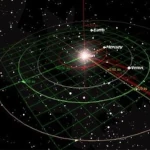 Stability and Chaos: Limits of the Solar System’s Orbital Harmony
 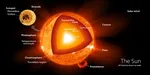 Where Does the Sun's Energy Come From?
  The Grand Tour: The Hidden Secrets of the Planets in Our Stellar Neighborhood
  The Sounds of Space: When Data Sings
  The Three-Body Problem: Three Celestial Bodies, One Law, Infinite Destinies
 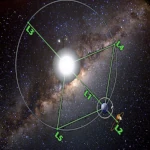 Lagrange Points: The Illusion of Stable Gravitational Oases
  Nemesis: The Theory of the Sun's Companion Star
  Solar System vs. Stellar Systems: A Comparison of Planetary Systems
  The Faint Young Sun Paradox: Why Wasn't Early Earth Frozen?
 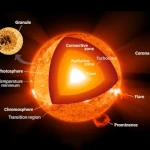 The Sun: 380 billion billion megawatts, far more than life needs
  The Ecliptic or the Apparent Orbit of the Sun
  Solar maximum and minimum
  The Sun: When the Yellow Star Turns Blue
  Understanding the Sun's Figure-8 Curve: The Analemma Explained
 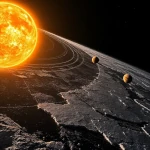 Frost Line: The Boundary That Shaped the Planets
 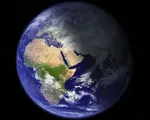 Tourist trip in the solar system
 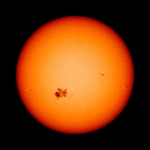 Sunspots and the Solar Cycle: From Minimum to Maximum
  The infernal journey of the photon or random walk
  Dynamics of Solar Cycles and Physical Mechanisms of Solar Flares
  Birth, Life and Death of the Sun: Chronicle of an Average Star
  Grains of Baily or pearls of light
  Sunlight and wavelengths
  The chaotic formation of the solar system
  Solar Storms and Catastrophic Scenarios
  Solar Prominences: Filaments of Matter in the Solar Atmosphere
  Why Does the Sun Rotate So Slowly? The Mystery of the Missing Angular Momentum
  Solar Winds: A Key Phenomenon of Interplanetary Space
  Heliosphere: At the Borders of the Solar System
  Chaos and sensitivity to initial conditions