


The Sounds of Space: When Data Sings
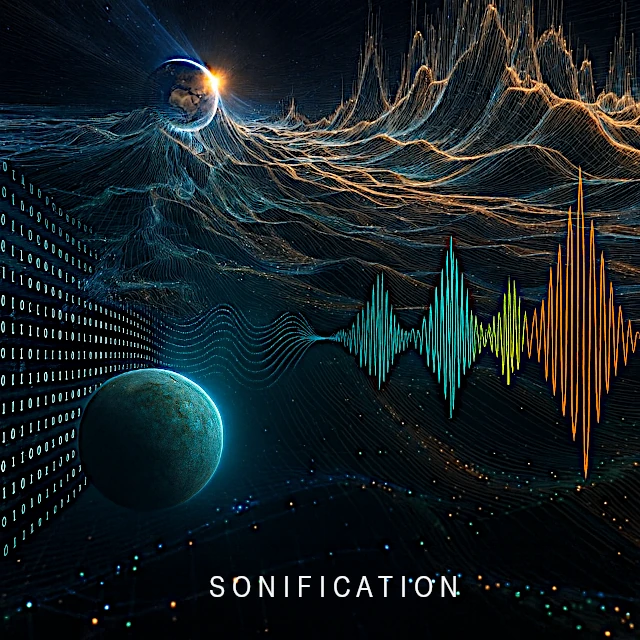
Illustration showing waves of data, radio waves, and magnetic field lines emanating from a planet and a star, gradually transforming into audible sound waveforms.
Image source: astronoo.com (new window) — AI-generated image, public domain.
Scientific Summary
Contrary to popular belief, space is not silent. It is filled with electromagnetic waves, plasma vibrations, and magnetic fields. Through a process called sonification, scientists transpose these signals (often at inaudible frequencies) into the audible spectrum. One can thus "hear" the humming of the Sun, the whistling of Jupiter's auroras, the "song" of Saturn's rings, the metronomic beating of a pulsar, the lowest note ever detected in the Universe at the heart of the Perseus cluster, or even the ascending "glissando" of the merger of two black holes. This approach constitutes a powerful analysis tool and a sensory bridge to the cosmos, particularly for visually impaired people.
What are these "sounds" that can be heard in space?
Contrary to popular belief, space is not silent. It is filled with electromagnetic waves, plasma vibrations, and magnetic fields. Through a process called sonification, scientists transpose these signals (often at inaudible frequencies) into the audible spectrum. One can thus "hear" the humming of the Sun, the whistling of Jupiter's auroras, the "song" of Saturn's rings, the metronomic beating of a pulsar, or even the ascending "glissando" of the merger of two black holes.
Also worth exploring
Continue your exploration of the Universe with these topics:
Also Discover
Continue your exploration of the Universe with these topics:
The Myth of Eternal Silence
A cosmos far from silent
Contrary to the popular belief popularized by the film "Alien": "In space, no one can hear you scream", the cosmos is far from silent. The interstellar void certainly prevents the propagation of mechanical sound waves as we know them, but the universe is filled with another type of "noise": a rich and vibrant electromagnetic landscape.
Sonification: revealing the hidden symphony
Since the mid-20th century, scientists have been capturing these signals using radio telescopes and space probes. These are not direct sounds, but data that, once converted by a process called sonification (transformation of non-auditory data into sound signals, allowing auditory perception of information.), reveal the hidden symphony of our solar system and beyond. This practice transforms variations in radio waves, plasma, or magnetic fields into signals audible to the human ear.
Sonification: Translating the Invisible into the Audible
A data analysis technique
Sonification is a data analysis technique that assigns sound parameters (pitch, volume, timbre) to numerical variables. In astrophysics, it allows one to "listen" to phenomena that are otherwise imperceptible. For example, the frequency of a radio wave can be transposed into the audible spectrum (generally between 20 Hz and 20 kHz), while its intensity modulates the volume.
A powerful analysis tool
This method is not merely an artistic curiosity; it constitutes a powerful analysis tool, capable of revealing patterns or anomalies in vast data sets that the human eye could easily overlook. The human ear is indeed very sensitive to rhythms, repetitions, and subtle changes in amplitude. Sonification is not a source of physical truth, but an excellent revealer of structure.
N.B.:
The original sounds of space are electromagnetic signals or vibrations in plasmas, often at frequencies well below or above our hearing range.
Sonification operates a transposition into our audible range, just as a piano transposes a score written for double bass. It is therefore not a direct recording, but a faithful translation of the dynamics of the phenomenon.
The Soundtrack of the Cosmos
The following table presents a representative sample of the "sounds" of space, derived from the sonification of scientific data. It illustrates the diversity of sources and acoustic signatures across our solar system and beyond.
| Celestial body / Phenomenon | Source of the "sound" | Sound characteristics after sonification | Probe / Main mission |
|---|---|---|---|
| Sun (oscillations & eruptions) | Internal pressure waves, radio and UV emissions from solar flares and the solar wind. | Deep fundamental humming, rumbling, intense crackling and "clicks" of eruptions. | SOHO, SDO (NASA/ESA), Parker Solar Probe, Solar Orbiter (ESA) |
| Mercury (magnetosphere & flybys) | Interactions of the solar wind with the residual magnetic field and the surface; probe telemetry during flybys. | Dry "claps" and short whistles, reflecting a small and turbulent magnetosphere. | MESSENGER (NASA), BepiColombo (ESA/JAXA) |
| Venus (atmospheric interaction) | Braking of the solar wind by the dense ionosphere (without a global magnetic field). | Continuous "breathing" noise and low-frequency pulsations, evoking a strong wind against an obstacle. | Venus Express (ESA), Akatsuki (JAXA) |
| Earth (magnetosphere) | Plasma waves in the Van Allen belts (chorus, whistlers). | Electronic chirping (chorus), clear descending whistles (whistlers). | Cluster (ESA), Van Allen Probes (NASA) |
| Mars (atmospheric dynamics) | Winds, dust devils, and Sun-atmosphere interactions captured *in situ*. | Harsh winds, sudden gusts, crackling of dust grains on the rover. | InSight, Perseverance (NASA) |
| Jupiter (auroras & magnetosphere) | Decametric radio emissions from the auroras and interactions with the satellite Io. | Piercing whistles, rapid clicks, intense and regular electrical humming. | Voyager, Galileo, Juno (NASA) |
| Saturn (rings & magnetosphere) | Saturn Kilometric Radiation (SKR), plasma-ring interactions. | Melodic modulations, crackling, "song" of the rings, pulsed signals. | Voyager, Cassini-Huygens (NASA/ESA/ASI) |
| Enceladus (plumes) | Particle and magnetic field data during Cassini's flyby of the ice plumes. | Dense crackling and humming, evoking the noise of particles hitting a detector. | Cassini (NASA/ESA/ASI) |
| Pulsar (rotation) | Extremely regular radio pulses emitted by the rotating neutron star. | Perfect metronomic "beat", a rapid and periodic cosmic "tick-tock". | Radio telescopes (e.g., Arecibo, FAST) |
| Perseus Cluster (central black hole) | Pressure waves emitted by the supermassive black hole, propagating through the cluster's hot gas. | The lowest note ever detected in the Universe: a B-flat, about 57 octaves below middle C, transposed to become audible. | Chandra X-ray Observatory (NASA) |
| Black hole (mergers & environment) | 1) Gravitational waves from merger. 2) X-ray emissions from accreting gas (disk) and jets. | 1) Ascending "glissando" followed by a "shock". 2) High-energy "rumblings" and "clicks", harp and chime notes depending on the source. | LIGO/Virgo (grav. waves), Chandra, Webb, IXPE (X-rays and infrared) |
Case Study: The Lowest Note in the Universe
Detection of pressure waves in the Perseus cluster
Among all the sonifications made to date, that of the Perseus galaxy cluster occupies a special place. In 2003, astronomers using the Chandra X-ray Observatory detected something extraordinary: pressure waves emitted by the supermassive black hole at the center of the cluster, which created measurable ripples in the immense reservoir of surrounding hot gas. Unlike interstellar space, which is almost empty, a galaxy cluster contains enough gas to allow a genuine acoustic wave to propagate through it.
Sonification: from the sub-bass B-flat to the audible
Translated into a musical note, this wave corresponds to a B-flat located about 57 octaves below middle C on the piano, a sound far too low for the human ear, whose lower limit is around 20 Hz. During its sonification, published by NASA and the Chandra Center, this signal was transposed upward by 57 to 58 octaves, i.e., a multiplication of its frequency by about 144 to 288 thousand trillion, to finally become audible. The result, a deep and haunting rumble, has since been used in several documentaries and has reached several million listens on NASA's networks.
A mechanism of galactic regulation
Beyond its spectacular nature, this discovery has real scientific significance: these pressure waves would partly heat the cluster's gas, slowing its cooling and therefore the formation of new stars within it, a regulation mechanism still being studied by astrophysicists.
2025: A New Sonic Trilogy for Black Holes
An unprecedented sonic trilogy
In May 2025, NASA published a new series of three sonifications devoted to different stages in the life of black holes, combining for the first time data from several observatories: Chandra (X-rays), the James Webb Space Telescope (infrared), and IXPE, dedicated to X-ray polarization.
Three pieces, three environments
The first piece features WR124, a massive and very short-lived Wolf-Rayet star, about 28,000 light-years away, likely to one day collapse into a black hole: its core is translated into harp sounds, the surrounding nebula into flutes, and the background stars into chimes. The second explores SS 433, a binary system about 18,000 light-years away where a Sun-like star orbits a neutron star or a black hole, whose orbital dance is rendered by a rhythmic pulsation. The third, finally, is devoted to the galaxy Centaurus A, about 12 million light-years away, whose central black hole projects a jet of particles crossing the entire galaxy, sonified into wind chimes and strings.
A diversity of environments revealed
This triptych illustrates the diversity of environments where black holes form, evolve, and interact with their surroundings, from the simple promise of a stellar collapse to the high-energy extragalactic jet.
Beyond Science: A Sensory Bridge to the Cosmos
An accessibility and educational tool
This auditory approach to astrophysics has implications that go beyond pure research. For visually impaired people, it offers a unique way to grasp cosmic concepts and data. It is also a powerful educational tool, making tangible abstract phenomena such as magnetic fields or plasma interactions.
A bridge between science and art
Composers and sound artists now collaborate with space agencies such as NASA and ESA to create works from this data, building a bridge between science and art. ESA thus launched in 2026 "Expedition Sound", a series of podcasts that takes the listener on a journey from the Sun to the confines of the Universe through sonifications of its missions (Solar Orbiter, BepiColombo, Gaia, Euclid), systematically giving a voice to visually impaired researchers on what listening to the data brings them.
References
- NASA Science — Data Sonifications: Black Holes (Perseus & M87, 2022) (new window)
- Chandra X-ray Center — A Universe of Sound: Perseus Cluster Sonification (new window)
- NASA — NASA Telescopes Tune Into a Black Hole Prelude, Fugue (May 2025) (new window)
- NASA — 'Listen' to the Light Echoes From a Black Hole (V404 Cygni) (new window)
- LIGO Caltech — The Sound of Two Black Holes Colliding (new window)
- NASA Science — Sonifications (Hubble, Chandra, Webb) (new window)
- ESA — Expedition Sound podcast series (new window)
FAQ: Everything You Need to Know About the Sounds of Space and Sonification
Is space really silent? Why is this popular belief false?
The idea that space is silent comes from the fact that mechanical sound waves (as in air) cannot propagate in the interstellar void. However, space is filled with other types of signals: electromagnetic waves (radio, X), vibrations in plasmas, and variations in magnetic fields. These signals, although inaudible to the human ear, exist and can be converted into sounds. In rare cases, such as within a galaxy cluster filled with hot gas, genuine acoustic waves can even propagate.
What is "sonification" of cosmic data?
Sonification is a technique that consists of transposing numerical data into sounds. In astrophysics, sound parameters (pitch, volume, timbre) are assigned to physical variables such as the frequency of a radio wave or the intensity of a magnetic field. The invisible and inaudible are thus "translated" into an audible "symphony". It is a powerful analysis tool, because the human ear is very sensitive to patterns and anomalies, and it is also a sensory bridge to the cosmos, particularly for visually impaired people.
What are the most famous or characteristic "sounds" of space?
The "soundtrack" of the cosmos is very varied: one can mention the deep humming of the Sun (its oscillations), the whistling of Jupiter's auroras, the melodic "song" of Saturn's rings, the electronic chirping (chorus) of Earth's magnetosphere, the metronomic beating of a pulsar (rotating neutron star), the lowest note ever detected at the heart of the Perseus cluster, or even the ascending "glissando" followed by a "shock" produced by the merger of two black holes (gravitational waves).
 Stability and Chaos: Limits of the Solar System’s Orbital Harmony
  Where Does the Sun's Energy Come From?
  The Grand Tour: The Hidden Secrets of the Planets in Our Stellar Neighborhood
  The Sounds of Space: When Data Sings
 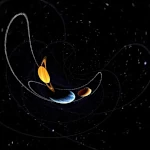 The Three-Body Problem: Three Celestial Bodies, One Law, Infinite Destinies
 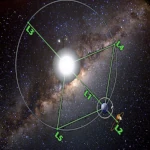 Lagrange Points: The Illusion of Stable Gravitational Oases
  Nemesis: The Theory of the Sun's Companion Star
 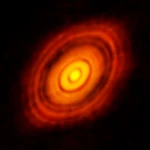 Solar System vs. Stellar Systems: A Comparison of Planetary Systems
  The Faint Young Sun Paradox: Why Wasn't Early Earth Frozen?
  The Sun: 380 billion billion megawatts, far more than life needs
  The Ecliptic or the Apparent Orbit of the Sun
  Solar maximum and minimum
  The Sun: When the Yellow Star Turns Blue
  Understanding the Sun's Figure-8 Curve: The Analemma Explained
  Frost Line: The Boundary That Shaped the Planets
  Tourist trip in the solar system
  Sunspots and the Solar Cycle: From Minimum to Maximum
  The infernal journey of the photon or random walk
  Dynamics of Solar Cycles and Physical Mechanisms of Solar Flares
  Birth, Life and Death of the Sun: Chronicle of an Average Star
  Grains of Baily or pearls of light
  Sunlight and wavelengths
  The chaotic formation of the solar system
  Solar Storms and Catastrophic Scenarios
  Solar Prominences: Filaments of Matter in the Solar Atmosphere
  Why Does the Sun Rotate So Slowly? The Mystery of the Missing Angular Momentum
  Solar Winds: A Key Phenomenon of Interplanetary Space
  Heliosphere: At the Borders of the Solar System
  Chaos and sensitivity to initial conditions