


The Three-Body Problem: Three Celestial Bodies, One Law, Infinite Destinies
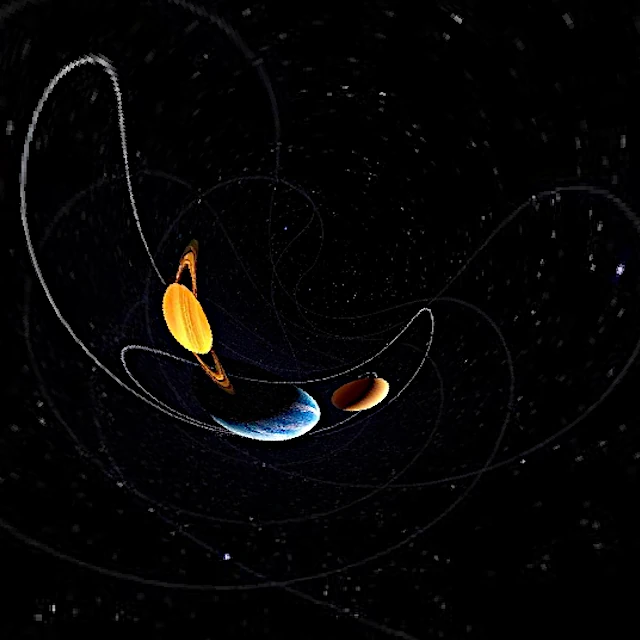
Artistic representation of three celestial bodies bound by their mutual gravitational attraction, illustrating the unpredictable orbit characteristic of the three-body problem.
Image source:
astronoo.com (new window)
Scientific Summary
The article explains why there is no general and exact mathematical solution to predict the motion of three celestial bodies interacting gravitationally (such as the Sun, Earth, and Moon). This impossibility stems from deterministic chaos: trajectories are so sensitive to initial conditions that an infinitesimal variation leads to radically different fates (ejection, collision, stable orbits). Henri Poincaré demonstrated this impossibility in the 19th century, laying the foundations of chaos theory. Our solar system remains stable thanks to "constants of motion" (energy, angular momentum) that act as safeguards, the hierarchy of masses, and the KAM theorem which preserves islands of stability, confining chaos within a dynamic attraction basin.
What is the three-body problem and why is it impossible to solve analytically?
The three-body problem asks whether we can predict the future motion of three celestial bodies (like the Sun, Earth, and Moon) using only the law of universal gravitation. The answer is no: there is no general, exact mathematical solution in the form of simple equations. This impossibility stems from deterministic chaos: trajectories are so sensitive to initial conditions that an infinitesimal variation leads to radically different fates (ejection, collision, etc.). Henri Poincaré demonstrated this impossibility in the 19th century, laying the foundations of chaos theory. Our solar system remains stable thanks to "constants of motion" (energy, angular momentum) acting as safeguards, mass hierarchy, and the KAM theorem preserving islands of stability.
Also worth exploring
Continue your exploration of the Universe with these topics:
The Fundamental Enigma of Celestial Mechanics
The three-body problem (fundamental problem of celestial mechanics) is one of the most famous and persistent enigmas in physics. Originally formulated by Isaac Newton (1643-1727), it poses a deceptively simple question: given the position, velocity, and mass of three celestial bodies (such as the Sun, Earth, and Moon), can we predict their future motion indefinitely using only the law of universal gravitation? The counterintuitive answer is no. There is no general and exact mathematical solution in the form of simple equations. Newton explicitly wrote that the motion of the Moon cannot be expressed by a simple closed-form formula.
This impossibility is due to deterministic chaos (extreme sensitivity to initial conditions in a dynamic system, making long-term predictions impossible.). Whether gravity is described by Newton's law or Einstein's general relativity, three mutually interacting celestial bodies have their trajectories intertwined in such a sensitive way that an infinitesimal variation in their initial positions or velocities inevitably leads to radically different destinies: violent ejection, collision, or temporarily stable orbits. One fundamental law, but an infinity of possible destinies.
A Scientific Quest Through the Centuries
The search for a solution has mobilized the greatest minds. After Newton, mathematicians like Joseph-Louis Lagrange (1736-1813) discovered particular stable configurations, the Lagrange points (points in space where a body of negligible mass remains in equilibrium under the attraction of two more massive bodies.). These five points are oases of stability in chaos, used today to position space telescopes like James Webb. In the 19th century, Henri Poincaré (1854-1912) revolutionized the understanding of the problem by demonstrating that it had no general analytical solution. His work laid the foundations of modern chaos theory.
In the 20th century, the advent of computers made it possible to numerically simulate the equations and visualize the extreme sensitivity of three-body systems. This has profound implications for astrophysics: the long-term stability of certain planetary systems, the fate of stars in dense clusters, or the formation of binary black holes capturing a third companion.
Comparison of Dynamic Systems
| System Considered | Dominant Perturbations | Lyapunov Time | Reliable Prediction Horizon | Scientific Reference |
|---|---|---|---|---|
| Sun-Earth (idealized two-body) | None | Infinite | Unlimited | Isaac Newton (1643-1727) |
| Sun-Earth-Moon | Sun-Moon gravitational coupling | ≈ 5 million years | ≈ 10 to 20 million years | Jacques Laskar (1955- ) |
| Sun-Earth-Moon + Jupiter | Secular perturbations from Jupiter | ≈ 3 to 5 million years | ≈ 10 million years | Jacques Laskar (1955- ) |
| Sun-Earth-Moon + Jupiter + Saturn | Secular resonances Jupiter-Saturn, modulation of Earth's eccentricity | ≈ 2 to 3 million years | ≈ 5 to 10 million years | Jacques Laskar (1955- ) |
How to Explain the Stability of Our Solar System Despite Chaos?
The overall stability of the solar system emerges from a dynamic balance far more complex than a simple fixed configuration. It is the result of the system's ability to explore, over cosmic timescales, a vast space of orbital configurations where gravitational forces balance out on average. Three fundamental theoretical pillars explain this phenomenon.
First, the constants of motion (physical quantities conserved in an isolated system, such as total energy, angular momentum, and, in certain approximations, kinetic momentum.) act as absolute safeguards. They delimit an accessible phase space that the system cannot leave, no matter how complex its evolution. Second, the hierarchical structure of masses (extreme disparity of masses: M_Sun ≫ M_Earth ≫ M_Moon. This hierarchy makes the system an ideal candidate for perturbative approximations.) (Sun ≫ Earth ≫ Moon) significantly reduces the amplitude of mutual perturbative interactions, keeping the core of the motion close to a stable Keplerian solution.
Finally, deep mathematical theorems describe this behavior. The KAM theorem (kolmogorov-Arnold-Moser theorem: it guarantees that for small perturbations, a large part of the regular (quasi-periodic) motions of an integrable system persists.) explains why, despite chaos, "islands of stability" persist. Similarly, the concept of Arnold diffusion (extremely slow process by which a chaotic trajectory can cross thin layers of instability, thus evolving over exponential timescales.) shows that exchanges of energy and angular momentum between bodies can be so slow that they are imperceptible over the lifetime of the solar system. Chaos exists, but it is confined within a basin of attraction (region of phase space towards which trajectories converge and where they remain trapped.) with virtual but extremely effective walls.
Thus, the long-term unpredictability of the Moon's exact position does not prejudge the permanence of its gravitational association with Earth. The Sun-Earth-Moon system dances on a chaotic tightrope, but this tightrope is firmly anchored to the laws of conservation of physics.
FAQ: Everything about the three-body problem
Why is the three-body problem so different from the two-body problem?
The two-body problem has an exact analytical solution: trajectories are ellipses, perfectly predictable indefinitely. The three-body problem adds one additional interaction, making the system non-integrable. The equations become coupled and non-linear, and trajectories become extremely sensitive to initial conditions (butterfly effect). An infinitesimal difference in a body's initial position or velocity leads, after a sufficiently long time, to radically different behaviors (ejection from the system, collision, etc.).
What are Lyapunov time and the prediction horizon?
Lyapunov time is the characteristic timescale beyond which prediction becomes impossible due to sensitivity to initial conditions. For the Sun-Earth-Moon system, this time is about 5 million years. The reliable prediction horizon is on the order of 10 to 20 million years. This means we cannot predict the exact position of the Moon in 100 million years, even if the system remains globally stable. The presence of Jupiter and Saturn further reduces these horizons (2-3 million years).
Is our solar system stable in the long term despite the chaos?
Yes, global stability emerges from a complex dynamic equilibrium. Three pillars explain this: 1) constants of motion (total energy, total angular momentum) act as absolute safeguards the system cannot leave; 2) mass hierarchy (Sun ≫ Earth ≫ Moon) reduces the amplitude of perturbations; 3) the KAM theorem (Kolmogorov-Arnold-Moser) explains why "islands of stability" persist despite chaos. The Sun-Earth-Moon system dances on a chaotic tightrope, but this rope is firmly anchored to the conservation laws of physics.
 Stability and Chaos: Limits of the Solar System’s Orbital Harmony
  Where Does the Sun's Energy Come From?
  The Grand Tour: The Hidden Secrets of the Planets in Our Stellar Neighborhood
  The Sounds of Space: When Data Sings
  The Three-Body Problem: Three Celestial Bodies, One Law, Infinite Destinies
 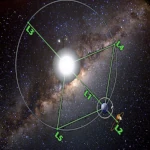 Lagrange Points: The Illusion of Stable Gravitational Oases
  Nemesis: The Theory of the Sun's Companion Star
  Solar System vs. Stellar Systems: A Comparison of Planetary Systems
  The Faint Young Sun Paradox: Why Wasn't Early Earth Frozen?
  The Sun: 380 billion billion megawatts, far more than life needs
  The Ecliptic or the Apparent Orbit of the Sun
  Solar maximum and minimum
  The Sun: When the Yellow Star Turns Blue
  Understanding the Sun's Figure-8 Curve: The Analemma Explained
 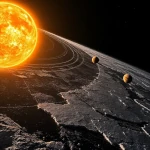 Frost Line: The Boundary That Shaped the Planets
  Tourist trip in the solar system
 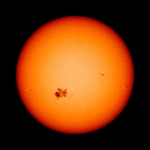 Sunspots and the Solar Cycle: From Minimum to Maximum
  The infernal journey of the photon or random walk
  Dynamics of Solar Cycles and Physical Mechanisms of Solar Flares
  Birth, Life and Death of the Sun: Chronicle of an Average Star
  Grains of Baily or pearls of light
  Sunlight and wavelengths
  The chaotic formation of the solar system
  Solar Storms and Catastrophic Scenarios
  Solar Prominences: Filaments of Matter in the Solar Atmosphere
  Why Does the Sun Rotate So Slowly? The Mystery of the Missing Angular Momentum
  Solar Winds: A Key Phenomenon of Interplanetary Space
  Heliosphere: At the Borders of the Solar System
  Chaos and sensitivity to initial conditions