


Phlegraean Fields: A volcano that really threatens Naples?
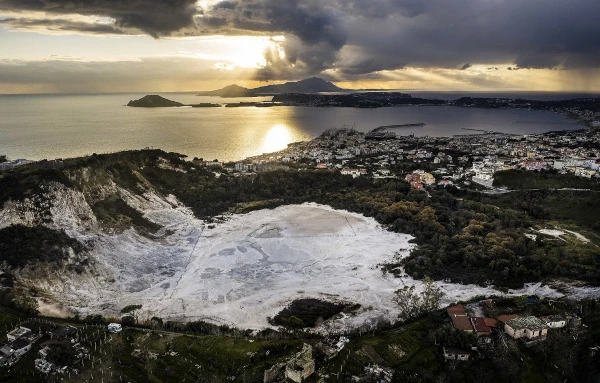
The Phlegraean Fields were formed approximately 40,000 years ago during a series of explosive volcanic eruptions.
Located in Italy near Naples, they consist of several volcanoes and calderas, which are large circular depressions formed by the collapse of the terrain after a major volcanic eruption.
Image source: astronoo.com (new window) — AI-generated image, public domain.
Scientific Summary
Astronoo's article introduces the Phlegraean Fields, a vast volcanic area located in Campania, near Naples, Italy. This region is home to several calderas, including Solfatara, formed by the collapse of the ground after major eruptions. Geothermal phenomena such as hot springs, fumaroles, and solfataras bear witness to the ongoing activity of the supervolcano. The region is also a natural laboratory for the study and prediction of eruptions, with constant scientific monitoring. Finally, the archaeological remains of Pompeii and Herculaneum recall the ancient human occupation of this fertile area, despite the volcanic risks.
What are the Phlegraean Fields and why are they so unique?
This article focuses on the Phlegraean Fields, also known as Campi Flegrei, a vast volcanic area located near Naples, Italy. But what makes this region so unique? The answer lies in its nature as an active supervolcano, characterized by multiple calderas, including Solfatara. Unlike a classical volcano with a single cone, the Phlegraean Fields form a vast depression created by the collapse of the terrain after cataclysmic eruptions. Their intense geothermal activity is evident through fumaroles, hot springs, and solfataras, which have been used since ancient times. Furthermore, the region is densely populated, making it one of the most monitored volcanic risks in the world. Scientists continuously study the precursors of an eruption here, while the ruins of Pompeii and Herculaneum testify to the destructive power of the past. The unique landscapes and geological formations also make it a fascinating place for exploration.
Also worth exploring
Continue your exploration of the Universe with these topics:
The Phlegraean Fields: An Overview
Geographical Location
The Phlegraean Fields (Campi Flegrei) form a vast volcanic area located in Campania, Italy, west of the city of Naples. They stretch along the Tyrrhenian coast from Naples to Pozzuoli and Cape Miseno, and extend underwater into the Gulf of Pozzuoli.
Etymology
The name comes from the Greek phlegraios, meaning "burning." The Greeks referred to this region of smoldering lands, where hot soil and gas emissions evoked the underground forces of mythology.
A Gigantic Caldera
What is a Caldera?
Calderas are geological depressions formed by the collapse of the ground after a major volcanic eruption when the magma chamber empties abruptly. They provide valuable insights into past eruptions and the evolution of the volcanic landscape over time.
Two Major Eruptions
The Phlegraean Fields caldera, about twelve kilometers wide, formed during two extremely violent eruptions: the Campanian Ignimbrite eruption, approximately 39,000 years ago, and the Neapolitan Yellow Tuff eruption, about 15,000 years ago. Since then, numerous secondary cones and craters have formed within the depression.
Solfatara
An Active Crater
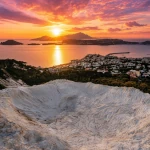
The most famous site in the region is Solfatara, a volcanic crater located within the caldera, near Pozzuoli. It is characterized by the emission of sulfurous gases, steam, and boiling mud.
Geothermal Activity and Bradyseism
Hot Springs and Fumaroles
The Phlegraean Fields are known for their geothermal activity: hot springs, fumaroles, and solfataras. These phenomena result from the heat and gases released by the deep magmatic system. They are harnessed for geothermal, energy, and therapeutic purposes.
Bradyseism
The region is also characterized by a slow phenomenon of uplift and subsidence of the ground, known as bradyseism, particularly visible in Pozzuoli. These deformations, often accompanied by earthquake swarms, are linked to the activity of the magmatic and hydrothermal system beneath the caldera.
History and Archaeology
A Land Inhabited Since Antiquity
The region has been inhabited since ancient times, attracted by the fertility of the volcanic soil. Greek colonists founded Cumae, one of the oldest Greek colonies in Italy, famous for its Sibyl. The Romans developed the thermal resort of Baiae and the port of Pozzuoli, and Lake Avernus was reputed to be an entrance to the Underworld.
The Famous Neighbor: Vesuvius
The Roman cities of Pompeii and Herculaneum, buried in 79 AD, are not part of the Phlegraean Fields; they were destroyed by the eruption of Vesuvius, another volcano in the Bay of Naples. These two neighboring volcanic systems make the region one of the most exposed in Europe.
Risks and Volcanic Monitoring
A Recent Eruption: Monte Nuovo
The last eruption of the Phlegraean Fields occurred in 1538: it created the cone of Monte Nuovo, the "new mountain," in just a few days.
A Natural Laboratory Under Surveillance
Due to their continuous activity and the dense population in the surrounding area, the Phlegraean Fields represent both a major volcanic risk and a natural laboratory for the study and prediction of eruptions. Scientists closely monitor ground deformation, seismicity, and gas composition to detect signs of a possible resumption of activity. This constant monitoring is essential for the safety of the inhabitants.
Landscapes and Exploration
Hiking and Discovery
The region offers unique landscapes, remarkable geological formations, and numerous opportunities for hiking and exploration, from the Solfatara crater to crater lakes and archaeological sites.
Volcanism Around the World
A Geologically Alive Planet
There are approximately 1,500 active terrestrial volcanoes, about sixty of which erupt every year. The Phlegraean Fields fit into this global context of active volcanism, reminding us that Earth remains a geologically alive planet.
References
FAQ: Everything You Need to Know About the Phlegraean Fields
What are the Phlegraean Fields?
The Phlegraean Fields, or Campi Flegrei in Italian, are a vast volcanic area located near Naples, Italy. It is a supervolcano composed of several calderas, the most famous of which is Solfatara. This region is characterized by intense geothermal activity and a complex eruptive history.
Where are the Phlegraean Fields located?
The Phlegraean Fields are located in the Campania region of southern Italy, west of the city of Naples. They cover an area of approximately 150 km² and include several municipalities, such as Pozzuoli, Bacoli, and Pozzuoli.
What is Solfatara?
Solfatara is an active volcanic crater located in the heart of the Phlegraean Fields. It is famous for its fumaroles, steam vents, and emissions of sulfurous gases. This site is a prime observation spot for volcanologists and a popular tourist destination.
Are the Phlegraean Fields dangerous?
Yes, the Phlegraean Fields are considered one of the most dangerous volcanoes in the world due to their proximity to a densely populated area. A major eruption could have catastrophic consequences for the Naples region. This is why constant monitoring is carried out by INGV.
When was the last eruption of the Phlegraean Fields?
The last major eruption of the Phlegraean Fields occurred in 1538, with the formation of Monte Nuovo. Since then, the region has experienced continuous fumarolic and seismic activity, but no significant eruption has occurred.
Can you visit the Phlegraean Fields?
Yes, the Phlegraean Fields are open to the public. Solfatara is accessible via guided tours, and numerous hiking trails allow visitors to explore the craters, fumaroles, and archaeological remains. However, it is recommended to follow safety guidelines.
 Overview of European Volcanoes: From Etna to Vesuvius
  Overview of African Volcanoes: From Kilimanjaro to Nyiragongo
  Overview of North American Volcanoes: From Mount Saint Helens to Popocatépetl
  Overview of South American Volcanoes: From Aconcagua to Cotopaxi
  Overview of Asian Volcanoes: From Fuji to Krakatoa
  Overview of Oceania's Volcanoes: From Indonesia to New Zealand
  Global Overview of Volcanoes: A World Tour of Fire Giants
  The Toba Super Eruption: Decades of Climatic Chaos
  Mauna Loa is the largest volcano in the world!
  Earth's Great Volcanoes: Red Fury, Gray Silence
  Volcanoes of Kamchatka: The Realm of Icy Volcanoes
  The Titans of Fire: Origin, Power, and Risks of Supervolcanoes
  Active Volcanoes of Colombia: Between Natural Beauty and Eruptive Risks
  New Zealand's Volcanoes: A Natural Laboratory for Plate Tectonics
  Volcanoes and the Origin of Life: When Fire and Water Spark Chemistry
  Underwater Eruptions and the Emergence of New Lands
  Volcanoes of Ecuador: Giants of Fire
  The Catastrophe of a Supervolcanic Super Eruption: Chaos and Global Consequences
  The Largest Calderas in the World: Earth's Scars
  Supervolcanoes are invisible!
  The Nevado del Ruiz volcano
  Phlegraean Fields: A volcano that really threatens Naples?
  The Yellowstone Supervolcano
 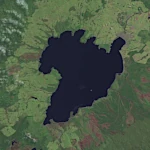 The spectacular caldera of Lake Taupo
  Chimborazo: The Highest Peak on the Planet!