


Fermi Bubbles: When the Milky Way's Black Hole Awakens
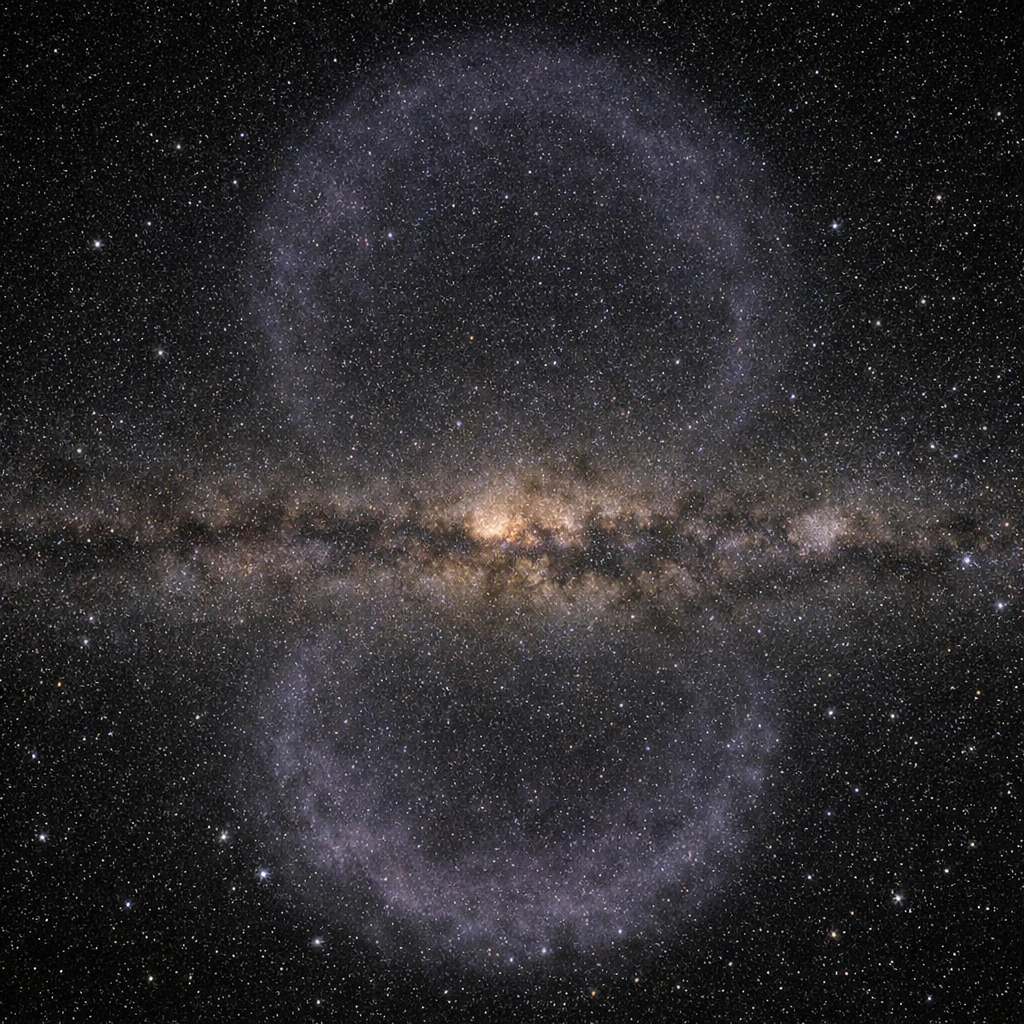
The Fermi Bubbles: two gamma-ray structures, each 25,000 light-years tall, extending like the lobes of a cosmic organ on either side of the galactic center.
These giant and perfectly symmetrical structures, discovered in 2010, could be the remnants of a cataclysmic event involving the supermassive black hole Sagittarius A*.
Image source: astronoo.com (new window)
Scientific Summary
The Fermi Bubbles are two immense, symmetrical structures emitting gamma rays, extending 50,000 light-years on either side of the Milky Way's center. Discovered in 2010, they are the remnants of a cataclysmic event that occurred 2 to 6 million years ago, likely linked to a period of intense activity from Sagittarius A*, the galactic supermassive black hole. Their morphology and energy suggest a past eruption, challenging the view of a quiet galaxy and opening perspectives on its recent dynamism.
What are the Fermi Bubbles, and what do they reveal about the Milky Way's violent history?
In 2010, NASA's Fermi space telescope revealed a stunning discovery: two immense bubble-shaped structures emitting gamma rays, intense and uniform, extending 25,000 light-years on either side of our galaxy's center. These Fermi Bubbles are the traces of an energetic event of unprecedented power, occurring several million years ago. Their origin remains debated, but their almost perfect morphology, sharp edges, and bipolar symmetry are all signatures of an extraordinary past event involving Sagittarius A*, the supermassive black hole at our galaxy's heart. What these bubbles whisper to our instruments is dizzying: the Milky Way, now calm and orderly, experienced a cataclysmic episode in its recent past (between 3 and 9 million years ago), whose scars we still read in the sky today.
Also worth exploring
Continue your exploration of the Universe with these topics:
The Discovery of the Fermi Bubbles: A Cosmic Surprise
It all began in 2010, when astrophysicists analyzing data from the Large Area Telescope (LAT) aboard the Fermi space telescope noticed an anomaly: a diffuse excess of gamma rays coming from the galactic center, extending far beyond the Milky Way's plane. By subtracting the background noise and known sources, they revealed two symmetrical lobes, centered on Sagittarius A*, the supermassive black hole at the heart of our galaxy.
These structures, named the Fermi Bubbles, span approximately 50,000 light-years (25,000 on each side of the galactic plane) and emit gamma radiation with energies between 1 and 100 GeV (giga-electronvolts). Their shape and symmetry suggest a common origin, linked to a cataclysmic event that occurred 6 to 9 million years ago.
Fermi Bubbles: A Surprisingly Young and Possibly Cyclic Event at the Heart of the Milky Way
To understand just how recent the event that created the Fermi Bubbles is, we must place Sagittarius A* (Sgr A*) in the context of its long history. Sagittarius A* is a supermassive black hole with a mass of 4.3 million solar masses, whose formation likely dates back to the first billion years of the Milky Way, or more than 10 billion years ago. For comparison, the Milky Way itself is about 13.6 billion years old, and the Sun formed 4.6 billion years ago.
In this context, the event that shaped the Fermi Bubbles 6 to 9 million years ago represents a tiny fraction of Sgr A*'s existence: just 0.06% of its age. If we compressed the entire history of this black hole into a single calendar year, this cataclysmic outburst—capable of releasing a total energy equivalent to tens of thousands of supernovae combined—would have lasted only a few hours, at the end of December 31st. At that same time, the first Australopithecines were roaming the African savannas, unaware that 26,000 light-years away, the heart of their own galaxy was silently tearing apart, spewing streams of relativistic particles of unimaginable violence into the galactic halo.
This temporal disproportion is one of the most striking aspects of the Fermi Bubbles: they do not bear witness to a distant and bygone era of the galaxy, but to an event almost contemporary on a cosmic scale. Sgr A* is therefore not a fossilized relic of an ancient time: it is a living object, whose last known major burst of activity is recent, and whose future cycles remain unpredictable.
What is the Origin of the Fermi Bubbles?
The hypotheses proposed to explain the formation of these bubbles provide a fascinating insight into our galaxy's turbulent past.
1. The Supermassive Black Hole Hypothesis: Sagittarius A* in Outburst
The most widely accepted theory involves Sagittarius A* (Sgr A*). A few million years ago, Sgr A* may have experienced a period of intense activity, during which it accreted enormous amounts of matter. This accretion would have generated flows of charged particles, which, upon interacting with the interstellar gas, could have produced the Fermi Bubbles.
This hypothesis is supported by recent observations: in 2020, astronomers discovered plasma bubbles (called eRosita bubbles) in the X-ray domain, which appear to be aligned with the Fermi Bubbles. These plasma bubbles could be the remnants of the same jets that created the Fermi Bubbles, thus confirming the link with Sgr A*.
2. The Hypothesis of a Stellar Formation Burst
Another theory suggests that the Fermi Bubbles are the result of an intense period of star formation at the galactic center. About 10 million years ago, a wave of massive star births may have occurred in this region. At the end of their lives, these stars would have exploded as supernovae, releasing enormous amounts of energy and particles into interstellar space. The resulting shock waves and stellar winds would then have blown bubbles of hot gas, emitting gamma rays.
This hypothesis is supported by the observation of an excess of cosmic rays coming from the galactic center, which could be linked to these supernovae.
Conclusion: The Fermi Bubbles Remain an Open Mystery
Their exact origin has not yet been determined with certainty, and many questions remain:
- Why are the Fermi Bubbles so perfectly symmetrical?
- What is the precise role of Sagittarius A* in their formation?
- How do the Fermi Bubbles interact with the rest of the galaxy?
- What is the exact nature of the gamma radiation emitted by the bubbles?
- Are Fermi Bubbles a very common phenomenon in spiral galaxies?
- What is the exact age of the Fermi Bubbles?
- Is there a direct link between the Fermi Bubbles and the eRosita bubbles?
- Are the Fermi Bubbles still being energized today?
Note:
The eRosita bubbles, named after the eROSITA (Extended Roentgen Survey with an Imaging Telescope Array) space telescope of the German Aerospace Center (DLR), are even larger structures than the Fermi Bubbles, extending over more than 70,000 light-years above and below the galactic center.
Discovered in 2020, they primarily emit X-rays and could represent the signature of an older and more extensive shock wave, linked to the same cataclysmic event that created the Fermi Bubbles.
References
- NASA Science - Blowing Bubbles in the Gamma-ray Sky (new window)
- NASA Goddard - Fermi Bubbles (new window)
- Astronomy & Astrophysics - Tidal disruption events as the origin of the eROSITA and Fermi bubbles (Scheffler et al., 2025) (new window)
- The Astrophysical Journal - Fermi and eROSITA Bubbles as Persistent Structures of the Milky Way (Shimoda & Asano, 2024) (new window)
- The Astrophysical Journal - Plasma Wave-particle Acceleration as the Origin of the Galactic Gamma-Ray Bubbles (Cardinali et al., 2025) (new window)
- Futura Sciences - L'origine des bulles de Fermi au centre de la Voie lactée est remise en question (new window)
- International Journal of Modern Physics D - Fermi/eROSITA bubbles as relics of the past activity of the galaxy's central black hole (Yang, 2026) (new window)
FAQ: Everything You Need to Know About the Fermi Bubbles
Why is the age of the Fermi Bubbles (2 to 6 million years) so surprising?
Because on a cosmic scale, it is extremely recent. The Milky Way is over 13 billion years old, and Sgr A* is about 9 billion years old, following a merger between the Milky Way and a satellite galaxy called Gaia-Enceladus. Discovering that it awoke only 2 to 6 million years ago—at the time when the first hominids were appearing on Earth—means that our galaxy is much more dynamic than previously thought, and that Sgr A* could awaken again.
Where are the Fermi Bubbles located?
The Fermi Bubbles are centered on Sagittarius A*, the supermassive black hole at the heart of the Milky Way. They extend perpendicular to the galactic plane, with one lobe above and one lobe below the galaxy's center.
What is the size of the Fermi Bubbles?
Each bubble extends about 25,000 light-years from the galactic center, giving a total height of 50,000 light-years for the entire structure.
What is the origin of the Fermi Bubbles?
The most likely hypothesis is that they were created by a period of intense activity of Sagittarius A*, 2 to 10 million years ago. Other theories suggest an origin linked to a burst of star formation or a long-duration gamma-ray burst.
Why do the Fermi Bubbles emit gamma rays?
Gamma rays are produced by high-energy charged particles (such as electrons or protons) interacting with interstellar gas or the galactic magnetic field. In the case of the Fermi Bubbles, these particles could come from jets emitted by Sagittarius A* or shock waves generated by supernovae.
Are the Fermi Bubbles dangerous for Earth?
No, the Fermi Bubbles pose no danger to Earth. They are located thousands of light-years away from us, and their gamma radiation is too weak to have any impact on our planet. Furthermore, the events that led to their formation occurred millions of years ago, long before the appearance of humanity.
Can the Fermi Bubbles be observed from Earth?
The Fermi Bubbles are not visible to the naked eye because they primarily emit gamma rays, which are blocked by Earth's atmosphere. They were discovered thanks to the Fermi space telescope, which observes the sky in the gamma-ray domain from space.
Are there similar structures in other galaxies?
Yes, structures similar to the Fermi Bubbles have been observed in other galaxies, such as NGC 3079 or M82. These observations suggest that gamma-ray bubbles may be a common phenomenon in galaxies hosting an active supermassive black hole.
 The Milky Way Is Not a Flat Disk: It Dances Like a Cosmic Wave
  JWST and Early Galaxies: When the Universe Defies Our Models
  Fermi Bubbles: When the Milky Way's Black Hole Awakens
  The Great Attractor: The Celestial Fountain Pulling Us into the Abyss
  The 5 Strangest Objects in Our Galaxy: From Zombie Stars to Diamond Planets
  Why Is It So Hard to See the Milky Way?
  What Is a Galaxy? Journey to the Land of Billions of Stars
  Galaxies from the Depths: Light from the Primordial Universe
  At the center of the Milky Way: a monster of 4 million suns
  JWST and Protogalaxies: Exploring the First Cosmic Structures
  Giant galaxies: collisions, mergers and absorption
  The upcoming merger between our Galaxy and the Sagittarius Galaxy
  Differences between the Milky Way and the Andromeda Galaxy
  Why are Galaxies, Unlike Stars, So Close to Each Other?
  Galaxies of the Local Group
  The hidden galaxy, one of Euclid's first images
  The Virgo Cluster spans approximately three Full Moons
  Where did the dark matter in our Galaxy go?
  Galaxy Mergers: From Encounter to Coalescence
  Gravitational Lenses: When Spacetime Bends Light
  Cartwheel Galaxy: A Wheel of Fire in the Universe
  From Dust to Stars: The Composition of Galaxies
  Galaxy Merger NGC 6745: A Traversal of One by the Other
  Extreme Shock Waves in the Universe: Impact on the Evolution of Cosmic Structures
  Gould Belt: The Mystery of the Milky Way's Tilted Ring
  Zoom on Our Galaxy: Journey to the Center of the Milky Way
  One Galaxy, Two Hearts: The Mystery of Andromeda's Double Nucleus
  Tinker Bell's Gravitational Flight: A Merger of Three Galaxies
  Coma or Berenice’s Hair: The Cosmic Colossus
  Bullet Cluster: Cosmic Collision and Direct Proof of Dark Matter
  El Gordo: The Cosmic Giant That Challenges Our Models of the Universe
  Einstein Rings: When Gravity Draws Cosmic Rings
  The Cigar Galaxy: A Smoke of Stars in the Night
  The Hubble Sequence: The Secret Code of Galactic Shapes
  Dance of the Stars: The Arms of the Milky Way
  At the Heart of Galaxies: When Shape Tells the Story of the Universe
  Ancient Galaxies and Cosmic Evolution: A Deep Look Back in Time
  MOND Theory and Dark Matter: Why MOND Fails in Cluster Collisions
  Laniakea, our supercluster of galaxies
 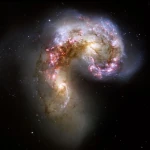 The Antennae Galaxies: An Ongoing Cosmic Collision
 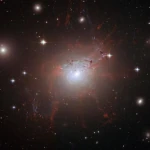 NGC 1275: A Turbulent Galaxy in the Perseus Cluster
 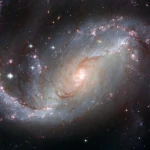 NGC 1672: A Barred Spiral Galaxy in Full Activity