


JWST and Early Galaxies: When the Universe Defies Our Models
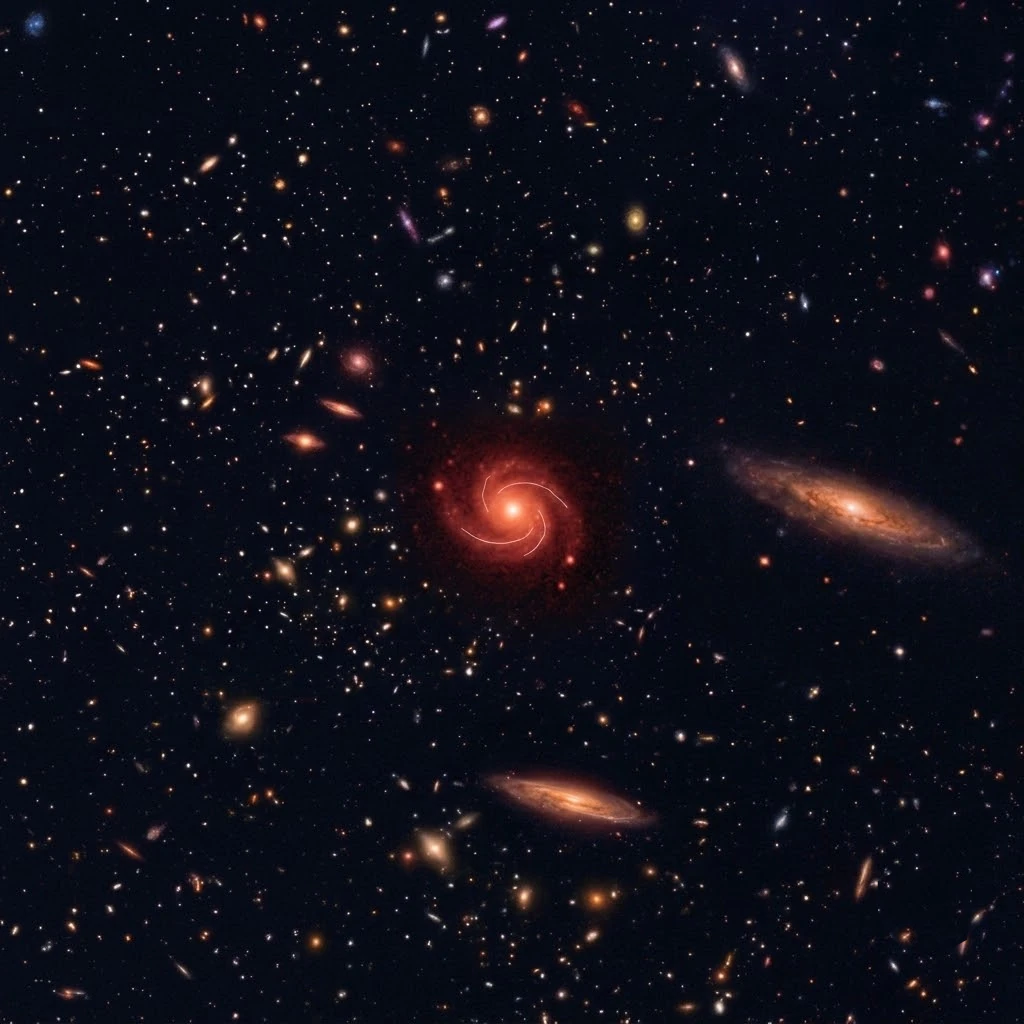
Artist's impression of the first galaxies observed by the James Webb Space Telescope (JWST).
These galaxies, less than 300 million years after the Big Bang, show surprisingly mature structures, spiral arms, well-formed disks, defying our traditional cosmological models.
Image source: astronoo.com (new window)
Scientific Summary
The James Webb Space Telescope (JWST) has observed surprisingly mature and massive galaxies when the Universe was only 290 million years old, challenging the standard ΛCDM cosmological model. These complex structures (disks, spiral arms) contradict the predicted hierarchical formation. The leading explanation is that active supermassive black holes (AGN) amplify their luminosity, masking their true mass. These discoveries, made possible by JWST's infrared capability, force a major revision of the chronology of the early Universe.
Why Do JWST's Latest Observations Challenge Our Understanding of the Early Universe?
The James Webb Space Telescope (JWST) has recently discovered galaxies that are surprisingly mature and massive when the Universe was only 280 to 290 million years old, less than 3% of its current age. These observations directly contradict traditional cosmological models, which predicted small, irregular, and dim galaxies at this time. Dubbed "theory breakers" by astrophysicists, these galaxies challenge our understanding of the formation of the first cosmic structures and force us to revise the timeline of the early Universe.
Also worth exploring
Continue your exploration of the Universe with these topics:
The Great JWST Surprise: Galaxies "Too" Mature to Be True
From its first observations in 2022-2023, the James Webb Space Telescope revealed an unexpected population of extremely distant galaxies. Among the most spectacular discoveries is the galaxy JADES-GS-z14-0, observed when the Universe was only 290 million years old (redshift z ≈ 14.32). Not only does this galaxy exist so early, but it is also surprisingly bright and massive, with hundreds of millions of solar masses and signs of already advanced star populations.
Even more troubling, some of these primordial galaxies exhibit complex morphological structures: spiral arms, well-formed disks, and even central bars. However, standard galaxy formation models predicted that such structures would take several billion years to emerge, after many mergers and accretions of matter.
The Challenge to the ΛCDM Model: When Dark Matter Falls Short
The standard cosmological model, known as ΛCDM (Lambda Cold Dark Matter), is the most advanced theoretical framework for describing the evolution of the Universe since the Big Bang. It relies on the existence of cold dark matter, whose gravitational clustering would have created the first "potential wells" into which ordinary matter would later fall to form the first stars and galaxies.
This model predicts a hierarchical formation of structures: small, primordial galaxies, shapeless and dim, gradually merging to give rise to larger, structured galaxies. JWST observations contradict this fundamental aspect: massive and structured galaxies exist too early, leaving too little time for the predicted hierarchical sequence.
- Temporal problem: With only 280 million years, there isn't enough time for sufficient dark matter to clump together and for baryonic (ordinary) matter to condense into massive galaxies.
- Morphological problem: Complex structures (spiral arms, disks) require long dynamical processes (mergers, relaxation) to appear.
- Brightness problem: The observed galaxies are much brighter than expected, suggesting extremely high star formation rates that are difficult to sustain over such short periods.
Possible Explanations: Black Holes or Ultra-Efficient Stars?
Faced with this observational challenge, astrophysicists are exploring several avenues to reconcile JWST data with theory.
1. The Active Black Hole Hypothesis
The currently favored explanation suggests that some of the light from these primordial galaxies does not come from stars but from supermassive black holes in active accretion (Active Galactic Nuclei or AGN). These objects, devouring surrounding matter, emit a colossal amount of energy, making galaxies appear brighter, more massive, and larger than they actually are.
By subtracting the AGN contribution from the total luminosity, the stellar mass of galaxies would return to values compatible with ΛCDM predictions. This hypothesis is supported by the detection, in some of these early galaxies, of emission lines characteristic of accreting black holes.
2. The Ultra-Efficient Star Formation Hypothesis
Alternatively, it is possible that star formation processes were radically different in the early Universe. Since it was denser and hotter, the mechanisms that limit star formation today (stellar winds, supernovae, radiative feedback) may have been less effective, allowing an ultra-rapid conversion of gas into stars. In this scenario, galaxies could accumulate considerable stellar masses in just a few tens of millions of years.
3. A Modification of Cosmology?
A more radical, still marginal hypothesis considers that these observations could be a sign of physics beyond the standard model: "warm" or "strongly interacting" dark matter, variable dark energy, or even modifications of the laws of gravity on large scales. However, most cosmologists currently favor more conservative explanations within the ΛCDM framework.
The New Timeline: What JWST Rewrites
JWST's discoveries require a major revision of the cosmic timeline of the early Universe.
| Event | Age of the Universe | Old Models (Pre-JWST) | JWST Observations |
|---|---|---|---|
| First atoms (CMB) | 380,000 years | 380,000 years | 380,000 years (confirmed) |
| First stars (Pop III) | 100-200 Ma | ~200 Ma | ~150 Ma (compatible) |
| First galaxies | 280-400 Ma | ~1 Ga (1 billion) | <290 Ma |
| First massive galaxies | 500-700 Ma | >2-3 Ga | ~500-700 Ma |
| First complex structures | 700-1000 Ma | >3-4 Ga | ~700-1000 Ma |
| First galaxy clusters | 700-1000 Ma | >2-3 Ga | ~700 Ma (protocluster) |
N.B.:
*Ma = million years after the Big Bang | *Ga = billion years after the Big Bang
The most striking difference concerns the appearance of the first galaxies, which occurred at least three times earlier than predicted by models.
Observing the Invisible: How JWST Perceives the Early Universe
JWST's success is based on its design optimized for the far infrared. Due to the expansion of the Universe, the light emitted by the first galaxies, initially in the ultraviolet and visible, is shifted to the infrared by a factor of 15-20 (redshift z ≈ 14-20). Only a giant, cold telescope operating in the infrared can capture this fossilized light.
JWST's NIRCam (Near Infrared Camera), combined with the NIRSpec spectrograph, allows both imaging these distant galaxies and analyzing their chemical composition, stellar age, metallicity, and the possible presence of active black holes. The JADES (JWST Advanced Deep Extragalactic Survey) and CEERS (Cosmic Evolution Early Release Science) programs were specifically designed to probe this distant epoch.
Key Takeaways
- Galaxies too early: JWST observed mature galaxies when the Universe was only 290 million years old, three times earlier than predicted by models.
- A challenge to the standard model: These discoveries question the cosmic timeline based on cold dark matter (ΛCDM).
- The favored explanation: Active supermassive black holes (AGN) could amplify the brightness of these galaxies, making them appear more massive than they actually are.
- A certainty: JWST has opened a new window on the early Universe, and future observations will help distinguish between hypotheses.
FAQ: JWST and Primordial Galaxies
What does "galaxies too early" mean in the context of JWST discoveries?
"Galaxies too early" refers to galaxies observed when the Universe was only 280 to 400 million years old (less than 3% of its current age). These galaxies are considered "too early" because traditional cosmological models, based on cold dark matter (ΛCDM), predicted that the first galaxies could only form after at least 500 million to 1 billion years. Their existence challenges the accepted timeline of structure formation.
How do these galaxies contradict the standard dark matter model (ΛCDM)?
The ΛCDM model predicts a hierarchical formation of structures: small dark matter halos form first, then progressively merge to create more massive galaxies. It takes time to accumulate enough mass. JWST galaxies are too massive too early (some equivalent to the Milky Way at 500 million years). Additionally, they exhibit complex morphologies (spiral arms, bars, disks) that models predict only after several billion years of mergers.
What are the main explanations proposed to reconcile these observations with theory?
Three main avenues are being explored:
- Active black holes (AGN): Some of the light could come from supermassive black holes in active accretion. By subtracting this contribution, galaxies return to masses compatible with ΛCDM. This is currently the favored explanation.
- Ultra-efficient star formation: Star formation processes may have been radically more efficient in the early Universe, allowing rapid accumulation of significant stellar masses.
- Physics beyond the standard model: More radical hypotheses (modified dark matter, modified gravity, variable dark energy) remain considered but are marginal.
What are the current records for the most distant galaxies discovered by JWST?
JADES-GS-z14-0 currently holds the record, with a redshift of z ≈ 14.32, corresponding to an age of the Universe of about 290 million years. This galaxy measures about 1,600 light-years in diameter (relatively small, 1/60th of the Milky Way) but has a stellar mass of several hundred million solar masses. Other candidates at z ≈ 16-20 are undergoing spectroscopic verification.
Why is JWST the only telescope capable of detecting these primordial galaxies?
JWST was specifically designed for infrared observation. Due to the expansion of the Universe, the light emitted by the first galaxies (initially ultraviolet and visible) is shifted to the infrared by a factor of 15 to 20 (redshift z ≈ 14-20). Only a large space telescope, cooled to prevent its own heat from emitting in the infrared, and equipped with ultra-sensitive instruments (NIRCam, NIRSpec, MIRI), can capture this light, which has become very faint and very red.
 The Milky Way Is Not a Flat Disk: It Dances Like a Cosmic Wave
  JWST and Early Galaxies: When the Universe Defies Our Models
  Fermi Bubbles: When the Milky Way's Black Hole Awakens
  The Great Attractor: The Celestial Fountain Pulling Us into the Abyss
  The 5 Strangest Objects in Our Galaxy: From Zombie Stars to Diamond Planets
  Why Is It So Hard to See the Milky Way?
  What Is a Galaxy? Journey to the Land of Billions of Stars
  Galaxies from the Depths: Light from the Primordial Universe
  At the center of the Milky Way: a monster of 4 million suns
  JWST and Protogalaxies: Exploring the First Cosmic Structures
  Giant galaxies: collisions, mergers and absorption
  The upcoming merger between our Galaxy and the Sagittarius Galaxy
  Differences between the Milky Way and the Andromeda Galaxy
  Why are Galaxies, Unlike Stars, So Close to Each Other?
  Galaxies of the Local Group
  The hidden galaxy, one of Euclid's first images
  The Virgo Cluster spans approximately three Full Moons
  Where did the dark matter in our Galaxy go?
  Galaxy Mergers: From Encounter to Coalescence
  Gravitational Lenses: When Spacetime Bends Light
  Cartwheel Galaxy: A Wheel of Fire in the Universe
  From Dust to Stars: The Composition of Galaxies
  Galaxy Merger NGC 6745: A Traversal of One by the Other
  Extreme Shock Waves in the Universe: Impact on the Evolution of Cosmic Structures
  Gould Belt: The Mystery of the Milky Way's Tilted Ring
  Zoom on Our Galaxy: Journey to the Center of the Milky Way
  One Galaxy, Two Hearts: The Mystery of Andromeda's Double Nucleus
  Tinker Bell's Gravitational Flight: A Merger of Three Galaxies
  Coma or Berenice’s Hair: The Cosmic Colossus
  Bullet Cluster: Cosmic Collision and Direct Proof of Dark Matter
  El Gordo: The Cosmic Giant That Challenges Our Models of the Universe
  Einstein Rings: When Gravity Draws Cosmic Rings
  The Cigar Galaxy: A Smoke of Stars in the Night
  The Hubble Sequence: The Secret Code of Galactic Shapes
  Dance of the Stars: The Arms of the Milky Way
  At the Heart of Galaxies: When Shape Tells the Story of the Universe
  Ancient Galaxies and Cosmic Evolution: A Deep Look Back in Time
  MOND Theory and Dark Matter: Why MOND Fails in Cluster Collisions
  Laniakea, our supercluster of galaxies
  The Antennae Galaxies: An Ongoing Cosmic Collision
  NGC 1275: A Turbulent Galaxy in the Perseus Cluster
  NGC 1672: A Barred Spiral Galaxy in Full Activity