


Einstein Rings: When Gravity Draws Cosmic Rings

In the image above, the gravity of a luminous red galaxy (LRG) has distorted the light of a much more distant blue galaxy. Typically, such light deflection produces two distinct images of the distant galaxy, but here, the lens alignment is so precise that the background galaxy is distorted into a horseshoe – an almost complete ring.
Image source: ESA/Hubble and NASA (new window).
Scientific summary
Astronoo's article explores the phenomenon of Einstein rings and the Einstein Cross, cosmic optical illusions predicted by general relativity. When a massive object (galaxy or cluster) is perfectly aligned between an observer and a distant light source (quasar or galaxy), the curvature of spacetime bends light to form a ring or a cross. These exceptional configurations serve as ideal gravitational lenses for probing the distribution of dark matter, measuring galactic masses and testing gravity under extreme conditions.
What are Einstein rings and why are they so valuable to astrophysicists?
This article is devoted to Einstein rings and the Einstein Cross, spectacular optical phenomena predicted by general relativity. When a massive galaxy aligns perfectly between Earth and a distant light source (such as a quasar), the curvature of spacetime bends the source's light to form a ring or cross-shaped image around the galaxy. But why are these phenomena so valuable to astrophysicists? Because they act as natural cosmic lenses, amplifying and distorting the light of the most distant objects in the Universe. They enable measurement of galaxy masses with unprecedented precision, mapping of dark matter (invisible yet omnipresent), and testing the laws of gravity under extreme conditions. These rare configurations, requiring near-perfect alignment between the observer, the lensing galaxy and the distant source, offer a unique window into the structure and evolution of the Universe.
Also worth exploring
Continue your exploration of the Universe with these topics:
A prediction of general relativity
Einstein rings, also known as the Einstein Cross, are a fascinating optical phenomenon predicted by Albert Einstein's theory of general relativity. This phenomenon occurs when light from a distant source, such as a galaxy or a star, is bent by the gravity of a massive object located between the observer and the light source. This deflection of light, called gravitational lensing, creates a ring-shaped image around the massive object.
The gravitational lensing effect
The gravitational lensing effect is due to the curvature of spacetime caused by the mass of the intervening object. When light passes near this object, it follows a curved trajectory, resulting in the formation of a distorted image of the light source. If the alignment between the observer, the massive object and the light source is perfect, the distorted image takes the form of a complete ring.
Rare and valuable phenomena
Einstein rings are rare and difficult to observe due to the very specific conditions required for their formation. However, they provide valuable information about the distribution of matter in the universe, including dark matter, and allow testing of the predictions of general relativity.
Formation Mechanisms
The required conditions
For an Einstein ring to form, several conditions must be met:
- A massive object, such as a galaxy or a cluster of galaxies, must be located between the observer and the light source.
- The alignment between the observer, the massive object and the light source must be nearly perfect.
- The light source must be sufficiently distant for the light deflection to be observable.
The formation of the ring
When these conditions are met, the light from the distant source is deflected by the gravity of the massive object, creating a ring-shaped image around this object. The size and shape of the ring depend on the mass and distribution of matter in the intervening object.
Observations and Discoveries
The first observation in 1988
Einstein rings were first observed in 1988 by astronomer Jacqueline Hewitt (1958-) from MIT and her colleagues. Since then, several other examples have been discovered through high-resolution observations made with space telescopes like the Hubble Space Telescope.
The contributions of observations
These observations have helped to better understand the distribution of matter in galaxies and galaxy clusters, as well as to test the predictions of general relativity. Einstein rings are also used to study dark matter, a form of invisible matter that can only be detected through its gravitational effects.
Applications in Astrophysics
Measuring masses and mapping dark matter
Einstein rings have many applications in astrophysics. They allow measurement of the mass of massive objects, mapping of the distribution of dark matter, and testing theories of gravitation. Additionally, they can be used to study the properties of distant light sources, such as galaxies and quasars.
Understanding the evolution of the Universe
Observations of Einstein rings also contribute to our understanding of the evolution of the universe. By studying the deflection of light by massive objects at different cosmic epochs, astronomers can obtain information about the structure and evolution of galaxies and galaxy clusters.
References
FAQ: Everything you need to know about Einstein rings
What is an Einstein ring?
An Einstein ring is an optical phenomenon where light from a distant source (galaxy or quasar) is bent by the gravity of a massive object (galaxy or cluster) located between the observer and the source, forming a perfect luminous ring around the object.
What is the difference between an Einstein ring and an Einstein Cross?
An Einstein ring forms when the alignment is perfect, creating a continuous luminous circle. An Einstein Cross forms when the alignment is imperfect, producing four distinct images arranged in a cross pattern around the massive object.
Who predicted Einstein rings?
Einstein rings were predicted by Albert Einstein's theory of general relativity in 1915. However, Einstein himself doubted they could ever be observed.
When was the first Einstein ring observed?
The first Einstein ring was observed in 1988 by astronomer Jacqueline Hewitt and her colleagues at MIT, using the Very Large Array (VLA) radio telescope.
What are Einstein rings used for in astrophysics?
They are used to measure galaxy masses, map dark matter, test general relativity, and study distant galaxies that would be too faint to observe otherwise.
Can an Einstein ring be observed with an amateur telescope?
No, Einstein rings are extremely small and faint. Their observation requires space telescopes (like Hubble or James Webb) or very large ground-based telescopes with advanced instruments.
Why are Einstein rings so rare?
They are rare because they require a near-perfect alignment between the observer, the lensing galaxy and the distant source. The probability of such an alignment is extremely low, even with the large number of galaxies in the Universe.
 The Milky Way Is Not a Flat Disk: It Dances Like a Cosmic Wave
  JWST and Early Galaxies: When the Universe Defies Our Models
  Fermi Bubbles: When the Milky Way's Black Hole Awakens
  The Great Attractor: The Celestial Fountain Pulling Us into the Abyss
  The 5 Strangest Objects in Our Galaxy: From Zombie Stars to Diamond Planets
  Why Is It So Hard to See the Milky Way?
  What Is a Galaxy? Journey to the Land of Billions of Stars
  Galaxies from the Depths: Light from the Primordial Universe
  At the center of the Milky Way: a monster of 4 million suns
  JWST and Protogalaxies: Exploring the First Cosmic Structures
  Giant galaxies: collisions, mergers and absorption
  The upcoming merger between our Galaxy and the Sagittarius Galaxy
  Differences between the Milky Way and the Andromeda Galaxy
  Why are Galaxies, Unlike Stars, So Close to Each Other?
 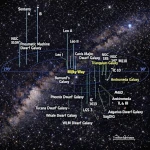 Galaxies of the Local Group
  The hidden galaxy, one of Euclid's first images
  The Virgo Cluster spans approximately three Full Moons
  Where did the dark matter in our Galaxy go?
  Galaxy Mergers: From Encounter to Coalescence
  Gravitational Lenses: When Spacetime Bends Light
  Cartwheel Galaxy: A Wheel of Fire in the Universe
  From Dust to Stars: The Composition of Galaxies
  Galaxy Merger NGC 6745: A Traversal of One by the Other
  Extreme Shock Waves in the Universe: Impact on the Evolution of Cosmic Structures
  Gould Belt: The Mystery of the Milky Way's Tilted Ring
  Zoom on Our Galaxy: Journey to the Center of the Milky Way
  One Galaxy, Two Hearts: The Mystery of Andromeda's Double Nucleus
  Tinker Bell's Gravitational Flight: A Merger of Three Galaxies
  Coma or Berenice’s Hair: The Cosmic Colossus
  Bullet Cluster: Cosmic Collision and Direct Proof of Dark Matter
  El Gordo: The Cosmic Giant That Challenges Our Models of the Universe
  Einstein Rings: When Gravity Draws Cosmic Rings
  The Cigar Galaxy: A Smoke of Stars in the Night
  The Hubble Sequence: The Secret Code of Galactic Shapes
  Dance of the Stars: The Arms of the Milky Way
  At the Heart of Galaxies: When Shape Tells the Story of the Universe
  Ancient Galaxies and Cosmic Evolution: A Deep Look Back in Time
  MOND Theory and Dark Matter: Why MOND Fails in Cluster Collisions
  Laniakea, our supercluster of galaxies
  The Antennae Galaxies: An Ongoing Cosmic Collision
  NGC 1275: A Turbulent Galaxy in the Perseus Cluster
  NGC 1672: A Barred Spiral Galaxy in Full Activity