


The Night Sky Map in South America: Constellations and Celestial Objects by Season
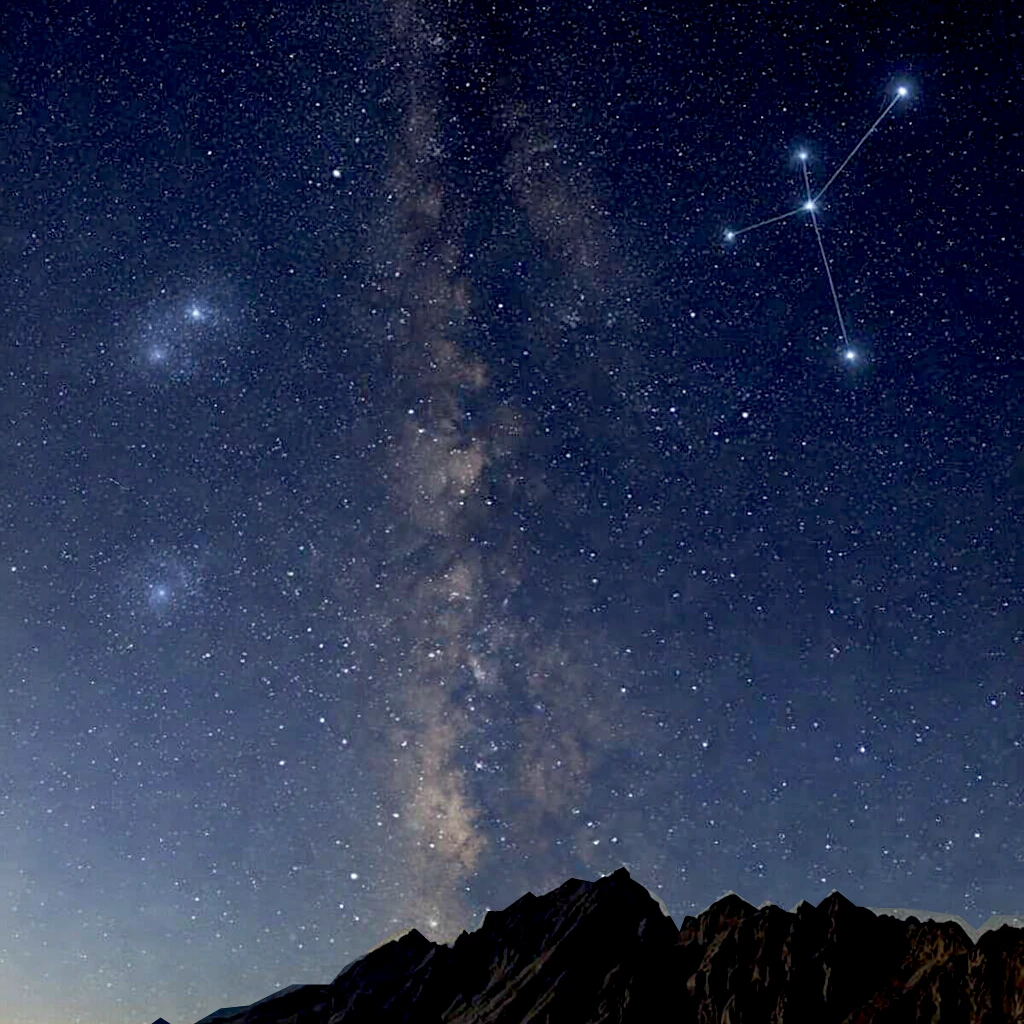
The night sky from the Andes region in Argentina, showing the Milky Way above the Andean mountain landscape.
The Southern Cross and the Magellanic Clouds dominate the southern zenith.
Each season offers some unchanging bright landmarks.
Image source: astronoo.com (new window)
Scientific Summary
South America offers some of the purest skies on the planet, particularly in the Atacama Desert and Patagonia. This practical guide describes celestial markers for orientation: the Southern Cross, extended by 4.5 times its length, points to the South Celestial Pole. Southern circumpolar constellations (Southern Cross, Carina, Centaurus) are always visible. Seasons are marked by dominant asterisms: the galactic center and the Sagittarius Teapot in winter, and the Southern Diamond around inverted Orion in summer. The Magellanic Clouds, dwarf galaxies, are visible to the naked eye year-round.
How to find your way around the starry sky of South America?
To find your bearings, use the Southern Cross (Crux) which indicates geographic South: its long axis, extended 4.5 times, points to the South Celestial Pole. The southern circumpolar constellations (Southern Cross, Carina, Centaurus, Musca) never set and serve as permanent landmarks. Each season, a different asterism dominates the sky: the Sagittarius Teapot and galactic center in winter, the Austral Diamond (Sirius, Canopus, Hadar, Acrux) around an inverted Orion in summer.
Also worth exploring
Continue your exploration of the Universe with these topics:
Why Does the Sky Change from Season to Season?
From South America, between latitudes 20° S and 55° S (from the Chilean Atacama to Argentine Patagonia), the night sky is never the same from one month to the next. This apparent movement of the stars is not theirs: it is the Earth, orbiting the Sun in one year, that points our hemisphere toward different regions of the celestial sphere. Each season corresponds to a new "window" on the Universe.
The Earth's rotation on its axis also rotates the celestial vault from east to west in 23 hours and 56 minutes (a sidereal day (duration of Earth's rotation relative to the fixed stars, slightly less than the 24-hour solar day)). In practice, the sky "advances" by about two hours per month: a constellation that rises in the east at 11 p.m. in December will already be high in the sky by 9 p.m. in January, then dominate the zenith in the evening in spring. The patient observer quickly learns to read this sky movement like a cosmic clock.
From South America, one area of the sky is always visible, regardless of the season: the southern circumpolar circle, centered on the South Celestial Pole (point in the sky located on the Earth's southern rotational axis, lacking a bright pole star but locatable thanks to the Southern Cross). The southern circumpolar constellations, such as the Southern Cross (Crux), Carina, Centaurus, and Musca, never set below our horizon. These are the first landmarks to master.
Finding South: The Southern Cross, the Immutable Celestial Compass
Before any seasonal observation, you must locate the Southern Cross (the most characteristic constellation of the southern hemisphere, formed by four bright stars in the shape of a cross, whose major axis points toward the South Celestial Pole) (Crux). It indicates the direction of geographic south with remarkable precision, as its long axis points directly toward the South Celestial Pole. Unlike the northern hemisphere, there is no bright pole star in the south: the Southern Cross is therefore used as a fundamental landmark.
To find the South Celestial Pole, extend the long axis of the Southern Cross (the line connecting the bottom star, Acrux, to the top star, Gacrux) by a distance of about 4.5 times the length of the cross. You will then reach an empty point in the sky, a few degrees from the Southern Pole Star (sigma Octantis, a faint star near the South Celestial Pole but not useful for naked-eye navigation) (Sigma Octantis), which is not visible to the naked eye in urban areas. This mnemonic trick works day and night, summer and winter.
Once the South is identified, the orientation of the other cardinal points follows immediately. Facing South, North is behind you, East to the left, West to the right. From South America, all stars reach their highest point in the sky when they pass due north: this is the best time to observe them, halfway between their rise in the east and their set in the west. For example, in early March around 10 p.m., the constellation Leo culminates due north about 45° above the horizon: its main star Regulus is then at its highest, in the best observation conditions.
Autumn (March, April, May): Leo and Virgo Dominate the North
In the southern autumn, the Earth faces a region of the sky rich in distant galaxies. The Lion's square is easily recognizable: its main star, Regulus (alpha star of Leo, a blue-white giant about 79 light-years away), marks the bottom of the "inverted question mark" drawn by the Lion's head.
Further east, the constellation Virgo is marked by Spica (alpha star of Virgo, a blue giant about 250 light-years away), a bluish star. To find Spica, use a celestial arc: by extending the arc formed by the tail of Centaurus, you reach Spica. Arcturus (alpha star of Boötes, an orange giant, one of the brightest stars in the northern sky, visible to the north in southern autumn), in Boötes, is a very bright orange giant.
In May around 10 p.m., look north at about 60° altitude: the Coma Berenices forms a diffuse patch visible to the naked eye in a dark sky, often mistaken for a cloud. It is actually an open cluster of real stars, one of the few visible without instruments. Turning south, the Southern Cross culminates high in the sky, accompanied by the Magellanic Clouds (Large and Small), two dwarf satellite galaxies of the Milky Way, visible as two milky patches on the southwest horizon.
Winter (June, July, August): The Galactic Center and the Royal Milky Way
Winter is, for many South American amateur astronomers, the queen season for observation. The nights are long and the spectacle is grand, especially in desert regions like the Atacama. The Galactic Center (central region of our Galaxy located in the constellation Sagittarius, visible as an intense bright bulge in the Milky Way) then dominates the zenith.
The constellation Sagittarius is easily recognizable thanks to its characteristic asterism:
- The Teapot: eight stars forming a teapot silhouette, with the "spout" pointing to the right (west) and the "handle" to the left (east).
- Alnasl (gamma Sagittarii): the star that marks the spout of the teapot, about 2° from the apex of the galactic bulge.
- Kaus Australis (epsilon Sagittarii): the brightest in Sagittarius, marking the bottom of the teapot.
In winter, the Milky Way (the Galaxy in which the Solar System is located, visible as a diffuse milky band crossing the sky, corresponding to the galactic plane seen from within) crosses the sky from northwest to southeast, passing through the zenith. Far from any light pollution, it appears as a silver ribbon dotted with billions of stars, with a spectacular bulge in the direction of Sagittarius. The constellation Scorpius, neighboring Sagittarius, draws attention with Antares (alpha Scorpii), a red supergiant whose orange hue rivals that of Mars.
The Magellanic Clouds reach their most favorable position in winter, culminating high in the southern sky in early evening. The Large Cloud (LMC) is in the constellation Dorado, the Small Cloud (SMC) in Tucana. These two irregular galaxies are visible to the naked eye as two distinct whitish patches, witnesses to the richness of the deep southern sky.
Spring (September, October, November): The Great Square of Pegasus and Andromeda
Spring establishes a characteristic geometric landmark in the north: the Great Square of Pegasus (asterism formed by four bright stars in the constellations Pegasus and Andromeda, serving as a starting point to locate the Andromeda Galaxy). These four stars, almost equally spaced, form a large rectangle clearly visible at the meridian around 10 p.m. in October. The inside of the square is remarkably poor in stars visible to the naked eye: a good indicator of the quality of the local sky.
From a northeastern corner of the Square, you move up to two stars in the constellation Andromeda, then turn north. This path leads to M31, the Andromeda Galaxy (the closest spiral galaxy to ours, visible to the naked eye, about 2.5 million light-years away, designated M31 or NGC 224). Visible to the naked eye in a low-pollution sky as a slightly elongated fuzzy patch, it is the farthest object that humans can perceive without instruments.
To the south, the Southern Cross begins to descend toward the horizon in early evening, heralding the southern summer. The Pleiades (M45) become visible in the northeast in the late night, while Orion points toward the horizon to the north at dawn. This is the ideal season to observe the Southern Perseids, a meteor shower active around September 9, with a radiant in the constellation Perseus (visible to the northeast).
Summer (December, January, February): Inverted Orion and the Southern Diamond
Summer offers the richest sky in bright stars of the year from South America, with the particularity that the northern constellations appear "upside down." The constellation of Orion (one of the most recognizable constellations in the sky, visible in the southern summer with an inverted orientation compared to the northern hemisphere) is the centerpiece, immediately recognizable by its belt: three perfectly aligned stars, Mintaka, Alnilam, and Alnitak. Unlike the northern hemisphere, Betelgeuse (the red shoulder) is at the bottom right, Rigel (the blue star) at the top left. Below the belt, Orion's sword contains a slightly milky fuzzy patch visible to the naked eye in a dark sky: this is the Orion Nebula (M42) (active star-forming region in the constellation Orion, about 1,344 light-years away, visible to the naked eye as the diffuse patch in the center of Orion's sword). The belt points northeast toward Sirius (the brightest star in the night sky, 8.6 light-years away), the brightest star in the night sky, and northwest toward the Pleiades (open cluster of young stars in Taurus, about 444 light-years away, visible to the naked eye as a tight group of bluish stars).
The Southern Diamond (southern summer asterism formed by four bright stars: Sirius (Canis Major), Canopus (Carina), Hadar (Centaurus), and Acrux (Southern Cross)) connects four stars all visible to the naked eye, forming a large rhombus that structures the summer sky:
- Sirius (Canis Major): the brightest in the sky, low to the north, brilliant white.
- Canopus (Carina): the second brightest star, to the west, white-yellow, almost at the zenith in the southern summer.
- Hadar (beta Centauri): to the southeast, blue giant, component of Centaurus.
- Acrux (alpha Crucis): the base of the Southern Cross, to the south, visually a double star to the naked eye.
By connecting these four stars with your gaze, you encircle a large part of the southern sky and structure the entire summer sky at a glance. The Magellanic Clouds are clearly visible low on the southern horizon, the Large Cloud (LMC) brighter and larger than the Small Cloud (SMC).
What Can Be Seen with the Naked Eye by Season
Without any instrument, the night sky already holds beautiful surprises beyond simple stars. Several remarkable objects are perceptible to the naked eye in a sufficiently dark sky, far from any light pollution. The Messier catalog, compiled by the French astronomer Charles Messier (1730-1817) in the 18th century, lists several accessible without instruments.
| Season | Object | Common Name | Type | Constellation | What You See |
|---|---|---|---|---|---|
| Autumn | Southern Cross | Crux | Constellation | Crux | Four stars in a cross, fundamental landmark of the southern sky |
| Autumn | Large Magellanic Cloud | LMC | Dwarf Galaxy | Dorado | Oval whitish patch, satellite galaxy of the Milky Way |
| Winter | Galactic Center | Galactic Bulge | Milky Way Region | Sagittarius | Intense bright bulge in the Milky Way at the zenith |
| Winter | Sagittarius Teapot | Asterism | Star Cluster | Sagittarius | Eight stars forming a teapot, with the spout pointing west |
| Winter | Antares | Alpha Scorpii | Supergiant Star | Scorpius | Very bright red-orange star, heart of Scorpius |
| Spring | M31 | Andromeda Galaxy | Spiral Galaxy | Andromeda | Elongated oval patch, the farthest object visible to the naked eye |
| Spring | Great Square of Pegasus | Asterism | Four Stars | Pegasus/Andromeda | Large rectangle of four stars in the north, autumnal landmark |
| Summer | M45 | Pleiades | Open Cluster | Taurus | Tight group of bluish stars, six to seven discernible stars |
| Summer | M42 | Orion Nebula | Emission Nebula | Orion | Misty patch below Orion's belt, in the heart of the sword |
| All Seasons | Southern Cross | Magellanic Clouds | Southern Circumpolar Constellations | Crux / Dorado / Tucana | Always visible above the southern horizon in much of temperate South America |
The Planets: Stars That Move
Unlike fixed stars, planets (celestial bodies orbiting the Sun in our Solar System, visible from Earth because they reflect sunlight) change position from week to week relative to the constellations. However, they all remain close to the ecliptic (imaginary line projected onto the celestial sphere corresponding to the plane of Earth's orbit around the Sun; planets and the Moon are always located near this line), the great band of the zodiac. The ecliptic passes through the constellations Taurus, Gemini, Cancer, Leo, Virgo, Libra, Scorpius, Sagittarius, Capricorn, Aquarius, and Pisces.
A planet can be distinguished from a star with the naked eye by two characteristics: it does not twinkle (or very little) and its color is often distinctive. Mars has a recognizable orange hue; Jupiter, the brightest of all, shines with a brilliant creamy white; Saturn, golden and stable, is clearly visible to the naked eye; Venus and Mercury, always close to the Sun, can only be observed at the beginning or end of the night.
An opposition (astronomical phenomenon where an outer planet is opposite the Sun relative to Earth, offering the best observation period of the year for that planet) is the ideal time to observe the outer planets with the naked eye: the planet rises at sunset, culminates due north at midnight, and sets at dawn, at its brightest of the year. The following table gives the next visible oppositions from South America.
| Planet | Approximate Date | Constellation | Color to the Naked Eye |
|---|---|---|---|
| Jupiter | January 2026 | Gemini | Creamy white, very bright |
| Saturn | September 2026 | Aquarius | Golden, stable light |
| Jupiter | February 2027 | Cancer | Creamy white, very bright |
| Mars | February 2027 | Leo | Orange, unmistakable |
| Saturn | October 2027 | Pisces | Golden, stable light |
| Mars | March 2029 | Virgo | Orange, unmistakable |
Ephemeral Phenomena: Meteor Showers and Eclipses
Some events occur on specific dates and offer spectacles entirely accessible to the naked eye, without any instrument. Meteor showers (periodic phenomenon during which Earth passes through the cometary debris of a meteor shower, producing many shooting stars that appear to radiate from the same point in the sky) are among the most accessible. The Eta Aquarids (early May), produced by Halley's Comet, are particularly favorable from South America, with hourly rates reaching 30 to 40 meteors per hour. The Perseids (August 12) remain popular, although the radiant is low on the northern horizon.
Since the early 2020s, the passage of artificial satellites (spacecraft placed in low orbit (LEO, 200 to 2,000 km altitude) and visible to the naked eye due to the reflection of sunlight on their panels or body) has become a common event in the South American night sky. A satellite is easily distinguished from a star: it silently crosses the sky in two to five minutes, without twinkling or flashing, and only at the beginning or end of the night when it is still illuminated by the Sun. The ISS (international Space Station, permanently inhabited orbital laboratory since November 2000, orbiting at about 400 km altitude, visible to the naked eye and sometimes brighter than Jupiter) is the most spectacular, sometimes outshining Jupiter in brightness during favorable passes. Starlink (mega-constellation of satellites in low orbit (550 km) developed by SpaceX since 2019, with over 6,000 operational satellites in 2025) (SpaceX) have become ubiquitous; just after launch, they form a train of satellites (visual phenomenon produced just after the launch of a batch of Starlink satellites, resembling a string of luminous pearls moving in a line across the sky), recognizable and visible for only a few days. The dates and trajectories of all these objects can be consulted in real time on the internet.
References
- Astronomical Society of Southern Africa - Observing & Sky Guide (Africa) (new window)
- Sky & Telescope - Stargazing & Observing (North America) (new window)
- European Southern Observatory - Night Visits to Paranal (South America) (new window)
- timeanddate - Night Sky Tonight, Concordia Station (Antarctica) (new window)
- National Astronomical Observatory of Japan - Sky Viewer & Ephemeris (Asia) (new window)
- BBC Sky at Night Magazine - Stargazing (Europe) (new window)
- Telescope & Astronomy - Planet Observation (Europe) (new window)
- Royal Astronomical Society of New Zealand (Oceania) (new window)
FAQ: Everything you need to know about stargazing in South America
How do you find south from South America?
Use the Southern Cross (Crux). Its long axis (the line connecting the bottom star, Acrux, to the top star, Gacrux) is extended about 4.5 times the length of the cross. You then reach an empty spot in the sky that marks the South Celestial Pole, indicating geographic South. Unlike the northern hemisphere, there is no bright southern pole star.
Which constellations are always visible throughout the year?
For observers in southern South America (Chile, Argentina, Uruguay), several constellations never set: the Southern Cross (Crux), Carina (with Canopus, the 2nd brightest star), Centaurus (with Alpha Centauri and Hadar), Musca, and the Southern Triangle (Triangulum Australe). These are the southern circumpolar constellations.
What is the Austral Diamond and when can you observe it?
The Austral Diamond is an asterism formed by four bright stars: Sirius (the brightest star in the sky), Canopus (2nd brightest), Hadar (beta Centauri), and Acrux (alpha Crucis). It structures the sky of the austral summer (December, January, February), around the constellation Orion which appears "inverted" compared to the northern hemisphere.
When is the best time to observe the galactic center and the Milky Way?
The best period is the austral winter (June, July, August). The galactic center, located in the constellation Sagittarius, culminates very high (sometimes at the zenith in northern Argentina and Chile). The Milky Way crosses the sky from northwest to southeast, with a spectacular bulge. This is also the ideal season to observe the Sagittarius Teapot (an eight-star asterism) and the red star Antares in Scorpius.
What are the Magellanic Clouds and why are they important?
They are two irregular dwarf galaxies (Large Magellanic Cloud LMC and Small Magellanic Cloud SMC), satellites of our Milky Way. Visible to the naked eye as two distinct whitish patches in the southern sky, they are particularly bright in the Atacama Desert (Chile) and Patagonia. They are visible year-round from temperate South America, culminating high in the winter sky.
 The Night Sky Map in Subtropical Deserts: Constellations and Celestial Objects Season by Season
  The Night Sky Map in the Indian Ocean: Constellations and Celestial Objects Season by Season
  The Night Sky Map in High-Altitude Deserts: Observatories at the Top of the World
 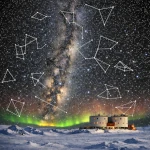 The Night Sky Map in Antarctica: Southern Circumpolar Constellations and Polar Phenomena
 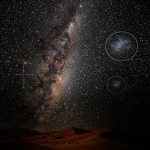 The Night Sky Map in Southern Africa: Constellations and Celestial Objects Season by Season
 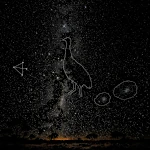 The Night Sky Map in Oceania: Constellations and Celestial Objects Season by Season
 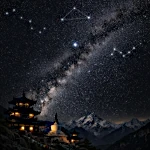 The Night Sky Map in Asia: Constellations and Celestial Objects by Season
  The Night Sky Map Under the Equator: Constellations and Celestial Objects Season by Season
  The Night Sky Map in South America: Constellations and Celestial Objects by Season
  The Night Sky Map in North America: Constellations and Celestial Objects Season by Season
  The Night Sky Map in Europe: Constellations and Celestial Objects by Season
  Zodiac signs
  The 88 Constellations of the Sky: Between Science and Mythology
  The Zodiac: Celestial Heritage of Ancient Civilizations
  From Antiquity to the Astronomical Union: The Path of the 88 Constellations
 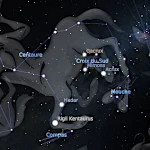 Guide to Southern Constellations: Southern Cross and Other Cosmic Gems
 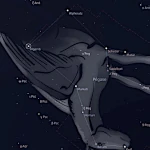 The Guide to Autumn Constellations
  Winter Constellations Guide: When the Stars Shine Brightest
  The Spring Sky Trinity: Leo, Virgo, and Boötes
 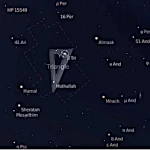 The Summer Constellations Guide
 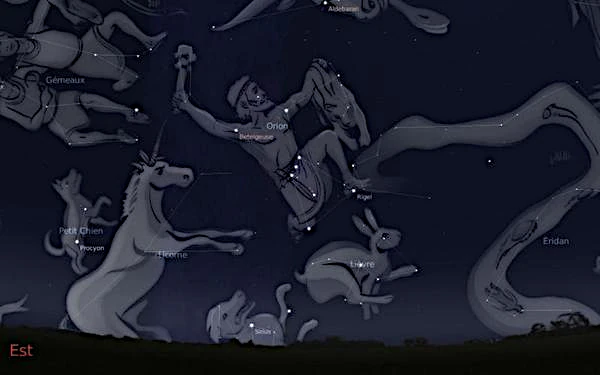 January sky
  February sky
  Mars Sky
  April sky
  May Sky
  June sky
  July sky
  August sky
  September sky
  October Sky
  November sky
  December sky