


The Night Sky Map in Oceania: Constellations and Celestial Objects Season by Season
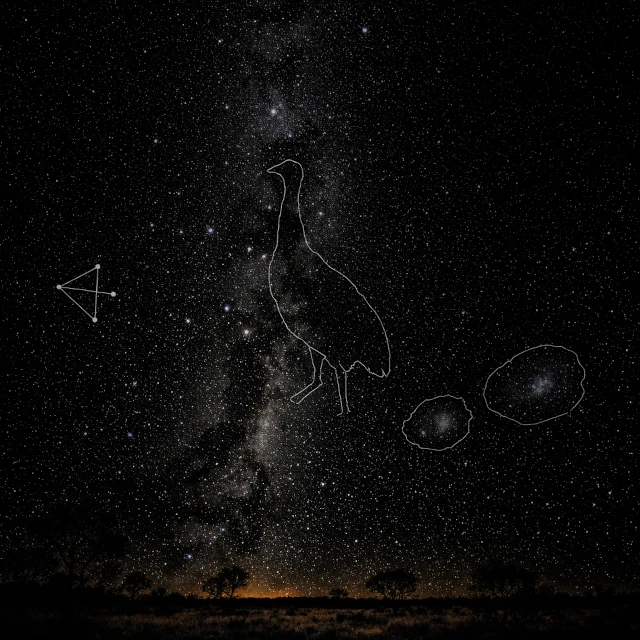
The night sky from the Australian Outback, showing the Milky Way crossing the zenith.
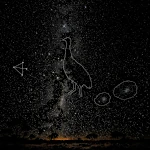
The Southern Cross, the Magellanic Clouds, and the Celestial Emu stand out in a sky of exceptional purity.
Oceania offers some of the darkest and richest skies on the planet.
Image source: astronoo.com (new window)
Scientific Summary
Oceania, from the equator to subantarctic latitudes, offers some of the most preserved skies on the planet, making this region an astronomical sanctuary. This practical guide describes celestial markers for orientation: the Southern Cross, extended by 4.5 times its length, points to the South Celestial Pole, while the Emu in the Sky, an Aboriginal asterism formed by the dark regions of the Milky Way, marks the sky. Circumpolar constellations (Southern Cross, Centaurus, Carina) and the Magellanic Clouds are always visible. The Milky Way and its galactic center culminate at the zenith during the austral winter, offering exceptional observations.
How to find your way around the starry sky of Oceania?
To find your bearings, we mainly use the Southern Cross (Crux): its long axis, extended 4.5 times, points to the South Celestial Pole. Another traditional landmark is the Emu in the Sky, formed by the dark regions of the Milky Way, whose head is the Coalsack Nebula next to the Southern Cross. The Magellanic Clouds (two dwarf galaxies) and the circumpolar constellations (Southern Cross, Centaurus, Carina) are always visible and mark the Oceanian sky.
Also worth exploring
Continue your exploration of the Universe with these topics:
Why is the Oceanic Sky Unique in the World?
Oceania, stretching from the equator to subantarctic latitudes (10° S to 55° S, from New Guinea to Tasmania and New Zealand), offers an exceptional diversity of night skies. Australia, New Zealand, Papua New Guinea, and the thousands of Pacific islands benefit from vast areas free of light pollution, making this region one of the last astronomical sanctuaries on the planet.
The Earth's rotation causes the celestial vault to turn from east to west in 23 hours and 56 minutes (a sidereal day (duration of Earth's rotation relative to the fixed stars, slightly less than the 24-hour solar day)). In practice, the sky "advances" by about two hours per month: a constellation seen rising in the east at 11 PM in December will already be high in the sky by 9 PM in January.
From temperate Oceania (southern Australia, Tasmania, New Zealand), one area of the sky remains always visible: the southern circumpolar circle, centered on the South Celestial Pole (point in the sky located on the Earth's southern rotational axis, lacking a bright pole star). The southern circumpolar constellations, such as the Southern Cross, Carina, Centaurus, Musca, and Triangulum Australe, never set below the horizon for observers south of 35° S.
A major cultural feature of Oceania is Aboriginal and Māori astronomy, one of the oldest astronomical traditions in the world. The Indigenous peoples of Australia and New Zealand developed sophisticated knowledge of celestial movements, using the stars for navigation, seasonal calendars, and the transmission of sacred stories.
Finding South: The Southern Cross and the Celestial Emu
Before any seasonal observation, locate the Southern Cross (the most characteristic constellation of the southern hemisphere, formed by four bright stars in the shape of a cross) (Crux). It indicates the direction of geographic south with remarkable precision, as its long axis points directly toward the South Celestial Pole. Unlike the northern hemisphere, there is no bright pole star in the south: the Southern Cross is therefore used as a fundamental reference.
To find the south celestial pole, extend the long axis of the Southern Cross (the line connecting the bottom star, Acrux, to the top star, Gacrux) by about 4.5 times the length of the cross. This leads to an empty point in the sky, a few degrees from the Southern Pole Star (sigma Octantis, a faint star near the south celestial pole) (Sigma Octantis), which is not visible to the naked eye. This mnemonic trick works all year round.
Another traditional Oceanic reference is the Celestial Emu (asterism formed by the dark regions of the Milky Way that Aboriginal Australians identify as a giant emu in the sky) (Emu in the Sky). It is not composed of stars but of dark areas of the Milky Way: the head of the Emu is formed by the Coalsack Nebula, a dark patch visible to the naked eye next to the Southern Cross. The body and legs of the Emu extend along the Milky Way toward Scorpius and Sagittarius. For Aboriginal peoples, the Celestial Emu indicates the seasons: when the Emu appears in the evening sky, it is time to harvest emu eggs.
The Southern Circumpolar Constellations: Permanent Jewels
For observers in southern Australia (Perth, Adelaide, Melbourne, Sydney, Tasmania) and New Zealand, a set of constellations never sets:
- The Southern Cross (Crux): the most famous, composed of four bright stars. Its brightest star, Acrux (alpha Crucis), is a double star visible to the naked eye.
- Centaurus (Centaurus): contains Alpha Centauri (Rigil Kentaurus), the closest star system to the Sun, and Hadar (beta Centauri), a blue supergiant.
- Carina (Carina): home to Canopus, the second brightest star in the sky after Sirius, as well as the vast Carina Nebula (NGC 3372), visible to the naked eye as a milky patch.
- Musca (Musca): a small, compact constellation between the Southern Cross and Centaurus.
- Triangulum Australe (Triangulum Australe): forms a small, well-visible equilateral triangle.
The Magellanic Clouds: Oceanic Galactic Jewels
One of the most remarkable spectacles of the Oceanic sky is the presence of the Magellanic Clouds (two dwarf satellite galaxies of the Milky Way, visible to the naked eye from the southern hemisphere). These two irregular galaxies, the Large Magellanic Cloud (LMC) and the Small Magellanic Cloud (SMC), are visible to the naked eye as two distinct whitish patches in the southern sky.
The Large Cloud, located in the constellation Dorado, is particularly bright and extensive, covering an area equivalent to several full moons. The Small Cloud, in Tucana, is smaller but just as evident in a dark sky. For the Indigenous peoples of Oceania, these two galaxies have major cultural significance:
- For the Yolngu Aboriginal people of northern Australia, the Magellanic Clouds are the camps of two creator ancestors.
- For the Māori of New Zealand, they are known as Te Pātaka o Rākaihautū (the storehouse of Rākaihautū).
- Polynesian navigators used the Magellanic Clouds as navigational references during their Pacific crossings.
Austral Autumn (March, April, May): Leo and Virgo in the North
In Oceanic autumn, Earth faces a region of the sky rich in galaxies. The Lion's square is easily recognizable: its main star, Regulus (alpha star of Leo, a blue-white giant about 79 light-years away), marks the bottom of the "backward question mark" that forms the head of Leo.
Further east, the constellation Virgo is marked by Spica (alpha star of Virgo, a blue giant about 250 light-years away), a bluish star. To find Spica, use a celestial arc: by extending the arc formed by the tail of Centaurus, you reach Spica. Arcturus (alpha star of Boötes, an orange giant, one of the brightest stars in the northern sky), in Boötes, is a very bright orange giant.
In autumn, the Milky Way sets early, but the Magellanic Clouds remain well visible high in the southwest sky. The Southern Cross culminates in the early evening, about 60° above the horizon from Sydney or Perth.
Austral Winter (June, July, August): The Galactic Center at the Zenith
Winter is the queen season for astronomy in Oceania. The nights are long, and the Milky Way stretches from horizon to horizon. The galactic center (central region of our Galaxy located in the constellation Sagittarius), located in the constellation Sagittarius, culminates high in the sky (sometimes at the zenith depending on latitude).
The constellation Sagittarius is recognizable by its Teapot asterism: eight stars forming a characteristic silhouette, with the "spout" pointing west and the "handle" east. Next to it, the constellation Scorpius draws attention with Antares (alpha Scorpii), a red supergiant with a striking orange hue.
The Southern Diamond (southern winter asterism formed by Sirius, Canopus, Hadar, and Acrux) structures the entire winter sky:
- Sirius (Canis Major): the brightest in the sky, low toward the northwest in the early evening.
- Canopus (Carina): the second brightest, high in the southwest sky.
- Hadar (beta Centauri): toward the southeast, a blue giant.
- Acrux (alpha Crucis): the base of the Southern Cross, to the south.
This is also the ideal time to observe the Carina Nebula (NGC 3372), visible to the naked eye as a milky patch in Carina, containing the massive star Eta Carinae, one of the brightest stars in our Galaxy. The Magellanic Clouds culminate high in the sky in the early evening, offering their best visibility of the year.
For the Māori of New Zealand, this season is marked by the appearance of Matariki (the Pleiades) in the dawn sky, marking the Māori New Year, a festival celebrating the return of ancestral spirits.
Austral Spring (September, October, November): Northern Galaxies
Spring establishes a characteristic geometric reference in the north: the Great Square of Pegasus (asterism formed by four bright stars in the constellations Pegasus and Andromeda). These four stars, almost equally spaced, form a large rectangle clearly visible at the meridian around 10 PM in October.
From the northeast corner of the Square, one moves up toward two stars in the constellation Andromeda, then turns north. This path leads to M31, the Andromeda Galaxy (the closest spiral galaxy to ours visible to the naked eye, about 2.5 million light-years away). Visible to the naked eye in a low-pollution sky as a slightly elongated fuzzy patch, it is the farthest object humans can perceive without instruments.
In the south, the Southern Cross lowers toward the horizon in the early evening, while the Magellanic Clouds remain well visible. This is the season for the Orionid meteor showers (October 21), produced by Halley's Comet, and the Southern Perseids (September), specific to the southern hemisphere.
Austral Summer (December, January, February): Inverted Orion and Warm Nights
Oceanic summer brings warm nights and deep skies. The constellation Orion (one of the most recognizable constellations in the sky, visible in the southern summer with an inverted orientation) dominates the night sky. Unlike the northern hemisphere, Betelgeuse (the red shoulder) is at the bottom right, and Rigel (the blue star) is at the top left. Orion's Belt (the Three Kings) points northeast toward Sirius and northwest toward the Pleiades (M45).
Below the Belt, Orion's Sword contains the Orion Nebula (M42) (active star-forming region in the constellation Orion, visible to the naked eye as a diffuse patch), particularly well placed for observation. The Pleiades (M45) are visible to the naked eye as a tight group of bluish stars, with six to seven discernible stars depending on visual acuity.
Summer is also the season for the Geminid meteor showers (December 13-14), one of the most active of the year, with up to 120 meteors per hour under good conditions. The Quadrantids (early January) also offer a beautiful spectacle, although the tropical rainy season may hinder observation in northern Australia.
What Can Be Seen with the Naked Eye by Season
Without any instrument, the Oceanic sky offers unique spectacles, especially thanks to the Magellanic Clouds and the richness of the southern Milky Way. The Messier catalog, compiled by the French astronomer Charles Messier (1730-1817) in the 18th century, lists several objects accessible without instruments.
| Season | Object | Common Name | Type | Constellation | What You See |
|---|---|---|---|---|---|
| Autumn | Crux | Southern Cross | Constellation | Crux | Four stars in a cross, fundamental reference of the southern sky |
| Autumn | LMC / SMC | Magellanic Clouds | Dwarf Galaxies | Dorado / Tucana | Two distinct whitish patches, satellite galaxies of the Milky Way |
| Winter | Galactic Center | Galactic Bulge | Region of the Milky Way | Sagittarius | Intense bright bulge in the Milky Way, culminating high in the sky |
| Winter | NGC 3372 | Carina Nebula | Emission Nebula | Carina | Diffuse milky patch, one of the largest nebulae visible to the naked eye |
| Winter | Antares | Alpha Scorpii | Supergiant Star | Scorpius | Very bright red-orange star, heart of Scorpius |
| Spring | M31 | Andromeda Galaxy | Spiral Galaxy | Andromeda | Elongated oval patch, the farthest object visible to the naked eye |
| Spring | Great Square of Pegasus | Asterism | Four Stars | Pegasus/Andromeda | Large rectangle of four stars in the north, autumnal reference |
| Summer | M45 | Pleiades | Open Cluster | Taurus | Tight group of bluish stars, six to seven discernible stars |
| Summer | M42 | Orion Nebula | Emission Nebula | Orion | Hazy patch below Orion's Belt, at the heart of the Sword |
| All Year (south of 35° S) | Crux, Centaurus, Carina | Circumpolar Constellations | Constellations | Various | Always visible above the southern horizon in Tasmania and New Zealand |
Aboriginal and Māori Astronomy: A Millennia-Old Science
The Indigenous peoples of Oceania developed sophisticated astronomical knowledge, now recognized as one of the oldest astronomical traditions in the world.
In Australia, Aboriginal peoples identified more than 50 different constellations from Western astronomy. The Celestial Emu (asterism formed by the dark regions of the Milky Way identified as an emu) (Emu in the Sky) is one of the most famous: its head is formed by the Coalsack Nebula, a dark patch visible to the naked eye next to the Southern Cross. The body and legs of the Emu extend along the Milky Way. The different positions of the Celestial Emu throughout the year indicated to Aboriginal peoples the breeding periods of terrestrial emus and the harvest seasons.
In New Zealand, the Māori have a rich astronomical tradition centered on Matariki (the Pleiades). The heliacal rising of Matariki (its appearance in the dawn sky) marks the Māori New Year, celebrated in June-July. The Māori also named the planets: Mercury was Whiro, Venus was Kōpū, Mars was Matahiroa, Jupiter was Pareārau, and Saturn was Pareārau-nui.
In Polynesia, navigators used exceptional astronomical knowledge to cross the Pacific. They oriented themselves by the Milky Way (called Te Ika a Maui in Māori, Maui's fish), bright stars like Sirius and Canopus, and the planets to guide their canoes across the ocean.
Planets Under the Oceanic Sky
Unlike northern temperate latitudes, planets can reach considerable heights in Oceania. The ecliptic (imaginary line on the celestial sphere corresponding to the plane of Earth's orbit) crosses the sky from northeast to southwest, allowing planets to culminate at high altitudes, sometimes at the zenith for observers in northern Australia.
A planet can be distinguished from a star with the naked eye by two characteristics: it does not twinkle (or very little), and its color is often distinctive. Jupiter can culminate very high, offering exceptional observation conditions. Venus is particularly bright and can be visible even during the day for a trained observer.
An opposition (astronomical phenomenon where an outer planet is opposite the Sun) is the ideal time to observe the outer planets: the planet rises at sunset, culminates at the zenith at midnight, and sets at dawn. The following table gives the next oppositions visible from Oceania.
| Planet | Approximate Date | Constellation | Color to the Naked Eye | Height at Culmination (from Sydney) |
|---|---|---|---|---|
| Jupiter | January 2026 | Gemini | Creamy white, very bright | 60-70° |
| Saturn | September 2026 | Aquarius | Golden, stable light | 50-60° |
| Jupiter | February 2027 | Cancer | Creamy white, very bright | 70-80° |
| Mars | February 2027 | Leo | Orange, unmistakable | 80-90° (near the zenith) |
| Saturn | October 2027 | Pisces | Golden, stable light | 40-60° (depending on latitude) |
| Mars | March 2029 | Virgo | Orange, unmistakable | Near the zenith |
Ephemeral Phenomena: Southern Meteor Showers
Oceania is ideally located to observe many meteor showers, as the radiant can culminate high in the sky. The most spectacular meteor showers (periodic phenomenon during which Earth passes through the cometary debris of a meteor shower) from Oceania are:
- The Eta Aquarids (early May): produced by Halley's Comet, particularly active in southern latitudes with hourly rates that can exceed 40 meteors.
- The Perseids (August 12): well visible, with a radiant in Perseus culminating at 40-50° depending on latitude.
- The Orionids (October 21): also linked to Halley's Comet.
- The Geminids (December 13-14): one of the most active, with up to 120 meteors per hour under good conditions.
- The Quadrantids (early January): offer a beautiful spectacle in the southern summer.
The passage of artificial satellites (spacecraft placed in low orbit visible to the naked eye) is particularly spectacular in Oceania, with many passes of the ISS (international Space Station) crossing the sky from west to east. The Australian Outback and rural regions of New Zealand offer ideal conditions for observing these phenomena, far from any light pollution.
A phenomenon particular to Oceania: the southern auroras (Southern Lights) are visible from Tasmania, southern New Zealand, and occasionally from southern Australia during strong solar storms. Unlike the northern lights, they are less frequent but just as spectacular, with green, red, and purple hues dancing in the southern sky.
References
- Astronomical Society of Southern Africa - Observing & Sky Guide (Africa) (new window)
- Sky & Telescope - Stargazing & Observing (North America) (new window)
- European Southern Observatory - Night Visits to Paranal (South America) (new window)
- timeanddate - Night Sky Tonight, Concordia Station (Antarctica) (new window)
- National Astronomical Observatory of Japan - Sky Viewer & Ephemeris (Asia) (new window)
- BBC Sky at Night Magazine - Stargazing (Europe) (new window)
- Telescope & Astronomy - Planet Observation (Europe) (new window)
- Royal Astronomical Society of New Zealand (Oceania) (new window)
FAQ: Everything you need to know about stargazing in Oceania
Why is there no southern pole star, and how do you find south?
Unlike the northern hemisphere, there is no bright southern pole star. So we use the Southern Cross (Crux): by extending its long axis (from the bottom star, Acrux, to the top star, Gacrux) about 4.5 times its length, you reach an empty spot in the sky that marks the South Celestial Pole.
What is the "Emu in the Sky"?
It is a traditional Aboriginal asterism, formed not by bright stars, but by the dark regions of the Milky Way. The head is the Coalsack Nebula (next to the Southern Cross), the neck and body stretch along the Milky Way toward Scorpius. Its position indicated to Aboriginal peoples the seasons for harvesting emu eggs.
What are the Magellanic Clouds and why are they important?
They are two irregular dwarf galaxies (Large and Small Magellanic Clouds), satellites of the Milky Way. Visible to the naked eye as two whitish patches, they hold major cultural importance: for the Yolngu Aboriginal people, they are the camps of creator ancestors; for the Māori, they are known as "the food pantry of Rākaihautū".
When is the best season to observe the Milky Way and the galactic center?
It is during the austral winter (June, July, August). Nights are long, the Milky Way stretches across the sky from horizon to horizon, and the galactic center (in Sagittarius) culminates very high, sometimes at the zenith. This is also the ideal time to observe the Carina Nebula.
What is Matariki for the Māori of New Zealand?
Matariki is the Māori name for the Pleiades (M45). Its heliacal rising (appearance in the dawn sky) marks the Māori New Year, celebrated in June-July. It is a festival honoring the return of ancestral spirits and the beginning of a new year.
 The Night Sky Map in Subtropical Deserts: Constellations and Celestial Objects Season by Season
  The Night Sky Map in the Indian Ocean: Constellations and Celestial Objects Season by Season
  The Night Sky Map in High-Altitude Deserts: Observatories at the Top of the World
  The Night Sky Map in Antarctica: Southern Circumpolar Constellations and Polar Phenomena
  The Night Sky Map in Southern Africa: Constellations and Celestial Objects Season by Season
  The Night Sky Map in Oceania: Constellations and Celestial Objects Season by Season
  The Night Sky Map in Asia: Constellations and Celestial Objects by Season
  The Night Sky Map Under the Equator: Constellations and Celestial Objects Season by Season
  The Night Sky Map in South America: Constellations and Celestial Objects by Season
  The Night Sky Map in North America: Constellations and Celestial Objects Season by Season
  The Night Sky Map in Europe: Constellations and Celestial Objects by Season
  Zodiac signs
  The 88 Constellations of the Sky: Between Science and Mythology
  The Zodiac: Celestial Heritage of Ancient Civilizations
  From Antiquity to the Astronomical Union: The Path of the 88 Constellations
 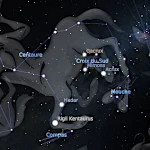 Guide to Southern Constellations: Southern Cross and Other Cosmic Gems
  The Guide to Autumn Constellations
  Winter Constellations Guide: When the Stars Shine Brightest
  The Spring Sky Trinity: Leo, Virgo, and Boötes
  The Summer Constellations Guide
 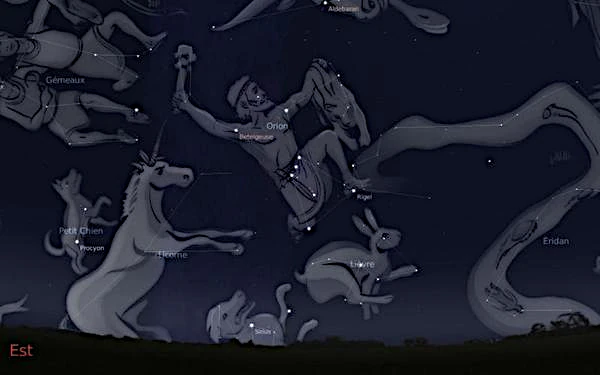 January sky
  February sky
  Mars Sky
  April sky
  May Sky
  June sky
  July sky
  August sky
  September sky
  October Sky
  November sky
  December sky