


The Night Sky Map Under the Equator: Constellations and Celestial Objects Season by Season
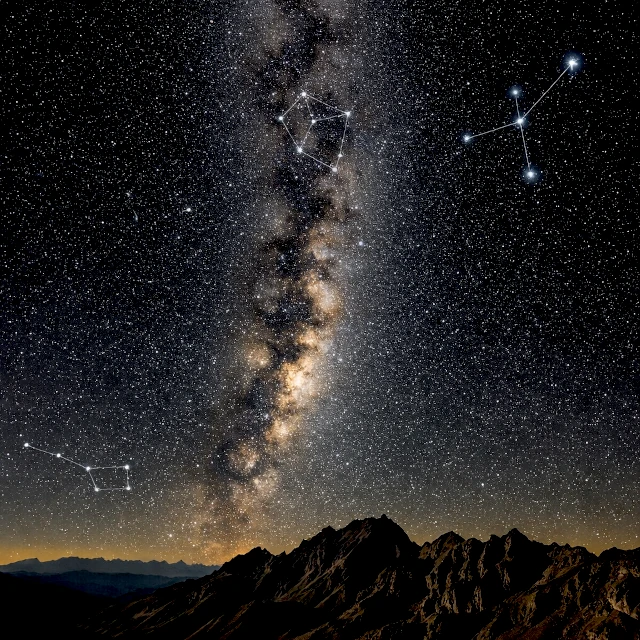
The night sky from the equatorial highlands, showing the Milky Way crossing the zenith.
Northern and southern constellations coexist: Ursa Major to the north, the Southern Cross to the south, Orion at the zenith.
A privileged position to embrace the entire celestial sphere.
Image source: astronoo.com (new window)
Scientific Summary
The equatorial zone offers a unique privilege: observing all the constellations of both hemispheres throughout the seasons. This practical guide describes celestial markers for orientation: the Big Dipper to find North via Polaris, and the Southern Cross, extended by 4.5 times its length, to locate the South Celestial Pole. No constellation is circumpolar, and all stars rise and set vertically. The Milky Way and its galactic center regularly pass through the zenith, while planets can culminate directly overhead.
How to find your way around the starry sky of the equatorial zone?
At the equator, use a dual orientation method: for North, extend the line of the two Big Dipper stars (Dubhe and Merak) five times to find Polaris, low on the northern horizon. For South, extend the long axis of the Southern Cross (Crux) 4.5 times to reach the South Celestial Pole. All stars rise and set vertically, and no constellation is circumpolar: you can observe all constellations from both hemispheres throughout the year, with the Milky Way regularly passing through the zenith.
Also worth exploring
Continue your exploration of the Universe with these topics:
Why is the equatorial sky unique?
From the equatorial zone, between latitudes 10°N and 10°S (from Ecuador and Colombia to northern Brazil, from Kenya to Indonesia), the observer enjoys a unique privilege: they can see all the constellations of both hemispheres throughout the year. This apparent movement of the stars is not theirs: it is the Earth, orbiting the Sun in one year, that points our planet toward different regions of the celestial sphere. Each season corresponds to a new "window" on the Universe, but unlike temperate latitudes, the equator offers a complete view of the northern and southern skies.
The Earth's rotation also rotates the celestial vault from east to west in 23 hours and 56 minutes (a sidereal day (duration of Earth's rotation relative to fixed stars, slightly less than the 24-hour solar day)). In practice, the sky "advances" by about two hours per month: a constellation that rises in the east at 11 p.m. in December will already be high in the sky by 9 p.m. in January. Under the equator, all stars rise and set vertically, offering 12-hour nights all year round with short twilights.
From the equatorial zone, no area of the sky is strictly circumpolar: the two celestial poles are on the northern and southern horizons. This means that throughout the seasons, you can observe both the Big Dipper and Cassiopeia as well as the Southern Cross and the Magellanic Clouds. It is the only latitude where you can see both celestial hemispheres simultaneously.
Finding directions: no polar star, double orientation
Under the equator, finding North and South requires a different approach than in temperate latitudes. Unlike Europe, the Polar Star (alpha star of Ursa Minor, located less than 1° from the North Celestial Pole) (Polaris) is visible but very low on the northern horizon (at a height equal to the observer's latitude, less than 10°). It can be hidden by vegetation or relief. Similarly, the South Celestial Pole has no bright star to mark it.
To find North, use the Big Dipper (the seven brightest stars of Ursa Major, forming an asterism shaped like a ladle) (Ursa Major) when it is visible. The two stars on the edge of the "ladle" (Dubhe and Merak) form the "guards": by extending the line they trace about five times their separation, you land directly on Polaris. At the equator, this method works mainly between September and March, when the Big Dipper is above the horizon.
To find South, use the Southern Cross (the most characteristic constellation of the southern hemisphere, formed by four bright stars in the shape of a cross) (Crux). Extend its long axis (from Acrux to Gacrux) about 4.5 times the length of the cross: you will then land on the South Celestial Pole. The Southern Cross is visible under the equator mainly between February and October, culminating low on the southern horizon.
Once North and South are identified, the orientation of the cardinal points is immediate. An equatorial peculiarity: all stars reach their highest point in the sky when they pass the meridian, but this point is the zenith (90° altitude) for stars located exactly on the celestial equator, such as the three stars of Orion's Belt.
Seasons and climate: an alternation of wet and dry
Unlike temperate latitudes, astronomical seasons under the equator do not correspond to marked thermal variations but to alternations of dry and wet seasons. The best period for astronomical observation is the dry season, generally from June to September in the northern equatorial hemisphere and from December to March in the southern equatorial hemisphere. Equatorial highland regions (Ecuadorian Andes, Kenyan mountains, Ethiopian highlands) offer exceptional observation conditions, with a thinner atmosphere and less cloud cover.
Nights are almost constantly 12 hours long throughout the year, with an astronomical twilight particularly short under the tropics: total darkness arrives about 1.5 hours after sunset, compared to nearly 2.5 hours under temperate latitudes.
The zenithal Milky Way: a unique spectacle
One of the privileges of the equatorial observer is to see the Milky Way (the galaxy in which the Solar System is located, visible as a diffuse milky band crossing the sky) pass exactly through the zenith twice a year. At the beginning of the night, depending on the season, the Milky Way can cross the sky from north to south, forming a perfect circular arc above the observer's head. The galactic center (central region of our Galaxy located in the constellation Sagittarius, visible as an intense bright bulge), located in the constellation Sagittarius, is particularly well placed for observation between May and September, culminating at nearly 80° altitude.
Constellations visible all year round
Unlike temperate zones where some constellations are circumpolar, under the equator, all constellations are visible at least part of the year. However, some constellations close to the celestial equator are observable all year round, although at different times:
- Orion: visible from October to April in the early night, and from May to September in the late night.
- Taurus: containing the Pleiades and Aldebaran, mainly observable from November to March.
- Gemini: with Castor and Pollux, visible from December to April.
- Canis Major: with Sirius, the brightest star in the sky.
First half of the year (January, February, March): Orion at the zenith and the southern summer
In January and February around 10 p.m., the constellation of Orion (one of the most recognizable constellations in the sky, visible under the equator in a vertical orientation) dominates the zenith. Its three stars in a line (the Belt) are almost vertical to the observer, a unique spectacle unknown to Europeans and temperate South Americans. The belt points northwest toward the Pleiades (open cluster of young stars in Taurus, about 444 light-years away) (M45) and southeast toward Sirius (the brightest star in the night sky, 8.6 light-years away).
Below the belt, Orion's sword contains the Orion Nebula (M42) (active star-forming region in the constellation Orion, visible to the naked eye as a diffuse patch), particularly well placed for naked-eye observation. Lower toward the northern horizon, you can see the Big Dipper beginning to rise; toward the southern horizon, the Southern Cross is low but visible in the southern equatorial regions.
The Winter Hexagon (asterism formed by the bright stars of the northern winter, visible under the equator at the beginning of the year) (Sirius, Procyon, Pollux, Capella, Aldebaran, Rigel) forms a large circle around Orion, structuring the entire sky of this season.
Second half of the year (April, May, June): Leo, Virgo, and galaxies
From April, Orion sets toward the western horizon in the early night. The sky is then dominated by the northern spring constellations. Leo with its star Regulus (alpha star of Leo, a blue-white giant) is well placed in the northwest. Virgo with Spica (alpha star of Virgo, a blue giant) shines in the north, while Arcturus (alpha star of Boötes, an orange giant) (Boötes) culminates high in the sky.
This is the ideal period to observe the galaxies of the Virgo Cluster with binoculars, but also the Andromeda Galaxy (M31) (the closest spiral galaxy to ours, 2.5 million light-years away), which becomes visible to the naked eye in the east in the late night. The Milky Way begins to rise in the late night, heralding the season of the galactic center.
In May and June, the Southern Cross is clearly visible low on the southern horizon in the early night, accompanied by the Magellanic Clouds (LMC and SMC) for observers located in the southern equatorial hemisphere (northern Brazil, Ecuador, eastern Peru).
Third half of the year (July, August, September): the galactic center at the zenith
Equatorial astronomy reaches its peak between July and September. The Milky Way crosses the sky from north to south, passing exactly through the zenith. The galactic center (central region of our Galaxy in Sagittarius), located in the constellation Sagittarius, culminates at nearly 90° altitude, offering the best possible observation conditions.
The constellation of Sagittarius is recognizable thanks to its asterism of the Teapot: eight stars forming a characteristic silhouette, the "spout" pointing west, the "handle" pointing east. Just above, the constellation of Scorpio draws attention with Antares, a red supergiant whose orange color is striking.
This is also the period when the southern constellations are highest in the sky:
- The Southern Cross (Crux) culminates between 30° and 50° altitude depending on the latitude.
- The Centaur with its bright stars Alpha Centauri (Rigil Kentaurus) and Hadar (Beta Centauri).
- The Carina with Canopus, the second brightest star in the sky.
- The Magellanic Clouds (Large and Small), visible as two milky patches in the southern sky.
For observers located exactly on the equator, July and August are the only months when you can simultaneously see the Big Dipper very low in the north and the Southern Cross low in the south, a unique spectacle of celestial completeness.
Fourth half of the year (October, November, December): the Great Square and the return of Orion
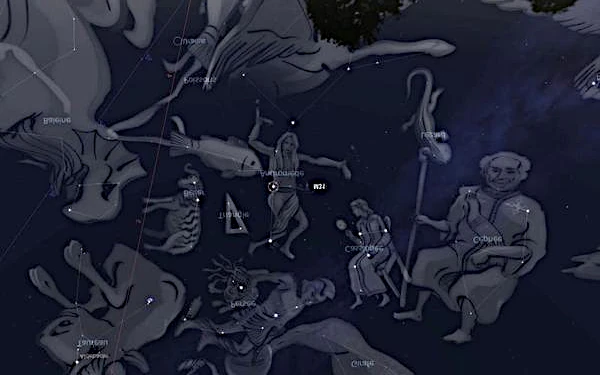
From October, the sky changes radically. The Great Square of Pegasus (asterism formed by four stars from the constellations Pegasus and Andromeda) dominates the sky to the north, heralding the arrival of the northern autumn constellations. The Andromeda Galaxy (andromeda Galaxy, M31) is well placed for naked-eye observation in a dark sky.
In November, the constellation of Orion begins to rise around 10 p.m. in the east, heralding the return of the bright stars of the northern winter. The Pleiades (M45) are already clearly visible in the northeast in the early night.
December is marked by the return of Orion to the zenith in the late night, and by the meteor shower of the Geminids around December 13-14, one of the most active of the year. The Southern Cross becomes difficult to observe for observers in the northern equatorial hemisphere, but remains visible in the early night for those located just south of the equator.
What can be seen with the naked eye by season
Without any instrument, the equatorial sky offers unique spectacles, thanks to the possibility of observing both northern and southern objects. The Messier catalog, compiled by the French astronomer Charles Messier (1730-1817) in the 18th century, includes many objects accessible without instruments.
| Season (northern hemisphere) | Object | Common name | Type | Constellation | What is seen |
|---|---|---|---|---|---|
| January-March | M42 | Orion Nebula | Emission nebula | Orion | Hazy patch below Orion's belt, at the zenith |
| January-March | M45 | Pleiades | Open cluster | Taurus | Tight group of bluish stars, six to seven stars discernible |
| April-June | M44 | Beehive (Praesepe) | Open cluster | Cancer | Diffuse milky patch in a very dark sky |
| April-June | M31 | Andromeda Galaxy | Spiral galaxy | Andromeda | Elongated oval patch, visible in the late night |
| July-September | Galactic Center | Galactic Bulge | Milky Way region | Sagittarius | Intense bright bulge at the zenith, zenithal Milky Way |
| July-September | Southern Cross | Crux | Constellation | Crux | Four stars in a cross, high in the southern sky |
| July-September | Magellanic Clouds | LMC and SMC | Dwarf galaxies | Dorado/Tucana | Two distinct whitish patches in the southern sky |
| October-December | Great Square of Pegasus | Asterism | Four stars | Pegasus/Andromeda | Large rectangle of four stars in the north |
| October-December | Geminids | Meteor shower | Meteor shower | Gemini | Up to 100 meteors per hour around December 13 |
| All year | Orion | The Hunter | Constellation | Orion | Visible at different times depending on the season, always identifiable |
Planets under the equator: a zenithal ecliptic
Unlike temperate latitudes where planets often remain low on the horizon, under the equator, planets (celestial bodies orbiting the Sun in our Solar System) can pass directly through the zenith. The ecliptic (imaginary line on the celestial sphere corresponding to the plane of Earth's orbit) crosses the sky from northeast to southwest, passing through the zenith, offering exceptional observation conditions.
A planet is distinguished from a star to the naked eye by two characteristics: it does not twinkle (or very little) and its color is often distinctive. Jupiter can culminate at 90° altitude, directly above the observer, a spectacle unknown to European observers. Venus, the shepherd's star, also reaches considerable heights, often visible even during the day for a trained observer.
An opposition (astronomical phenomenon where an outer planet is opposite the Sun) is the ideal time to observe the outer planets: the planet rises at sunset, culminates at the zenith at midnight, and sets at dawn. The following table gives the next oppositions visible from the equatorial zone.
| Planet | Approximate date | Constellation | Color to the naked eye | Altitude at culmination |
|---|---|---|---|---|
| Jupiter | January 2026 | Gemini | Creamy white, very bright | Near the zenith |
| Saturn | September 2026 | Aquarius | Golden, steady light | 60-80° depending on latitude |
| Jupiter | February 2027 | Cancer | Creamy white, very bright | Near the zenith |
| Mars | February 2027 | Leo | Orange, unmistakable | 80-90° |
| Saturn | October 2027 | Pisces | Golden, steady light | 50-70° |
| Mars | March 2029 | Virgo | Orange, unmistakable | Near the zenith |
Ephemeral phenomena: equatorial meteor showers
The equatorial zone is ideally located to observe many meteor showers, as the radiant (the point from which meteors appear to originate) can culminate high in the sky. The most spectacular meteor showers (periodic phenomenon during which Earth passes through the cometary debris of a meteor shower) under the equator are:
- Quadrantids (early January): radiant in Boötes, active around January 3.
- Eta Aquarids (early May): produced by Halley's Comet, particularly active under the tropics with hourly rates that can exceed 40 meteors.
- Perseids (August 12): the famous "Tears of St. Lawrence," clearly visible with a radiant in Perseus culminating at 70-80°.
- Orionids (October 21): also linked to Halley's Comet.
- Geminids (December 13-14): one of the most active, with up to 120 meteors per hour under good conditions.
The passage of artificial satellites (spacecraft placed in low orbit visible to the naked eye) is particularly spectacular under the equator, as low-orbit satellites can pass directly through the zenith. The ISS (international Space Station) offers regular zenithal passes, with exceptional brightness. The Starlink (spaceX's Starlink mega-constellation of satellites) form particularly visible satellite trains a few days after each launch.
Rare phenomena: eclipses and occultations
The equatorial zone is the region of the world where the passages of the Moon and the Sun are the most spectacular. Total solar eclipses are frequent under the tropics, with longer totality durations than at temperate latitudes. Occultations of stars by the Moon are also more frequent and more spectacular, with the Moon regularly passing in front of bright stars such as Antares, Spica, or Regulus.
A phenomenon unique to equatorial regions: bright planets and stars can culminate at the zenith, a rare and impressive spectacle where the celestial object is exactly vertical to the observer. This configuration occurs for stars whose declination is equal to the observer's latitude. Under the equator, Orion's Belt (declination 0°) passes exactly through the zenith twice a year.
References
- Astronomical Society of Southern Africa - Observing & Sky Guide (Africa) (new window)
- Sky & Telescope - Stargazing & Observing (North America) (new window)
- European Southern Observatory - Night Visits to Paranal (South America) (new window)
- timeanddate - Night Sky Tonight, Concordia Station (Antarctica) (new window)
- National Astronomical Observatory of Japan - Sky Viewer & Ephemeris (Asia) (new window)
- BBC Sky at Night Magazine - Stargazing (Europe) (new window)
- Telescope & Astronomy - Planet Observation (Europe) (new window)
- Royal Astronomical Society of New Zealand (Oceania) (new window)
FAQ: Everything you need to know about stargazing in the equatorial zone
Why is there no usable pole star at the equator?
The North Star (Polaris) does exist but is very low on the northern horizon (at a height equal to the observer's latitude, less than 10°). It is often hidden by vegetation or terrain. Likewise, the South Celestial Pole has no bright star to mark it. Therefore, indirect methods are used: the Big Dipper to find North, and the Southern Cross to find South.
How do you find North and South at the equator?
For North, use the Big Dipper (visible from September to March): extend the line of the two bowl-edge stars (Dubhe and Merak) about five times their distance apart to reach Polaris. For South, use the Southern Cross (Crux) (visible from February to October): extend its long axis (from Acrux to Gacrux) 4.5 times its length to reach the South Celestial Pole.
What is the unique advantage of the equatorial sky?
Equatorial observers enjoy a unique privilege: they can see all constellations from both hemispheres over the course of the year. No constellation is circumpolar, and all stars rise and set vertically. It is the only latitude where you can simultaneously see the Big Dipper very low in the north and the Southern Cross low in the south (in July-August).
When is the best time to observe the Milky Way and galactic center at the equator?
The best period is between July and September. The Milky Way then crosses the sky from north to south, passing exactly through the zenith. The galactic center (in Sagittarius) culminates at nearly 90° altitude, offering the best possible viewing conditions. This is also the ideal time to observe the Southern Cross, the Magellanic Clouds, and the southern constellations.
What celestial objects can be seen with the naked eye from the equator?
Several objects are accessible: the Orion Nebula (M42) at the zenith in January-March, the Pleiades (M45), the Andromeda Galaxy (M31) in the late-night sky in spring, the galactic center at the zenith in July-September, the Southern Cross, and the Magellanic Clouds (two dwarf galaxies visible as whitish patches). Planets (Jupiter, Venus, Mars, Saturn) can also pass directly through the zenith, a rare spectacle.
 The Night Sky Map in Subtropical Deserts: Constellations and Celestial Objects Season by Season
  The Night Sky Map in the Indian Ocean: Constellations and Celestial Objects Season by Season
  The Night Sky Map in High-Altitude Deserts: Observatories at the Top of the World
 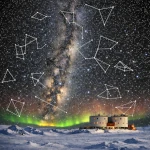 The Night Sky Map in Antarctica: Southern Circumpolar Constellations and Polar Phenomena
 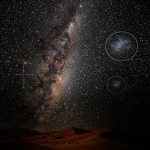 The Night Sky Map in Southern Africa: Constellations and Celestial Objects Season by Season
 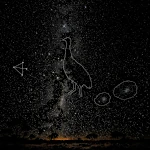 The Night Sky Map in Oceania: Constellations and Celestial Objects Season by Season
 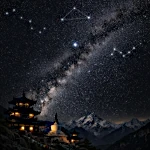 The Night Sky Map in Asia: Constellations and Celestial Objects by Season
 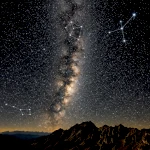 The Night Sky Map Under the Equator: Constellations and Celestial Objects Season by Season
  The Night Sky Map in South America: Constellations and Celestial Objects by Season
  The Night Sky Map in North America: Constellations and Celestial Objects Season by Season
  The Night Sky Map in Europe: Constellations and Celestial Objects by Season
  Zodiac signs
  The 88 Constellations of the Sky: Between Science and Mythology
  The Zodiac: Celestial Heritage of Ancient Civilizations
  From Antiquity to the Astronomical Union: The Path of the 88 Constellations
  Guide to Southern Constellations: Southern Cross and Other Cosmic Gems
  The Guide to Autumn Constellations
  Winter Constellations Guide: When the Stars Shine Brightest
  The Spring Sky Trinity: Leo, Virgo, and Boötes
  The Summer Constellations Guide
 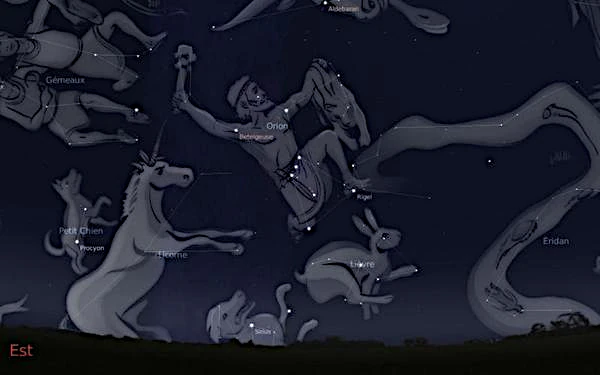 January sky
  February sky
 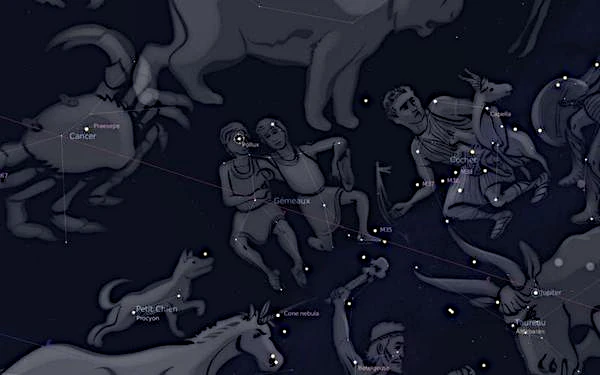 Mars Sky
 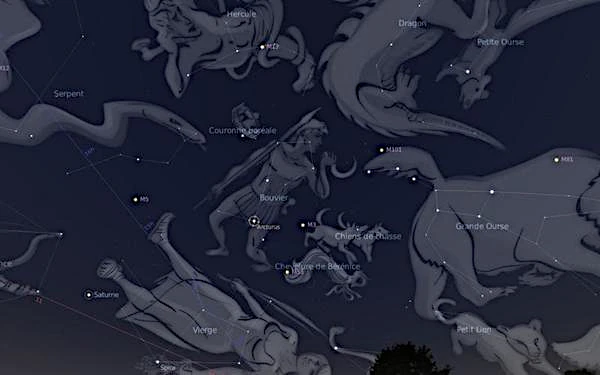 April sky
 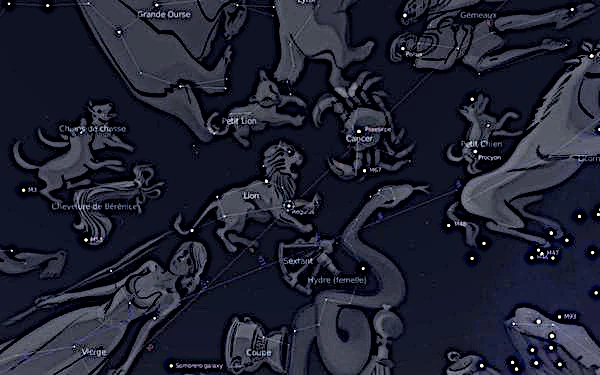 May Sky
 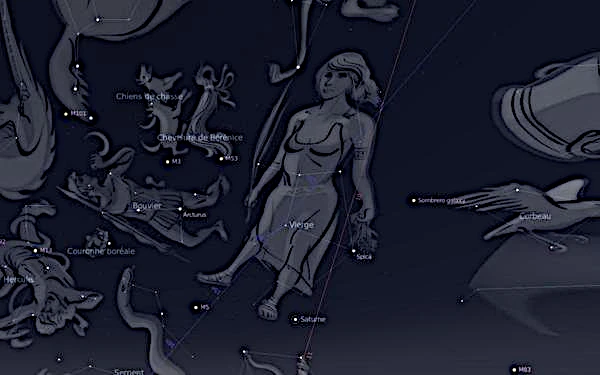 June sky
  July sky
  August sky
  September sky
  October Sky
  November sky
  December sky