


The night sky map in high-altitude deserts: observatories at the roof of the world
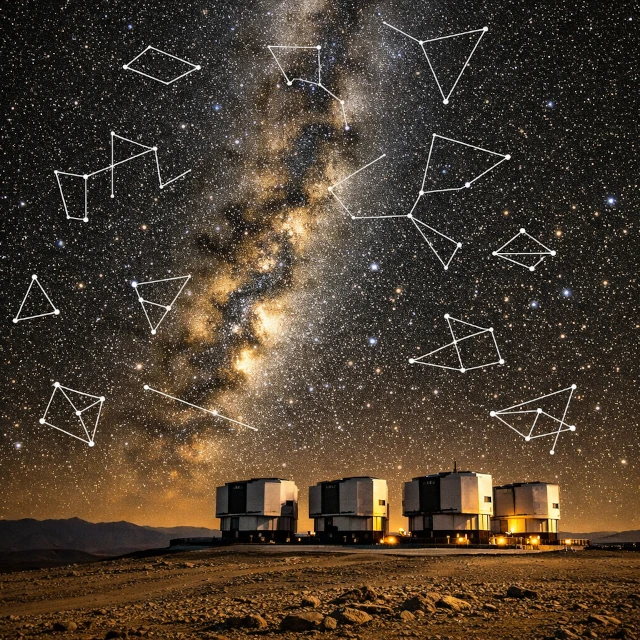
The night sky from the Paranal Observatory in the Atacama Desert in Chile, at 2,635 m altitude.
The four telescopes of the Very Large Telescope (VLT) stand out against the Milky Way, whose galactic centre is perfectly visible.
The Atacama, one of the driest and highest deserts in the world, offers unmatched observing conditions.
Image source: astronoo.com (new window) — AI-generated image, public domain.
Scientific summary
High-altitude deserts (Atacama, Mauna Kea, Canaries, Himalaya, American West), located between 2,000 and 5,000 m, offer the best conditions for astronomical observation: thin and stable atmosphere, extreme aridity, absence of light pollution and more than 300 usable nights per year. This practical guide describes the seasonal celestial landmarks used for orientation: the Southern Cross in the southern hemisphere, the Pole Star via the Great Bear in the northern hemisphere. The Milky Way, the galactic centre, the Magellanic Clouds and distant galaxies are visible there to the naked eye with exceptional detail.
How do you find your way in the starry sky of high-altitude deserts?
High-altitude deserts (Atacama, Mauna Kea, Canaries, Himalaya, American West), located between 2,000 and 5,000 m, offer the best observing conditions in the world: thin and stable atmosphere, almost total absence of light pollution, extreme aridity and more than 300 usable nights per year. To orient themselves, observers use celestial landmarks depending on the hemisphere: in the south (Atacama, Andes), the Southern Cross and the Magellanic Clouds are the fundamental guides; in the north (Hawaii, Canaries, Himalaya, American West), the Great Bear leads to the Pole Star. The Milky Way, the galactic centre and distant galaxies (Andromeda, Magellanic Clouds) are visible there to the naked eye with exceptional detail.
Also worth exploring
Continue your exploration of the Universe with these topics:
- The Night Sky Map in the Indian Ocean: Constellations and Celestial Objects Season by Season
- The Night Sky Map in North America: Constellations and Celestial Objects Season by Season
- The 88 Constellations of the Sky: Between Science and Mythology
- The Night Sky Map in South America: Constellations and Celestial Objects by Season
Why are high-altitude deserts the sanctuaries of world astronomy?
High-altitude deserts represent the most exceptional astronomical observation sites on the planet. Located between 2,000 and 5,000 metres altitude, in arid regions with perpetually clear skies, they concentrate the largest observatories in the world. From the Chilean Atacama to the summits of the Himalaya, via the Argentine Andes, the volcanoes of Hawaii and the high plateaus of the Canary Islands, these sites offer unique conditions: thin and stable atmosphere, almost total absence of light pollution, low water vapour content, and nights of exceptional quality.
The Earth's rotation on itself makes the celestial vault turn from east to west in 23 hours 56 minutes (a sidereal day (rotation period of the Earth relative to the fixed stars, slightly less than the 24-hour solar day)). In high-altitude deserts, the atmosphere is so stable that the "seeing" (atmospheric turbulence) is often less than one arcsecond, allowing observations of exceptional sharpness.
Unlike temperate latitudes, high-altitude deserts are distributed over both hemispheres, offering complementary observing windows on the entire sky. Their common characteristics are:
- High altitude: reduction of the thickness of atmosphere crossed, therefore less absorption and turbulence
- Extreme aridity: very low water vapour content, crucial for infrared and submillimetre observation
- Distance from urban centres: almost total absence of light pollution
- Atmospheric stability: weak winds, thermal inversions, perpetually clear sky
- Quality nights: more than 300 usable nights per year at the best sites
The main astronomical high-altitude deserts
This table lists the main high-altitude deserts and high-mountain astronomical sites in the world, with their altitudes and major observatories.
| Region / Desert | Country / Territory | Altitude | Major observatories | Characteristics |
|---|---|---|---|---|
| Atacama Desert The best site in the world | Chile | 1) 2,635 m (Paranal) 2) 2,400 m (La Silla) 3) 5,000 m (ALMA) 4) 2,380 m (Las Campanas) 5) 2,200 m (Cerro Tololo) 6) 2,700 m (Cerro Pachón) | 1) Paranal: VLT (ESO) — 4 telescopes of 8.2 m + 4 auxiliary of 1.8 m 2) La Silla: ESO's first observatory in Chile, about twenty telescopes 3) ALMA: Atacama Large Millimeter/submillimeter Array, the largest radio telescope in the world 4) Las Campanas: Magellan telescopes (2 x 6.5 m) + future GMT (25 m) 5) Cerro Tololo: Victor Blanco telescope (4 m) + Dark Energy Camera (DECam) 6) Cerro Pachón: SOAR telescope + Gemini South (8.1 m) | Driest desert in the world, exceptional sky, more than 300 usable nights per year |
| Hawaiian Volcanoes Mauna Kea and Mauna Loa | United States (Hawaii) | 1) 4,207 m (Mauna Kea) 2) 3,397 m (Mauna Loa) | 1) Mauna Kea Observatories: Keck (2 x 10 m), Subaru (8.2 m), Gemini North (8.1 m), CFHT (3.6 m), JCMT (submillimetre) 2) Mauna Loa Observatory: atmospheric studies (CO₂) and solar astronomy | Oceanic isolation, stable atmosphere, thermal inversion |
| Argentine and Bolivian Andes | Argentina Argentina Bolivia | 1) (Córdoba) 2) 2,550 m (CASLEO) 3) 5,200 m (Chacaltaya) | 1) Observatory of the National University of Córdoba: historical observatory 2) El Leoncito Astronomical Complex (CASLEO): Jorge Sahade telescope (2.15 m) 3) Chacaltaya Observatory: one of the highest in the world, cosmic ray studies | Sites of extreme altitude, often above 4,000 m |
| Canary Islands | Spain | 1) 2,396 m (La Palma) 2) 2,390 m (Tenerife) | 1) Roque de los Muchachos Observatory: Gran Telescopio Canarias (GTC) of 10.4 m (largest optical telescope), WHT (4.2 m), NOT (2.5 m), MAGIC (gamma rays) 2) Teide Observatory: THEMIS solar telescope and other instruments | Thermal inversion created by the trade winds, exceptional sky quality |
| Himalaya and Tibetan Plateau The roof of the world | India (Ladakh) Tibet Tibet Tibet | 1) 4,500 m (IAO) 2) 4,300 m (Mt LP) 3) 5,100 m (Ngari) 4) 4,800 m (Eastern high plateau) | 1) Indian Astronomical Observatory (IAO): Himalayan Chandra telescope (2 m) 2) Mt LP Observatory: cosmic ray research and gamma astronomy 3) Ngari Observatory: under construction, optical and infrared astronomy 4) Eastern High Plateau Observatory: Sino-Japanese submillimetre observatory | Sites of extreme altitude, exceptional potential, still under development |
| American West deserts | Arizona Texas Arizona California California | 1) 2,096 m (Kitt Peak) 2) 2,070 m (McDonald) 3) 2,210 m (Lowell) 4) 1,742 m (Mount Wilson) 5) 1,713 m (Palomar) | 1) Kitt Peak Observatory: largest collection of telescopes in the world (about twenty instruments) 2) McDonald Observatory: Hobby-Eberly telescope (9.2 m) 3) Lowell Observatory: where Pluto was discovered 4) Mount Wilson Observatory: historic, where Hubble discovered the expansion of the Universe 5) Palomar Observatory: Hale telescope (5 m) | Moderate-altitude deserts (1,500-2,500 m), historical and active sites |
What can be seen with the naked eye from high-altitude deserts
Naked-eye observation from a high-altitude desert is a radically different experience from what one can experience at temperate latitudes or in the plains. The absence of light pollution, atmospheric transparency and sky stability allow the perception of details invisible elsewhere.
| Hemisphere | Object | Common name | Type | Constellation | High-altitude particularity |
|---|---|---|---|---|---|
| Southern hemisphere (Atacama, Andes, southern Himalaya) | Milky Way | Galactic centre | Galaxy | Sagittarius/Scorpius | Visible as an intense luminous bulge, with nebulae distinct to the naked eye |
| Southern hemisphere (Atacama, Andes, southern Himalaya) | Large Magellanic Cloud | LMC | Dwarf galaxy | Dorado | Spiral structure perceptible to the naked eye under the best conditions |
| Southern hemisphere (Atacama, Andes, southern Himalaya) | Small Magellanic Cloud | SMC | Dwarf galaxy | Tucana | Visible as a well-defined patch, smaller but distinct |
| Southern hemisphere (Atacama, Andes, southern Himalaya) | Carina Nebula | NGC 3372 | Emission nebula | Carina | Visible to the naked eye as a large milky patch, brighter than elsewhere |
| Southern hemisphere (Atacama, Andes, southern Himalaya) | Omega Centauri | NGC 5139 | Globular cluster | Centaurus | Partially resolved to the naked eye under the best conditions |
| Southern hemisphere (Atacama, Andes, southern Himalaya) | Southern Cross | Crux | Constellation | Crux | Of exceptional sharpness, the Coalsack very distinct |
| Northern hemisphere (Hawaii, Canaries, northern Himalaya, American West) | Milky Way | Orion and Cygnus arms | Galaxy | Cygnus/Cassiopeia | Visible as a dense ribbon crossing the zenith |
| Northern hemisphere (Hawaii, Canaries, northern Himalaya, American West) | Andromeda Galaxy | M31 | Spiral galaxy | Andromeda | Visible as an extended oval, the central bulge distinct |
| Northern hemisphere (Hawaii, Canaries, northern Himalaya, American West) | Pleiades | M45 | Open cluster | Taurus | More than 10 stars discernible to the naked eye in a dark sky |
| Northern hemisphere (Hawaii, Canaries, northern Himalaya, American West) | Orion Nebula | M42 | Emission nebula | Orion | Visible as a structured luminous patch, sometimes with a greenish tint |
| Northern hemisphere (Hawaii, Canaries, northern Himalaya, American West) | Double Cluster in Perseus | h and chi Persei | Open clusters | Perseus | Two patches distinct to the naked eye in a quality sky |
| Northern hemisphere (Hawaii, Canaries, northern Himalaya, American West) | Pole Star | Polaris | Star | Ursa Minor | Accompanied by a circle of circumpolar stars of rare sharpness |
Observing seasons in high-altitude deserts
Unlike temperate zones, seasons in high-altitude deserts are marked mainly by the position of the Sun and local weather conditions. The best observing periods vary according to hemisphere and latitude.
Atacama Desert (Chile) — southern hemisphere, 24° S
Ideal season: April to September (austral winter and spring)
The austral winter (June-August) offers the longest and most stable nights. The galactic centre culminates high in the sky, and the Magellanic Clouds are perfectly placed. Temperatures drop to -10°C at night, but the air is extremely dry. Summer (December-February) is marked by the arrival of the Altiplano Winter (rains on the Altiplano) which can occasionally affect the summits.
Mauna Kea (Hawaii) — northern hemisphere, 20° N
Ideal season: all year round, with a peak from April to October
Hawaii enjoys an exceptionally stable high-altitude tropical climate. The dry season (May to October) offers the best conditions. Tropical storms are rare and only occasionally affect the summit.
Canary Islands (Spain) — northern hemisphere, 28° N
Ideal season: June to September, and December to February
The thermal inversion created by the trade winds guarantees exceptional atmospheric stability all year round. Summer nights are shorter but offer excellent transparency. Winter brings longer nights and often optimal conditions.
Himalaya and Tibetan Plateau — northern hemisphere, 30-35° N
Ideal season: October to April
The Himalayan winter (December-February) offers the best conditions: dry sky, no monsoon, very cold temperatures (-20°C to -30°C). The monsoon (June-September) makes observation impossible.
American West deserts — northern hemisphere, 30-35° N
Ideal season: April to June, September to November
Spring and autumn offer the best compromise between night length and atmospheric stability. Summer is marked by the Arizona monsoon (July-August rains) which reduces sky quality. Winter can bring snow to the highest sites.
Amateur observation in high-altitude deserts
For amateur astronomers, high-altitude deserts offer unique opportunities, but require specific preparation.
Sites accessible to amateurs
- Atacama (Chile): several astronomical lodges welcome tourists and amateurs (San Pedro de Atacama, Elqui Valley)
- Canary Islands (Spain): amateur observation points exist around the professional observatories
- Hawaii (United States): the Mauna Kea visitor centre offers observations, but access to the summit is regulated
- South-western American deserts: many amateur sites (Arizona, New Mexico, California)
- Himalaya (India, Nepal, Tibet): access more difficult, but astronomical lodges are beginning to develop
Precautions and advice
- Acclimatisation to altitude: acute mountain sickness (AMS) can occur from 2,500 m. Allow several days of acclimatisation before observing.
- Sun protection: ultraviolet is much more intense at altitude. Sunscreen, protective glasses, hat essential even at night (lunar reflection).
- Warm clothing: even in hot deserts, night temperatures at altitude often drop below 0°C. Plan several layers.
- Hydration: the air is extremely dry, dehydration is rapid. Drink regularly, avoid alcohol.
- Equipment: telescopes and cameras must be acclimatised. Provide extra batteries (cold reduces their autonomy).
- Respect for sites: many professional observatories are located in protected areas. Respect access rules and observation zones reserved for amateurs.
The unique atmospheric phenomena of high-altitude deserts
The extreme dryness and purity of the atmosphere of high-altitude deserts allow the observation of rare atmospheric phenomena:
- The green flash: optical phenomenon observed at sunset, particularly visible in the Atacama
- Noctilucent clouds: observed in summer at high latitudes, but sometimes visible from high-altitude deserts
- Halos and parhelia: luminous circles around the Sun, frequent in the cold, dry air of the high plateaus
- Airglow: natural atmospheric emission, often visible as a faint greenish glow in the darkest skies
- Zodiacal light: cone of diffuse light along the ecliptic, visible in skies free of light pollution
The planets in high-altitude deserts
Planetary observation particularly benefits from the atmospheric stability of high-altitude deserts. The exceptional seeing (often less than 0.5 arcsecond) allows the discernment of details impossible to see elsewhere.
Jupiter: the equatorial bands, the Great Red Spot, and the shadows of the Galilean moons are clearly visible with amateur telescopes. Saturn: the Cassini division in the rings is often resolved, and details of the planet itself appear. Mars: during favourable oppositions, the polar caps and surface albedo variations are perceptible. Venus: the phases are of exceptional sharpness.
An opposition (astronomical phenomenon where an outer planet is opposite the Sun) is particularly favourable from high-altitude deserts, because atmospheric stability allows full use of the resolution of instruments. The following table gives the next major oppositions.
| Planet | Approximate date | Constellation | Favourable hemisphere | Observable details |
|---|---|---|---|---|
| Jupiter | January 2026 | Gemini | North and south | Bands, Great Red Spot |
| Saturn | September 2026 | Aquarius | North and south | Rings, Cassini division |
| Jupiter | February 2027 | Cancer | North and south | Bands, Great Red Spot |
| Mars | February 2027 | Leo | North and south (best in the south) | Polar caps, surface details |
| Saturn | October 2027 | Pisces | North and south | Widely open rings |
| Mars | March 2029 | Virgo | North and south (best in the south) | Favourable opposition, large apparent diameter |
Ephemeral phenomena: meteor showers, eclipses and satellites
High-altitude deserts offer exceptional conditions for observing ephemeral celestial phenomena. The absence of light pollution and atmospheric transparency allow these events to be appreciated under optimal conditions.
Meteor showers
Meteor showers (periodic phenomenon during which the Earth crosses the cometary debris of a meteoroid stream) are among the most spectacular phenomena. From high-altitude deserts, the observable hourly rate is often higher than standard predictions.
| Shower | Peak maximum | Radiant | ZHR (max) |
|---|---|---|---|
| Quadrantids | 3-4 January | Boötes | 60-120 |
| Eta Aquariids | 5-6 May | Aquarius | 30-60 |
| Perseids | 12-13 August | Perseus | 60-100 |
| Orionids | 21-22 October | Orion | 15-25 |
| Geminids | 13-14 December | Gemini | 80-120 |
| Alpha Centaurids | 8 February | Centaurus | 5-10 |
Eclipses
High-altitude deserts are privileged sites for observing eclipses. Low cloud cover and atmospheric transparency offer optimal conditions.
Next remarkable total solar eclipses
- 12 August 2026: total in Spain (near the Canary Islands)
- 2 August 2027: total in North Africa, Arabian Peninsula
- 25 November 2030: total in Botswana, South Africa (Kalahari Desert)
Next total lunar eclipses
- 28 August 2026, 20-21 January 2027, 17-18 July 2027
Visible artificial satellites
- ISS (International Space Station): the most spectacular, brightness capable of surpassing Jupiter (magnitude -3 to -5), passes in 2-5 minutes
- Starlink (SpaceX): satellite constellations, visible in "train" just after launches
- OneWeb, Iridium (flares), scientific satellites (Hubble, etc.)
Observation: consult applications (Heavens-Above, ISS Detector) to know the passes. A satellite is distinguished by its regular, silent movement, and the absence of scintillation.
The multiplication of satellite constellations poses a challenge for professional astronomy. Agreements with operators have reduced the impact (anti-reflective coatings, radio silence zones around major observatories).
References
- Astronomical Society of Southern Africa - Observing & Sky Guide (Africa) (new window)
- Sky & Telescope - Stargazing & Observing (North America) (new window)
- European Southern Observatory - Night Visits to Paranal (South America) (new window)
- timeanddate - Night Sky Tonight, Concordia Station (Antarctica) (new window)
- National Astronomical Observatory of Japan - Sky Viewer & Ephemeris (Asia) (new window)
- BBC Sky at Night Magazine - Stargazing (Europe) (new window)
- Telescope & Astronomy - Planet Observation (Europe) (new window)
- Royal Astronomical Society of New Zealand (Oceania) (new window)
FAQ: Everything you need to know about celestial navigation in high-altitude deserts
Why are high-altitude deserts the best astronomical sites in the world?
Located between 2,000 and 5,000 m altitude, these sites (Atacama, Mauna Kea, Canaries, Himalaya, American West) offer unique conditions: thin and stable atmosphere reducing turbulence (seeing often less than 1 arcsecond), extreme aridity (low water vapour content, crucial for infrared), almost total absence of light pollution, and more than 300 usable nights per year.
What are the main astronomical high-altitude deserts?
The major sites are: the Atacama Desert (Chile, 2,400-5,000 m) with the VLT and ALMA, the best site in the world; Mauna Kea (Hawaii, 4,207 m) with the Keck and Subaru telescopes; the Canary Islands (La Palma and Tenerife, 2,400 m) with the Gran Telescopio Canarias; the Himalaya and Tibetan Plateau (4,500-5,200 m) under development; and the American West deserts (Kitt Peak, McDonald, Palomar).
How do you find south in high-altitude deserts of the southern hemisphere?
In the southern hemisphere (Atacama, Andes), the Southern Cross (Crux) is used. Its long axis is extended over a distance about 4.5 times the length of the cross to locate the celestial South Pole. The Magellanic Clouds (dwarf satellite galaxies of the Milky Way) are also valuable landmarks, visible as two distinct milky patches.
How do you find north in high-altitude deserts of the northern hemisphere?
For the northern hemisphere (Hawaii, Canaries, Himalaya, American West), the Great Bear (Ursa Major) is used. The two stars on the edge of the "saucepan" (Dubhe and Merak) form the "guards": by extending the line they trace over about five times their separation, one falls directly on Polaris, the Pole Star.
What objects can be seen with the naked eye from high-altitude deserts?
In the southern hemisphere: the galactic centre as an intense luminous bulge, the Magellanic Clouds (LMC and SMC), the Carina Nebula, Omega Centauri, and the Southern Cross with the very distinct Coalsack. In the northern hemisphere: the Milky Way as a dense ribbon, the Andromeda galaxy (M31) as an extended oval, the Pleiades (M45) with more than 10 discernible stars, the Orion Nebula (M42), and the Double Cluster in Perseus.
What is the best season to observe in each high-altitude desert?
Atacama: April to September (austral winter) — galactic centre high, long nights. Mauna Kea: all year round, peak from April to October (dry season). Canary Islands: June to September and December to February — thermal inversion guarantees exceptional stability. Himalaya: October to April (winter) — dry sky, no monsoon. American West: April to June, September to November — spring and autumn.
Why is planetary observation exceptional from high-altitude deserts?
The exceptional atmospheric stability (seeing often less than 0.5 arcsecond) allows details impossible elsewhere: Jupiter shows its equatorial bands, the Great Red Spot and the shadows of the Galilean moons; Saturn reveals the Cassini division in the rings; Mars presents its polar caps and surface albedo variations during favourable oppositions.
What precautions should be taken to observe from high-altitude deserts?
Acclimatisation to altitude (acute mountain sickness can occur from 2,500 m): allow several days before observing. Sun protection: ultraviolet is much more intense, even at night (lunar reflection). Warm clothing: night temperatures often drop below 0°C. Hydration: the air is extremely dry, drink regularly. Equipment: extra batteries (cold reduces their autonomy).
What unique atmospheric phenomena can be observed in high-altitude deserts?
The green flash at sunset (particularly visible in the Atacama), halos and parhelia (luminous circles around the Sun), airglow (natural greenish atmospheric emission in the darkest skies), and the zodiacal light (cone of diffuse light along the ecliptic).
What observation sites are accessible to amateurs?
Atacama: astronomical lodges in San Pedro de Atacama and the Elqui Valley. Canary Islands: amateur observation points around the professional observatories. Hawaii: Mauna Kea visitor centre (summit access regulated). American West: many amateur sites in Arizona, New Mexico and California. Himalaya: astronomical lodges are beginning to develop.
 The Night Sky Map in Subtropical Deserts: Constellations and Celestial Objects Season by Season
  The Night Sky Map in the Indian Ocean: Constellations and Celestial Objects Season by Season
  The Night Sky Map in High-Altitude Deserts: Observatories at the Top of the World
  The Night Sky Map in Antarctica: Southern Circumpolar Constellations and Polar Phenomena
  The Night Sky Map in Southern Africa: Constellations and Celestial Objects Season by Season
  The Night Sky Map in Oceania: Constellations and Celestial Objects Season by Season
  The Night Sky Map in Asia: Constellations and Celestial Objects by Season
  The Night Sky Map Under the Equator: Constellations and Celestial Objects Season by Season
  The Night Sky Map in South America: Constellations and Celestial Objects by Season
  The Night Sky Map in North America: Constellations and Celestial Objects Season by Season
  The Night Sky Map in Europe: Constellations and Celestial Objects by Season
  Zodiac signs
  The 88 Constellations of the Sky: Between Science and Mythology
  The Zodiac: Celestial Heritage of Ancient Civilizations
  From Antiquity to the Astronomical Union: The Path of the 88 Constellations
  Guide to Southern Constellations: Southern Cross and Other Cosmic Gems
  The Guide to Autumn Constellations
  Winter Constellations Guide: When the Stars Shine Brightest
  The Spring Sky Trinity: Leo, Virgo, and Boötes
  The Summer Constellations Guide
  January sky
  February sky
  Mars Sky
  April sky
  May Sky
  June sky
  July sky
  August sky
  September sky
  October Sky
  November sky
  December sky