


The Night Sky Map in Antarctica: Southern Circumpolar Constellations and Polar Phenomena
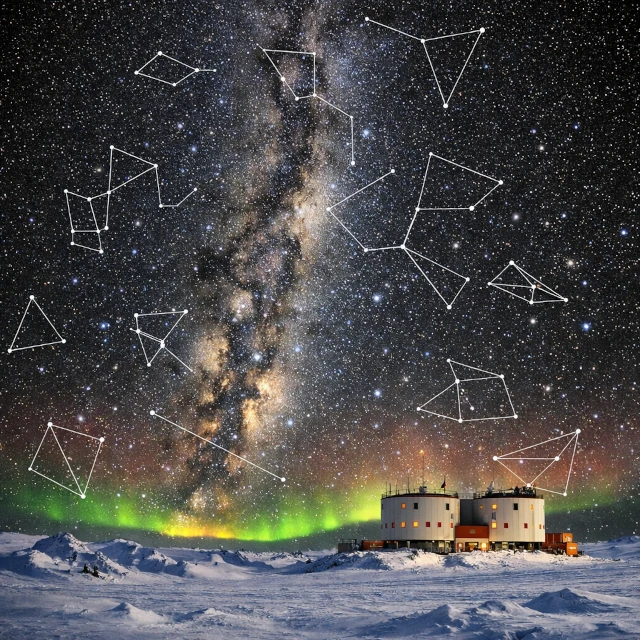
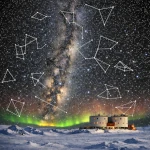
The night sky from the Antarctic plateau, near the Franco-Italian Concordia base (Dome C).
The Milky Way crosses the zenith, the southern circumpolar constellations are perfectly visible, and southern auroras dance on the horizon.
Antarctica offers unique observation conditions, with six-month polar nights and an exceptionally stable atmosphere.
Image source: astronoo.com (new window)
Scientific Summary
Antarctica offers unique astronomical observing conditions: during the polar night (April to September), darkness is continuous and all visible stars are circumpolar, circling the South Celestial Pole without ever rising or setting. This practical guide describes celestial markers for orientation: the Southern Cross, extended by 4.5 times its length, locates the South Celestial Pole, which is at the zenith at the geographic South Pole. The Magellanic Clouds, the Southern Lights (Aurora Australis), and a Milky Way of exceptional purity are the jewels of this unique sky.
How to find your way in the starry sky of Antarctica?
In Antarctica, the sky offers unique conditions worldwide: during the polar night (April to September), darkness is continuous and all visible stars are circumpolar — none rise or set, they simply circle around the South Celestial Pole. To orient yourself, use the Southern Cross (Crux): extend its long axis 4.5 times its length to locate the South Celestial Pole. At the geographic South Pole (90° S), this celestial pole lies exactly at the zenith. The Magellanic Clouds (dwarf satellite galaxies of the Milky Way) and the aurora australis are the jewels of this exceptional sky, where the total absence of light pollution and the purity of the atmosphere reveal details invisible elsewhere.
Also worth exploring
Continue your exploration of the Universe with these topics:
Why is the Antarctic sky unique in the world?
Antarctica offers absolutely unique astronomical observation conditions. Located between 66° S and 90° S, the continent experiences extreme phenomena: the midnight sun in the austral summer (continuous daylight for several months) and the polar night in winter (continuous darkness). It is during the polar night, which lasts from six months at the South Pole to a few weeks at the edge of the polar circle, that astronomy reaches its peak.
The Earth's rotation causes the celestial vault to rotate from east to west in 23 hours and 56 minutes (a sidereal day (duration of Earth's rotation relative to the fixed stars, slightly less than the 24-hour solar day)). In Antarctica, this movement is particularly visible: the stars rotate around the zenith without ever rising or setting for observers at the South Pole.
From Antarctica, all visible stars are circumpolar: no star rises or sets. The sky rotates around the South Celestial Pole (point in the sky located exactly on the Earth's southern rotational axis, at the zenith of the geographic South Pole), which is at the zenith for an observer located exactly at the geographic South Pole. As you move away from the pole, the South Celestial Pole lowers towards the horizon, but remains always visible, unlike the northern hemisphere where the North Star is fixed but low at temperate latitudes.
Specificities of the Antarctic sky: polar night and midnight sun
Antarctica experiences two radically different astronomical seasons:
Polar night (austral winter: April to September)
This is the prime observation period. The Sun remains below the horizon for:
- 6 months at the South Pole (one sunrise and sunset per year)
- Several weeks to a few months depending on the latitude, for bases located on the edge of the continent (Dumont d'Urville Base, McMurdo, etc.)
During this period, the observer benefits from continuous darkness, with exceptional observation conditions. The southern constellations are visible 24 hours a day, slowly rotating around the South Celestial Pole. This is also the season of the southern auroras, a spectacular light phenomenon caused by the interaction of the solar wind with the Earth's magnetosphere.
Midnight sun (austral summer: October to March)
During the Antarctic summer, the Sun does not set:
- 6 months of continuous light at the South Pole
- Several weeks for coastal bases
No astronomical observation is possible during this period, except for the Sun itself.
Finding directions: the South Celestial Pole at the zenith
In Antarctica, orientation is particular because the South Celestial Pole occupies a unique position depending on the latitude.
At the geographic South Pole (90° S): The South Celestial Pole is exactly at the zenith (directly above the observer). All stars rotate around this point without ever rising or setting.
On the Antarctic plateau (80° S - 90° S): The South Celestial Pole is at a height equal to the latitude. For example, at Dome C (75° S), the South Celestial Pole culminates at 75° above the southern horizon. The stars rotate around this point, and some constellations close to the pole are always visible (circumpolar).
On the Antarctic coast (66° S - 70° S): The South Celestial Pole is lower, between 66° and 70° above the horizon. Some circumpolar constellations, the furthest from the pole, can rise and set.
Unlike the northern hemisphere, there is no bright pole star to mark the pole. The Southern Cross (Crux) and the pointer stars (Alpha and Beta Centauri) are used to locate the South Celestial Pole. The method consists of extending the long axis of the Southern Cross (from Acrux to Gacrux) 4.5 times its length to reach the pole.
Southern circumpolar constellations: a sky that never sets
For an observer at the South Pole (90° S), all constellations of the southern hemisphere are circumpolar. For an observer at Dome C (75° S), all constellations located south of -15° declination are circumpolar.
Here are the most remarkable constellations, always visible from most of Antarctica:
- The Southern Cross (Crux): the most famous of the southern constellations, composed of four bright stars in the shape of a cross. It is the fundamental landmark for finding the south celestial pole.
- Centaurus (Centaurus): contains Alpha Centauri (Rigil Kentaurus), the star system closest to the Sun (4.37 light-years), and Hadar (Beta Centauri). It also hosts the globular cluster Omega Centauri (NGC 5139), the largest and brightest in the Milky Way.
- Carina (Carina): hosts Canopus, the second brightest star in the sky, as well as the immense Carina Nebula (NGC 3372), visible to the naked eye as a milky patch.
- The Fly (Musca): a small compact constellation between the Southern Cross and Centaurus.
- The Southern Triangle (Triangulum Australe): forms a small, well-visible equilateral triangle.
- The Altar (Ara): a constellation located near Scorpius, containing remarkable open clusters.
- The Compass (Circinus), the Wolf (Lupus), the Rule (Norma), the Southern Crown (Corona Australis), the Telescope (Telescopium), the Peacock (Pavo), the Indian (Indus), the Crane (Grus), the Phoenix (Phoenix), the Toucan (Tucana), the Male Hydra (Hydrus), the Dorado (Dorado), the Table (Mensa), the Octant (Octans), all these constellations, often little known to observers at temperate latitudes, are wonders of the southern sky.
The Magellanic Clouds: the galactic jewels of Antarctica
One of the most remarkable spectacles of the Antarctic sky is the presence of the Magellanic Clouds (two dwarf satellite galaxies of the Milky Way, visible to the naked eye from the southern hemisphere). These two irregular galaxies, the Large Magellanic Cloud (LMC) and the Small Magellanic Cloud (SMC), are visible to the naked eye as two distinct whitish patches in the southern sky. In Antarctica, where light pollution is non-existent and the atmosphere is exceptionally pure, they appear in all their splendor.
The Large Cloud, located in the Dorado constellation, is particularly bright and extensive, covering an area equivalent to several times the full Moon. It hosts the Tarantula Nebula (NGC 2070), one of the most active star-forming regions in the Local Group, visible to the naked eye as a small bright patch in the Large Cloud. The Small Cloud, in the Toucan, is smaller but just as evident.
Southern auroras: the light show of Antarctica
One of the most spectacular phenomena of the Antarctic sky is that of the southern auroras (light phenomenon caused by the interaction of the solar wind with the Earth's magnetosphere, visible in polar regions) (Southern Lights), also called Aurora Australis. Unlike the northern lights (Aurora Borealis) of the northern hemisphere, southern auroras are less known because they occur in a practically uninhabited region.
Characteristics:
- They occur when charged particles from the solar wind are captured by the Earth's magnetic field and collide with atoms in the upper atmosphere (mainly oxygen and nitrogen).
- The dominant color is green (oxygen at 100-150 km altitude), but red (high-altitude oxygen), purple, and blue (nitrogen) are also observed.
- Their shape varies: veils, arcs, crowns, rays, and sometimes spectacular luminous pillars.
- They are mainly visible during the polar night, from March to September, with a peak in activity around the equinoxes.
Best observation sites:
- Dumont d'Urville Base (Adélie Land): located at 66° S, it offers a good compromise between accessibility and visibility of auroras.
- McMurdo Base (Ross Island): the largest Antarctic base, with regular observations.
- Amundsen-Scott Base (South Pole): auroras are visible but often less intense than at lower latitudes (the South Pole is within the auroral cap).
- Casey Base and Davis Base (Australia): located in the optimal auroral zone.
For winterers, the appearance of the first auroras after weeks of total darkness is a moment of wonder, often described as one of the most beautiful spectacles of nature.
Unique atmospheric phenomena in Antarctica
Antarctica is the stage for rare atmospheric optical phenomena, favored by the extreme dryness of the air and very low temperatures:
- Halos and parhelia: luminous circles, false suns, and light columns caused by the refraction of light by ice crystals suspended in the atmosphere. Very frequent during the Antarctic summer (midnight sun).
- Circumzenithal arcs: brightly colored arcs, sometimes called "celestial smiles".
- Light columns: vertical beams of light rising above the Sun or Moon.
- Noctilucent clouds: very high clouds (80-85 km) illuminated by the Sun when it is below the horizon, visible in the Antarctic summer in subpolar regions.
- The "diamond dust" phenomenon: ice crystals suspended in the air that sparkle like thousands of diamonds in the light of the Sun or Moon.
Astronomical seasons in Antarctica
Unlike other regions of the world, the astronomical seasons in Antarctica are marked by the alternation between polar night and polar day. Three distinct periods can be distinguished for observation:
Astronomical winter (April to September): the polar night
This is the prime observation period. The Sun remains below the horizon, and the stars are visible 24 hours a day. The constellations of the southern sky rotate around the zenith (at the South Pole) or the South Celestial Pole (at lower latitudes).
Privileged observation:
- June-July: the Milky Way crosses the entire sky, the galactic center (Sagittarius) culminates high. Optimal observation of the Magellanic Clouds, the Carina Nebula, Omega Centauri.
- August-September: appearance of the first southern auroras. The constellations of the austral winter (Scorpio, Sagittarius, Centaurus) are well placed.
- Temperatures drop to -60°C to -80°C on the Antarctic plateau, making outdoor observations extremely difficult without specialized equipment.
Astronomical spring and autumn (September-October and March-April): transition periods
These are the periods when the Sun is near the horizon, with days and nights of varying lengths depending on the latitude. This is also when auroral activity is most intense (maximum around the equinoxes). Observation conditions are often excellent, with slightly milder temperatures than in the depths of winter.
Astronomical summer (October to March): the midnight sun
No astronomical observation is possible during this period, except for the Sun itself and diurnal atmospheric phenomena (halos, parhelia, circumzenithal arcs).
What can be seen with the naked eye in Antarctica
Antarctica offers unparalleled naked-eye observation conditions: total absence of light pollution, exceptionally pure atmosphere, and polar nights lasting several months. Celestial objects appear with a clarity and sharpness impossible to obtain at other latitudes.
| Object | Common name | Type | Constellation | Antarctic particularity |
|---|---|---|---|---|
| Southern Cross | Crux | Constellation | Crux | Fundamental landmark, always visible, sometimes at the zenith at the South Pole |
| Large Magellanic Cloud | LMC | Dwarf galaxy | Dorado | Very bright whitish patch, up to 15° in apparent diameter |
| Small Magellanic Cloud | SMC | Dwarf galaxy | Toucan | Smaller but distinct whitish patch |
| Carina Nebula | NGC 3372 | Emission nebula | Carina | Visible to the naked eye as a milky patch, one of the largest nebulae in the sky |
| Omega Centauri | NGC 5139 | Globular cluster | Centaurus | The largest globular cluster in the Milky Way, visible as a bright fuzzy patch |
| Canopus | Alpha Carinae | Star | Carina | Second brightest star in the sky, always visible |
| Alpha Centauri | Rigil Kentaurus | Star system | Centaurus | Star system closest to the Sun, visible as a single star to the naked eye |
| Antares | Alpha Scorpii | Supergiant star | Scorpio | Reddish-orange star, heart of Scorpius, well visible in the Antarctic winter |
| Galactic center | Galactic bulge | Region of the Milky Way | Sagittarius | Intense luminous bulge, culminates high during the austral winter |
| Southern auroras | Aurora Australis | Light phenomenon | - | Veils, arcs, and columns of green, red, and purple light dancing in the sky |
| Milky Way | Our Galaxy | Galaxy (view from inside) | - | Visible as a complete ring around the sky during the polar night |
Professional astronomy in Antarctica
Antarctica is home to several world-renowned astronomical observatories, taking advantage of the unique conditions offered by the continent:
Dome C (Concordia) — 75° S, 123° E
Franco-Italian base located on the Antarctic plateau, at 3,233 m altitude. Dome C is one of the best astronomical sites on the planet:
- Astronomical seeing: among the best in the world (0.3 to 0.5 arcseconds in infrared)
- Low atmospheric emission: due to extreme dryness and low temperatures
- Atmospheric stability: reduced turbulence, quasi-spatial observations
- Polar night: up to 4 months of continuous observation
Instruments installed: ASTEP (Antarctic Search for Transiting ExoPlanets), IRAIT (International Robotic Antarctic Infrared Telescope), SPIDER (Submillimeter Polarimeter for Ice Dust and Echo Radiation), and several instruments for deep sky study.
Dome A — 80° S, 77° E
The highest point on the Antarctic plateau (4,093 m), managed by China. Dome A is considered the best astronomical site on the planet for infrared and submillimeter observation, with an atmosphere even more stable than Dome C. The AST3 (Antarctic Survey Telescope) telescope is installed there for the search for supernovae and exoplanets.
South Pole (Amundsen-Scott) — 90° S
The American base at the South Pole houses several astronomical instruments:
- The 10 m South Pole Telescope (SPT): observation of the cosmic microwave background
- IceCube: neutrino detector buried in the ice, which observes the most energetic cosmic particles
- BICEP/Keck Array: telescopes for the study of the polarization of the cosmic microwave background
Other sites
Smaller instruments are installed in other Antarctic bases, notably at Davis Base (Australia), Mawson, Casey, and Syowa (Japan), mainly for the study of the atmosphere, auroras, and cosmic rays.
Challenges of observation in Antarctica
Observing the sky from Antarctica presents unique challenges:
- Extreme temperatures: down to -80°C on the Antarctic plateau. Instruments must be specially designed to withstand these conditions, and outdoor observations are limited to a few minutes for personnel.
- Isolation and logistics: bases are isolated during winter (no flights from March to October). Equipment must be transported during the austral summer.
- Human adaptation: wintering personnel must adapt to continuous darkness, isolation, and extreme conditions. Strict protocols are in place for outdoor outings.
- Frost and ice: condensation and frost can obstruct instruments. Heating and protection systems are necessary.
- Lack of liquid water: water must be produced by melting ice, which adds a logistical constraint.
Planets in Antarctica
During the polar night, planets are visible depending on their position relative to the Sun. The outer planets (Jupiter, Saturn) can be observed for several consecutive months. Venus and Mercury, closer to the Sun, are only visible during transition periods (Antarctic spring and autumn).
An opposition (astronomical phenomenon where an outer planet is opposite the Sun) is particularly favorable in Antarctica, as the planet can be observed throughout the polar night. The following table gives the next oppositions visible from Antarctica.
| Planet | Approximate date | Constellation | Color to the naked eye | Visibility from Antarctica |
|---|---|---|---|---|
| Jupiter | January 2026 | Gemini | Creamy white, very bright | Visible during the Antarctic summer (midnight sun) → observation impossible |
| Saturn | September 2026 | Aquarius | Golden, stable light | Visible during the polar night → excellent observation |
| Jupiter | February 2027 | Cancer | Creamy white, very bright | Visible at the end of the polar night/beginning of spring → possible observation |
| Mars | February 2027 | Leo | Orange, unmistakable | Visible at the end of the polar night → favorable observation |
| Saturn | October 2027 | Pisces | Golden, stable light | Visible during the polar night → excellent observation |
| Mars | March 2029 | Virgo | Orange, unmistakable | Visible during the polar night → excellent observation |
Tips for observation in Antarctica
For those lucky enough to stay in Antarctica, here are some practical tips:
- Protective equipment: extreme cold clothing (several layers), protective glasses against glare (in summer), mask and face protection against cold and wind.
- Observation equipment: telescopes must be designed for extreme cold. Naked-eye observation is often the most practical, with special binoculars for low temperatures.
- Planning: night outings are strictly supervised in Antarctic bases. Safety protocols and authorized schedules must be respected.
- Acclimatization: adaptation to continuous darkness and extreme temperatures requires several weeks.
- Documentation: noting observations, dates, and weather conditions is essential for scientists.
- Photography: astronomical photography in Antarctica is possible but requires robust equipment and batteries capable of operating at very low temperatures.
For amateur astronomers, Antarctica remains an inaccessible dream. But the images and scientific data transmitted by Antarctic bases allow everyone to share the magic of this unique sky. In Antarctica, night after night, for six months, the sky is not a distant vault, but an ocean of light in which all humanity bathes.
References
- Astronomical Society of Southern Africa - Observing & Sky Guide (Africa) (new window)
- Sky & Telescope - Stargazing & Observing (North America) (new window)
- European Southern Observatory - Night Visits to Paranal (South America) (new window)
- timeanddate - Night Sky Tonight, Concordia Station (Antarctica) (new window)
- National Astronomical Observatory of Japan - Sky Viewer & Ephemeris (Asia) (new window)
- BBC Sky at Night Magazine - Stargazing (Europe) (new window)
- Telescope & Astronomy - Planet Observation (Europe) (new window)
- Royal Astronomical Society of New Zealand (Oceania) (new window)
FAQ: Everything you need to know about celestial navigation in Antarctica
Why is the Antarctic sky unique in the world?
Antarctica (66° S to 90° S) experiences extreme phenomena: the midnight Sun in austral summer (continuous daylight) and the polar night in winter (continuous darkness for 6 months at the South Pole). It is during the polar night that astronomy reaches its peak, with continuous darkness and exceptional observation conditions.
How to find south and orient yourself in Antarctica?
Use the Southern Cross (Crux): extend its long axis (from Acrux to Gacrux) 4.5 times its length to locate the South Celestial Pole. At the geographic South Pole (90° S), this celestial pole lies exactly at the zenith (directly overhead). On the Antarctic plateau (80° S - 90° S), the South Celestial Pole culminates at an altitude equal to the latitude. Unlike the northern hemisphere, there is no bright pole star to mark the pole.
What constellations are always visible in Antarctica?
All visible stars are circumpolar: none rise or set. Remarkable constellations always visible are: the Southern Cross (Crux), Centaurus (with Alpha Centauri, the closest star to the Sun, and Omega Centauri, the largest globular cluster), Carina (with Canopus, the second brightest star, and the Carina Nebula), Musca, Triangulum Australe, Ara, Pavo, Tucana, and many other southern constellations little known at temperate latitudes.
What are the Magellanic Clouds and why are they spectacular in Antarctica?
They are two dwarf galaxies, satellites of our Milky Way: the Large Magellanic Cloud (LMC) and the Small Magellanic Cloud (SMC). In Antarctica, where light pollution is nonexistent and the atmosphere exceptionally pure, they appear in all their splendor as two distinct whitish patches. The Large Cloud hosts the Tarantula Nebula (NGC 2070), visible to the naked eye as a small bright patch.
What are the aurora australis and when to observe them?
The aurora australis (Southern Lights) are luminous phenomena caused by the interaction of the solar wind with Earth's magnetosphere. Their dominant color is green, but red, purple, and blue are also observed. They are visible mainly during the polar night (March to September), with peak activity around the equinoxes. The best observation sites are coastal bases like Dumont d'Urville, McMurdo, Casey, and Davis.
What objects can be seen with the naked eye in Antarctica?
The total absence of light pollution and atmospheric purity allow you to see: the Southern Cross, the Magellanic Clouds (LMC and SMC), the Carina Nebula, Omega Centauri (visible as a bright fuzzy patch), Canopus (the second brightest star), Alpha Centauri (the closest star to the Sun), Antares (red-orange star), the galactic center as an intense luminous bulge, the Milky Way visible as a complete ring around the sky, and of course the aurora australis.
What is the best time for observing in Antarctica?
The best time is the astronomical winter (April to September) during the polar night. The Sun remains below the horizon and stars are visible 24/7. In June-July, the Milky Way crosses the entire sky and the galactic center culminates high. In August-September, the first aurora australis appear. Temperatures drop to -60°C to -80°C on the plateau, making outdoor observations extremely difficult without specialized equipment.
What are the main astronomical observatories in Antarctica?
Dome C (Concordia) (75° S, 3,233 m): Franco-Italian base, one of the best sites worldwide with seeing of 0.3 to 0.5 arcseconds. Dome A (80° S, 4,093 m): managed by China, considered the best site for infrared and submillimeter observation. South Pole (Amundsen-Scott) (90° S): hosts the 10-meter South Pole Telescope (studying the cosmic microwave background), IceCube (neutrino detector), and BICEP/Keck Array.
What are the challenges of astronomical observation in Antarctica?
The main challenges are: extreme temperatures (down to -80°C), isolation and logistics (no flights from March to October), human adaptation (continuous darkness, isolation), frost and ice that obstruct instruments, and lack of liquid water (water produced by melting ice). Instruments must be specially designed to withstand these extreme conditions.
What unique atmospheric phenomena are observed in Antarctica?
Extreme air dryness and very low temperatures favor: halos and parhelia (luminous circles and sun dogs), circumzenithal arcs (vividly colored arcs), light pillars (vertical beams above the Sun or Moon), noctilucent clouds (visible in summer in subpolar regions), and diamond dust (ice crystals sparkling like thousands of diamonds).
 The Night Sky Map in Subtropical Deserts: Constellations and Celestial Objects Season by Season
  The Night Sky Map in the Indian Ocean: Constellations and Celestial Objects Season by Season
  The Night Sky Map in High-Altitude Deserts: Observatories at the Top of the World
  The Night Sky Map in Antarctica: Southern Circumpolar Constellations and Polar Phenomena
  The Night Sky Map in Southern Africa: Constellations and Celestial Objects Season by Season
  The Night Sky Map in Oceania: Constellations and Celestial Objects Season by Season
  The Night Sky Map in Asia: Constellations and Celestial Objects by Season
  The Night Sky Map Under the Equator: Constellations and Celestial Objects Season by Season
  The Night Sky Map in South America: Constellations and Celestial Objects by Season
  The Night Sky Map in North America: Constellations and Celestial Objects Season by Season
  The Night Sky Map in Europe: Constellations and Celestial Objects by Season
  Zodiac signs
  The 88 Constellations of the Sky: Between Science and Mythology
  The Zodiac: Celestial Heritage of Ancient Civilizations
  From Antiquity to the Astronomical Union: The Path of the 88 Constellations
 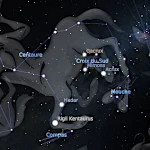 Guide to Southern Constellations: Southern Cross and Other Cosmic Gems
  The Guide to Autumn Constellations
  Winter Constellations Guide: When the Stars Shine Brightest
  The Spring Sky Trinity: Leo, Virgo, and Boötes
  The Summer Constellations Guide
 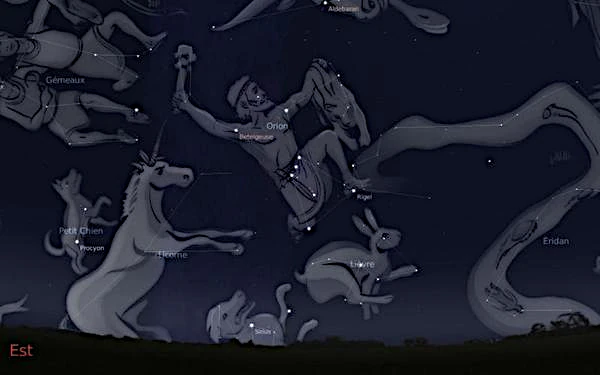 January sky
  February sky
  Mars Sky
  April sky
  May Sky
  June sky
  July sky
  August sky
  September sky
  October Sky
  November sky
  December sky