


The Black River: Dark Silhouette of the Milky Way

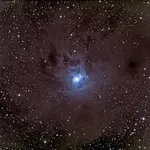
View of the "Black River," a dark band consisting of dense molecular clouds obscuring starlight. Image source: Credit: ESA, Hubble, NASA (new window)
The Black River: Galactic Eclipse
The Black River is a dense region of the Milky Way, observable as a dark silhouette crossing the galactic plane. This apparent phenomenon results from the absorption and scattering of starlight by interstellar clouds composed mainly of molecular gas and dust.
Silhouettes on the Milky Way
The dark clouds that make up the Black River are primarily composed of hydrogen molecules \( \mathrm{H_2} \), as well as dust consisting of silicate grains, amorphous carbons, ices, and other complex compounds. These microscopic grains cause selective extinction of light, more pronounced in the visible than in the infrared, explaining the appearance of a black silhouette against the more distant stars.
Location of the Black River in the Milky Way
The Black River, observable to the naked eye as a dark band interrupting the brightness of the Milky Way, extends over approximately 80 degrees of arc along the galactic plane. It begins in the constellation of Sagittarius, near the very dense galactic center, and extends northward through the constellations of Serpens, Aquila, and then Cygnus.
This dark silhouette results from the presence of molecular complexes and interstellar dust clouds concentrated in these directions, masking the light of background stars. The Black River is particularly visible during the summer in the northern hemisphere, when the galactic plane is high in the night sky.
In galactic coordinates, the Black River corresponds to a region around the galactic plane, between approximate galactic longitudes of 20° to 100°, where the density of interstellar matter is maximal.
Role in Star Formation
Dark regions like the Black River are privileged zones for star formation. The high density and low temperature favor the gravitational collapse of dense cores, initiating the creation of proto-stars.
Multi-Wavelength Observation
While the Black River is visible as an obscuration in the visible domain, its study is enriched by observations in radio waves, infrared (partially avoiding extinction), and X-rays (detecting very dense and hot regions). These techniques allow mapping the three-dimensional structure and internal dynamics of these clouds.
Comparative Table of Typical Properties of Dark Clouds in the Black River
| Cloud Type | Density (particles/cm3) | Temperature (K) | Main Composition | Typical Scale (pc) |
|---|---|---|---|---|
| Diffuse Cloud | 10 - 102 | 30 - 100 | Atomic Hydrogen H, fine dust | 10 - 100 |
| Dark Cloud | 103 - 104 | 10 - 20 | Molecular Hydrogen H2, CO, dust | 1 - 10 |
| Giant Molecular Nebula | 104 - 106 | 10 - 15 | H2, CO, ice, thick dust | 10 - 100 |
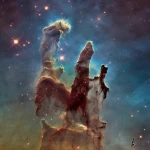 The Eagle Nebula: Stellar Nursery and Pillars of Creation
 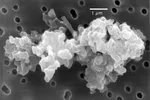 Composition of Interstellar Dust
 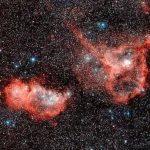 Heart and Soul Nebulae: Giant H II Regions
 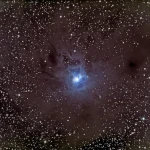 Interstellar Clouds: The Dark Forests of the Galaxy
 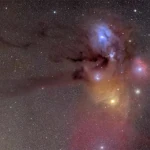 The Black River: Dark Silhouette of the Milky Way
 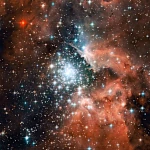 Nebula NGC 3603: One of the Largest Massive Star Factories
 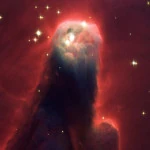 The Cone Nebula and the Christmas Tree Cluster: A Stellar Nursery in the Making
 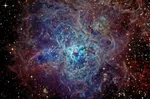 The Tarantula Nebula: A Cosmic Jewel
 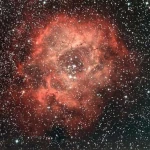 The Rosette Nebula: A Stellar Nursery in Full Bloom
 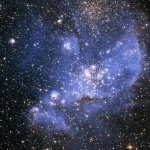 NGC 346: A Stellar Nursery in the Small Magellanic Cloud
 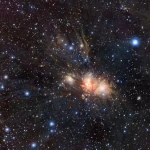 Nebula NGC 2170: A Kaleidoscope of Dust and Light
 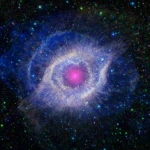 The Helix Nebula: When a Star Dies
 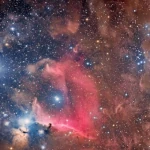 Nebulas: Journey to the Heart of Stellar Cradles
 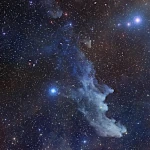 The Witch Head Nebula: Phantom of the Cosmos
 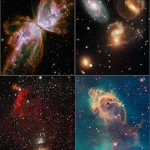 Diffuse, Dark, and Planetary Nebulae: A Physical Classification
 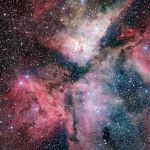 Carina: A Nebula More Active than the Horsehead and Orion Combined?
  The Orion Nebula: A Stellar Nursery
  The Crab Nebula M1: Remnant of a Historical Supernova
  Planetary nebulae
  Dark Nebulas: What do the black patches of the cosmos reveal?
  Coatlicue: The Mother Nebula of the Sun and the Solar System