


Gliese 581 g: A Serious Candidate for Habitability
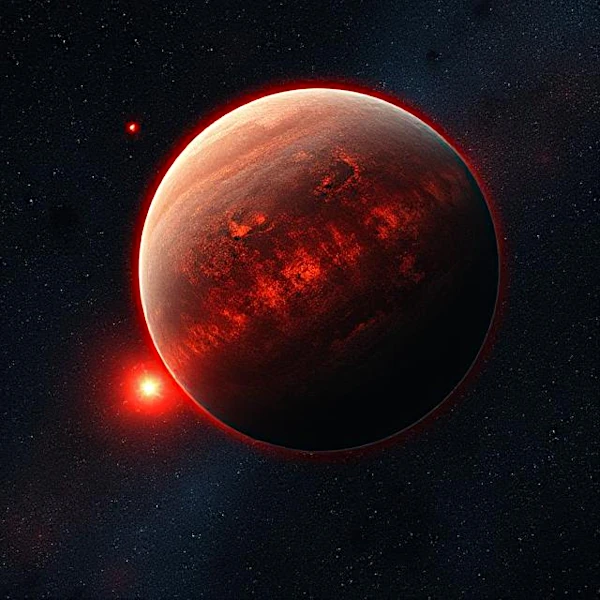
View of the exoplanet Gliese 581 g, showing a dense atmosphere under the illumination of its red dwarf star — AI-generated image, public domain.
A world on the edge of the habitable zone
Gliese 581 g is an exoplanet presumed to orbit the star Gliese 581, an M3 spectral type red dwarf located about 20.4 light-years from Earth, in the constellation Libra. It was announced in 2010 as a rocky planet located in the habitable zone, meaning at a distance from its star that would allow the presence of liquid water on its surface.
Physical conditions favorable to life?
With a minimum mass estimated at about 3.1 times that of Earth, Gliese 581 g is likely a super-Earth. It completes a full revolution in just 36.6 days, implying that it is probably in synchronous rotation, always showing the same face to its star. This could generate extreme thermal gradients, but also stable temperate zones in the twilight area, conducive to the emergence of life.
A controversial detection
The very existence of Gliese 581 g has been the subject of debate in the scientific community. The radial velocity method, used to detect it, is sensitive to disturbances. Reanalyses of the data have sometimes attributed the signals to artifacts of stellar activity. Nevertheless, its study remains a textbook case for refining detection methods and exploring habitability criteria.
| Parameter | Estimated Value | Reference |
|---|---|---|
| Planet Type | Rocky Super-Earth | Vogt et al. (2010) |
| Minimum Mass | 3.1 M⊕ | Vogt et al. (2010) |
| Estimated Radius | 1.5 R⊕ (assumed) | Estimation based on Earth's density |
| Distance to Star | 0.146 AU | Vogt et al. (2010) |
| Orbital Period | 36.6 days | Vogt et al. (2010) |
| Equilibrium Temperature | 223 K (−50 °C) | Selsis et al. (2007) |
| Host Star | Gliese 581 (Red Dwarf M3V) | SIMBAD Database |
Candidates for habitability in our galactic neighborhood
Since the discovery of the first exoplanets, one of the major goals of contemporary astronomy has been to identify worlds located in the habitable zone of their star — that orbital region where the temperature allows the existence of liquid water on the surface. While water is not proof of life, it remains an essential ingredient to its chemistry as we know it. The simultaneous presence of a rocky surface, a stable atmosphere, and moderate irradiation is considered a favorable configuration for the development of life. Below, a summary table lists some of the most promising exoplanets, selected according to rigorous astrophysical criteria.
| Name | Mass (M⊕) | Radius (R⊕) | Equilibrium Temp. (K) | Distance (ly) | Star | Star Type | Reference |
|---|---|---|---|---|---|---|---|
| TRAPPIST-1 e | 0.692 | 0.92 | 251 | 39 | TRAPPIST-1 | M8V | Gillon et al. (2017) |
| Kepler-442 b | 2.34 | 1.34 | 233 | 1,206 | Kepler-442 | K5V | Torres et al. (2015) |
| Proxima Centauri b | 1.27 | — | 234 | 4.24 | Proxima Centauri | M5.5V | Anglada-Escudé et al. (2016) |
| Gliese 667 Cc | 3.8 | — | 276 | 23.6 | Gliese 667 C | M1.5V | Anglada-Escudé et al. (2012) |
| Kepler-186 f | 1.4 | 1.11 | 188 | 582 | Kepler-186 | M1V | Quintana et al. (2014) |
| Gliese 581 d | 6.98 | 2.2 | 222 | 20.4 | Gliese 581 | M3V | Udry et al. (2007) |
| Teegarden's Star c | 1.05 | — | 276 | 12.5 | Teegarden's Star | M7V | Zechmeister et al. (2019) |
| Kepler-62 f | 2.8 | 1.41 | 208 | 1,200 | Kepler-62 | K2V | Borucki et al. (2013) |
- Data from the NASA Exoplanet Archive, exoplanetarchive.ipac.caltech.edu (new window)
 Exoplanet Overview: Candidates and Confirmed
  Gliese 581 g: A Serious Candidate for Habitability
  Discovery of solid buckyballs
  Kepler-22b: First Habitable Exoplanet Discovered in the Temperate Zone
  Exoplanets: On the Trail of Earth 2.0
  Cheops, characteristics of exoplanets
  Discovering Mini-Neptunes, Intriguing Exoplanets
  Turn Off the Stars to Detect Life!
  The New Promised Lands: Top Candidates for Habitability
  JWST, the end of the dark ages
  The Milky Way: A Galaxy Teeming with Habitable Worlds
  HD 100546 b: A Giant Exoplanet Forming in an Extended Habitable Zone
  Super-Earths: Habitable Planets in Sight?
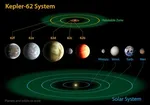
  The habitable zone of the Kepler-186 system
  Rogue Exoplanets: Lost Worlds in the Cosmic Darkness
  55 Cancri e, the diamond planet
  Number of candidate and confirmed exoplanets
  Trappist or the harmony of the cosmos