


ETNO, Relics of the Primordial Chaos: In Pursuit of the Ghost of Planet Nine
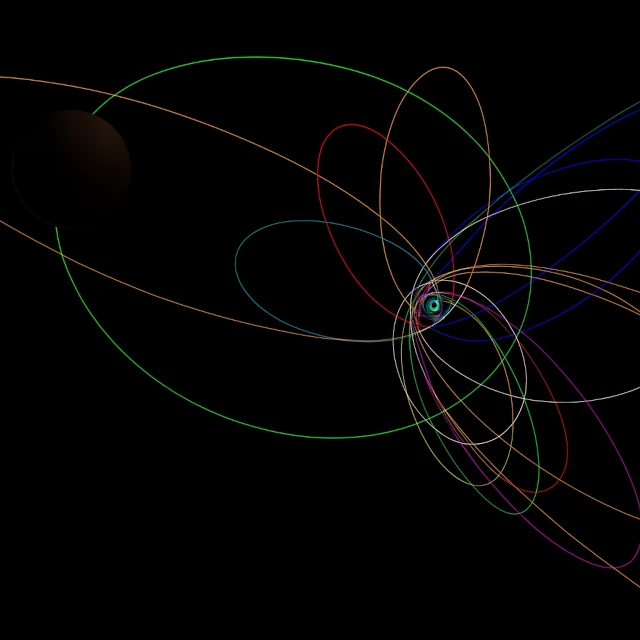
Extreme trans-Neptunian objects (ETNO) show trajectories highly inclined relative to the plane of the solar system.
Their orbits are represented by very elongated ellipses (Neptune orbits on the small blue circle at the center).
A dark and hypothetical planet, Planet Nine, would organize the dance of these distant bodies.
Image source: astronoo.com (new window)
Scientific Summary
The article presents Extreme Trans-Neptunian Objects (ETNOs), icy bodies located at the outskirts of the solar system, beyond Neptune's orbit. Their distinguishing feature is their highly elongated and inclined orbits, with a perihelion always far from Neptune (>40 AU), which protects them from the gravitational influence of known giant planets. In the early 21st century, astronomers discovered that the orbits of these objects were not randomly distributed: certain orbital parameters (such as the argument of perihelion) appeared to cluster. This statistical anomaly led Konstantin Batygin and Mike Brown to propose in 2016 the existence of a hypothetical Planet Nine (mass ~5-10 Earths, highly eccentric orbit at 400-800 AU), whose gravity would have sculpted these orbits. The hunt for this "gravitational ghost" is now underway.
What are ETNOs and why do they suggest the existence of a Planet Nine?
Extreme trans-Neptunian objects (ETNOs) are icy bodies located at the far reaches of the solar system, beyond Neptune's orbit. Their particularity is having very elongated and inclined orbits, with a perihelion always far from Neptune (>40 AU), protecting them from the gravitational influence of the known giant planets. In the early 21st century, astronomers discovered that the orbits of these objects were not randomly distributed: certain orbital parameters (like the argument of perihelion) appeared clustered. This statistical anomaly led Konstantin Batygin and Mike Brown in 2016 to propose the existence of a hypothetical Planet Nine (mass ~5-10 Earths, eccentric orbit at 400-800 AU), whose gravity would have sculpted these orbits. The hunt for this "gravitational ghost" is now on, with telescopes like Subaru.
Also worth exploring
Continue your exploration of the Universe with these topics:
What if the planets are only the tip of the iceberg?
Beyond the familiar orbits of the planets, in the cold and silent immensity, the solar system hides an innumerable population. Billions of relics, witnesses to planetary formation, compose a true "fossil archipelago" of which we are only beginning to discover the first objects.
Relics of planetary formation at the edge of the solar system
Sentinels on enigmatic orbits
In the icy darkness where the Sun is just a particularly bright star, enigmatic worlds evolve: the extreme trans-Neptunian objects (ETNO). Unlike classical Kuiper Belt objects, these icy bodies follow very particular orbits with a perihelion (closest point to the Sun) always very far from Neptune (>40 AU) and a semi-major axis extremely long (>150 AU, sometimes reaching over 1000 AU). Their trajectories are often very inclined and eccentric, radically distinguishing them from the planets and most small bodies of the solar system.
Fossil archives of primordial chaos
This unique configuration protects them from strong gravitational perturbations from the known giant planets. For astronomers, they are not just distant pebbles, but true relics of primordial chaos that reigned during the formation of the solar system. Their orbits are fossil archives, preserved by cold and distance, which could contain clues to ancient cataclysmic events, such as the passage of nearby stars or the migration of giant planets, or reveal the presence of an unidentified perturber.
The gravitational anomaly and the Planet Nine hypothesis
The orbital clustering: an improbable signature
The real enigma around ETNOs appeared at the beginning of the 21st century, when studies highlighted that their orbits were not randomly distributed. Against all expectations for objects supposed to be isolated, certain orbital parameters, such as the argument of perihelion, seemed to cluster. The probability that this arrangement is the result of chance is extremely low, on the order of a few tenths of a percent.
N.B.:
The argument of perihelion \((\omega)\) is an angle that describes the orientation of an object's orbit in its own plane.
More precisely, it measures the position of the closest point to the Sun (the perihelion) relative to the point where the orbit crosses the reference plane of the solar system (the ascending node).
If the orbits of a group of objects are randomly oriented, their arguments of perihelion should be uniformly distributed between \(0^\circ\) and \(360^\circ\).
The fact that those of certain ETNOs cluster around a similar value is a strong statistical signal that an external force, such as the gravity of an undetected massive body, has "locked" them into this configuration over time.
A bold hypothesis: the invisible puppeteer
It is this statistical anomaly that led astronomers Konstantin Batygin and Mike Brown (both born in 1975) to formulate in 2016 a bold hypothesis: the existence of an undetected giant planet, located on a very distant and eccentric orbit. This hypothetical Planet Nine, with an estimated mass between 5 and 10 times that of Earth, would be the invisible "puppeteer" whose gravity, over billions of years, would have sculpted and clustered the orbits of the ETNOs we observe.
An ancient origin and a modern quest
It is not a "rogue" planet from outside, but was probably ejected to the outer reaches of the solar system during its turbulent youth, more than 4 billion years ago. The hunt for this gravitational ghost is now open. Telescopes like Subaru in Hawaii are methodically scanning the regions of the sky where it might be hiding, but the task is immense: its apparent motion is very slow and its brightness extremely faint.
Estimated orbit and distance of Planet Nine
A very elliptical trajectory e ≈ 0.5
If it exists, Planet Nine does not evolve on a circular orbit, but on a very elliptical trajectory, a signature of a chaotic past. Current models estimate that its semi-major axis (average distance) would be between 400 and 800 AU (Neptune → 30 AU). Concretely, its distance from the Sun would vary enormously: it could approach to about 200-300 AU at its perihelion, before moving away to more than 1200 AU at its aphelion.
For Planet Nine, models published by Konstantin Batygin and Mike Brown suggest an eccentricity between \( e \approx 0.2 \) and \( e \approx 0.6 \). The most commonly cited value in recent studies is around \( e \approx 0.5 \) (Neptune → 0.008).
An orbit inclined between 15° and 25°
Unlike the eight main planets whose orbits are close to the plane of the ecliptic (inclination <3° for Neptune), Planet Nine would be on a highly inclined orbit, between 15° and 25°. This major difference is a "dynamic signature" that suggests it could not have formed in its current location. Astronomers believe it was catapulted onto this inclined orbit by gravitational interactions with the gas giants, more than 4 billion years ago. This extreme orbit, coupled with its presumed low brightness, explains the difficulty of its direct detection.
Relics with improbable trajectories
The discovery of emblematic objects like Sedna (discovered in 2003) paved the way for the revolutionary hypothesis of a massive ninth planet at the edge of the solar system. With a perihelion at 76 AU and an aphelion (farthest point) at about 900 AU, its orbit is completely decoupled from Neptune's influence. More recently, 2012 VP113 ("Biden") and especially 2015 TG387 ("The Goblin"), have confirmed the existence of this distinct population. Each new member discovered, like the very distant 2018 AG37 ("FarFarOut"), refines the model and constrains the possible parameters of Planet Nine.
N.B.:
For ETNOs, a perihelion greater than 40 Astronomical Units (AU) ensures that they never approach Neptune, thus avoiding any major gravitational perturbation that would unpredictably modify their orbit.
Table of ETNOs: Relics of the primordial chaos
| Object name | Year of discovery | Semi-major axis (AU) | Perihelion (AU) | Comment |
|---|---|---|---|---|
| 90377 Sedna | 2003 | ~ 506 AU | 76 AU | Prototype object; orbit completely isolated from Neptune. |
| 2012 VP113 ("Biden") | 2012 | ~ 261 AU | 80 AU | Its orbit contributed to highlighting the clustering of the arguments of perihelion. |
| 2014 FE72 | 2014 | ~ 1550 AU | 36 AU | Immense orbit (aphelion >3000 AU), potentially influenced by nearby stars. |
| 2015 TG387 ("The Goblin") | 2015 | ~ 1050 AU | 65 AU | Discovered near Halloween; its orbit strongly supports the Planet Nine hypothesis. |
| 2018 VG18 ("Farout") | 2018 | ~ 90 AU (est.) | ~ 42 AU | Former holder of the title of most distant object; characteristic pinkish color. |
| 2018 AG37 ("FarFarOut") | 2018 | ~ 101 AU (est.) | ~ 27 UA | Temporary holder of the title of the most distant object observed. |
| 2021 DR15 | 2021 | ~ 700 AU (est.) | ~ 39 AU | Recent discovery confirming the persistence of the ETNO population. |
- Source: Data compiled from the archives of the Minor Planet Center (MPC) (new window) and publications from The Astrophysical Journal (new window).
Other hypotheses facing the mystery
While the Planet Nine hypothesis is the most publicized, it is not the only one on the table. The scientific community is exploring other avenues to explain the enigmatic arrangement of ETNO orbits:
- Chaotic dynamics: The close passage of a star in the vicinity of the solar system, hundreds of millions of years ago, could have disturbed the orbits.
- Observational biases: We might only see a biased part of the total ETNO population, creating an illusion of clustering.
- Ejected or migrating planet: A massive planet could have existed in the early solar system, influenced the dynamics of ETNOs, and then been ejected during orbital instabilities linked to the migration of giant planets. ETNOs would then retain a fossil memory of this transient phase.
- Dark matter disk: Some researchers have proposed that a ring of dark matter, although not directly detected, could exert a sufficient collective gravitational influence to sculpt the orbits of trans-Neptunian objects.
- Residual Neptune effect: Recent simulations suggest that the gravitational influence of Neptune, combined with complex orbital resonances and dynamic evolution over billions of years, could suffice to explain some of the observed anomalies without requiring a ninth planet.
- Primordial black hole: An exotic hypothesis proposes that a mini black hole the size of a grapefruit, dating from the Big Bang, could be hiding in the outer solar system and producing the same gravitational effects as a massive planet.
The pursuit of this gravitational ghost, whether planetary or the result of another phenomenon, is an observational and modeling challenge that mobilizes astronomers. Large sky surveys like that of the future Vera C. Rubin Observatory (planned for the mid-2020s) promise to revolutionize the field of ETNOs.
FAQ: Everything about ETNOs and Planet Nine
What is the difference between a classical trans-Neptunian object and an ETNO?
Classical trans-Neptunian objects (Kuiper Belt) orbit at about 30-50 AU and are still gravitationally influenced by Neptune. ETNOs differ by three criteria: a perihelion always greater than 40 AU (they never approach Neptune, thus preserved from its perturbations), a very long semi-major axis (>150 AU, sometimes >1000 AU), and often very inclined and eccentric orbits. This configuration makes them "fossil archives" of the primordial chaos of solar system formation.
What is the "argument of perihelion" and why is its clustering a statistical anomaly?
The argument of perihelion is an angle describing the orientation of an object's orbit within its own plane. If orbits were randomly oriented, these angles should be uniformly distributed between 0° and 360°. However, astronomers observed that for several ETNOs, these angles cluster around a similar value. The probability of this alignment being due to chance is extremely low (a few tenths of a percent), strongly suggesting that an external force (like the gravity of an undetected massive body) has "locked" these orbits over time.
What are the main alternative hypotheses to Planet Nine?
Several rival hypotheses exist to explain the strange orbits of ETNOs: a close stellar flyby hundreds of millions of years ago; observational biases (we might only see a biased subset of the total population); the residual influence of complex orbital resonances with Neptune over billions of years; the presence of an exotic dark matter disk; or even a primordial black hole the size of a grapefruit. The most consensual hypothesis for now remains Planet Nine, as it naturally explains the observed orbital clustering.
 ETNO, Relics of the Primordial Chaos: In Pursuit of the Ghost of Planet Nine
  Phantom Super-Earths: The Lost Worlds of the Solar System
  Why aren't orbits perfect circles?
  Winds of the solar system and giant planets
  The Sky Ordered Our Week: Monday, Tuesday, Wednesday...
  3D Simulator: Revolutions of the Planets
  Mercury: The Planet with Two Faces
  Venus vs Earth: Why Did the "Twin" Become a Hell?
  Earth, the Blue Planet: A Fragile Jewel in the Universe
  Mars: Six Decades of Robotic Exploration on the Eve of Human Flight
  Jupiter: A Failed Star at the Heart of Our System
  Saturn: The Harmony of Orbital Resonances
  Uranus: Why Is It the Strangest Planet in the Solar System?
  Neptune: The Blue Giant of the Solar System
  Roche limit
  Remarkable characteristics of the planet Mercury
  Remarkable Characteristics of Venus, the Burning Hell with Acid Clouds
  Unique Characteristics of Earth: The Living Planet
  Remarkable characteristics of the planet Mars
  Remarkable characteristics of the planet Jupiter
  Saturn Revealed: Amazing Features of the Ringed Planet
  Characteristics and Mysteries of Uranus, the Tilted Planet
  Remarkable characteristics of the planet Neptune
  Characteristics of Planets: What Makes Them Unique
  Venus, Veiled Planet: A Puzzle in our Solar System
  Live on Mars
  The seven wonders of the World
  Planet 9: The Enigma That Challenges Planetary Models
  Axial Tilt of Planets: An Unstable Dance Through the Ages
  Comparative sizes of planets and stars
  The Journey of the Planets Along the Ecliptic: A Cosmic Choreography
  Declination and right ascension
  Saturn's Rings: A Ring System in Jeopardy