


Why is our Our matter not quantum?
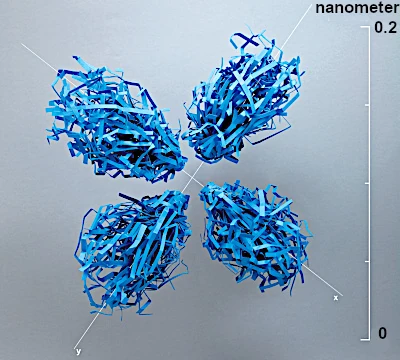
Atomic orders of magnitude.
In the world of the infinitely small, the orbitals of the electron can take different characteristic forms depending on the nature of the atom.
For example the orbitals of hydrogen have a spherical shape, the orbitals of oxygen have the shape of two drops of water, the orbitals of iron have the shape of four drops of water.
This shape of the atomic orbital defines the size of the atom.
The characteristic sizes of atoms or the distances between nuclei in molecules are of the order of angstroms (one tenmillionth of a millimetre) in agreement with experiment.
We can say that the atoms are separated from each other by a few angstroms.
Why is our Our matter not quantum?
Our universe is filled with very small particles called atoms. These atoms are the building blocks of everything we see around us, such as trees, animals, buildings, and even ourselves!
At such a small scale, the laws of physics that govern them are different from those we see at our scale, called the macroscopic scale. At the atomic scale, physics is governed by the rules of quantum mechanics, which are very different from the rules of classical physics that we use to describe the world at our scale.
For example, at the quantum scale, particles can behave like waves and particles at the same time, which may seem very strange to us! Moreover, on the quantum scale, particles can be in several different states at the same time, which is called "superposition".
But then, why do we not see these phenomena on our scale? This is because these quantum effects are very weak and tend to cancel out when we look at larger objects. At our scale, atoms are so numerous and so tightly bound that quantum effects are negligible. This means that classical physics, which we use to describe the world on our scale, is sufficient to explain what is happening around us.
However, there are scientists who study quantum effects on our scale. They created experiments to observe quantum effects on larger objects, such as molecules or crystals. These experiments have shown that quantum effects can have important consequences, even on our scale.
Ultimately, our matter is not quantum at the macroscopic scale because quantum effects are very small and tend to cancel out at this scale. However, quantum physics is still important for understanding the universe because it governs the behavior of particles on a smaller scale and can even impact our world on our scale.
 Why Can Telescopes See So Far?
  The Rainbow of Planets: Why Do They Have Colors?
  When You Look at the Stars, You Travel Through Time!
  When Earth Tilts, the Seasons Change!
  Floating Life: The Daily Routine of Astronauts on the Space Station
  Eclipse: The Great Game of Shadow and Light Between the Moon and the Sun
  Shooting Stars: The Celestial Tears That Grant Wishes
  The Metaverse: A Virtual World
  Quantum Physics, Simply!
  Why Are There Rings Around the Giant Planets?
  Why Does the Sun Shine?
  What is a Supernova?
  Why does emptiness not exist?
  What is the equivalence principle in physics?
  Incredible Phenomena of the World
  What is Time?
  What is Matter?
  Why is the sky blue?
  The Benefits of Fuse Beads for Children's Creativity
  Our Milky Way
  How to measure distances in the Universe?
  How did the Moon form?
  What is a black hole?
  Why are stars different colors?
  Why don't we feel that the Earth is rotating?
  How to properly observe the stars in the sky?
  How stars work
 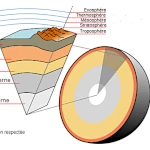 What are the inner and outer layers of the Earth?
  January Sky, Orion Constellation
  February sky, Auriga constellation
  March sky, constellation of Gemini
  April sky, Bouvier constellation
  May sky, constellation Leo
  June sky, constellation Virgo
 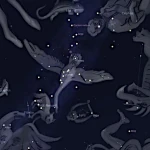 July sky, Cygnus constellation
  August sky, constellation of the Eagle
 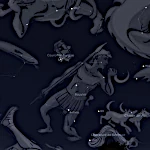 September sky, Corona Borealis Constellation
  October sky, constellation Pegasus
  November sky, Andromeda constellation
  December sky, Perseus constellation