


Red Moon and Blood Moon: The Earth's Atmosphere to Blame
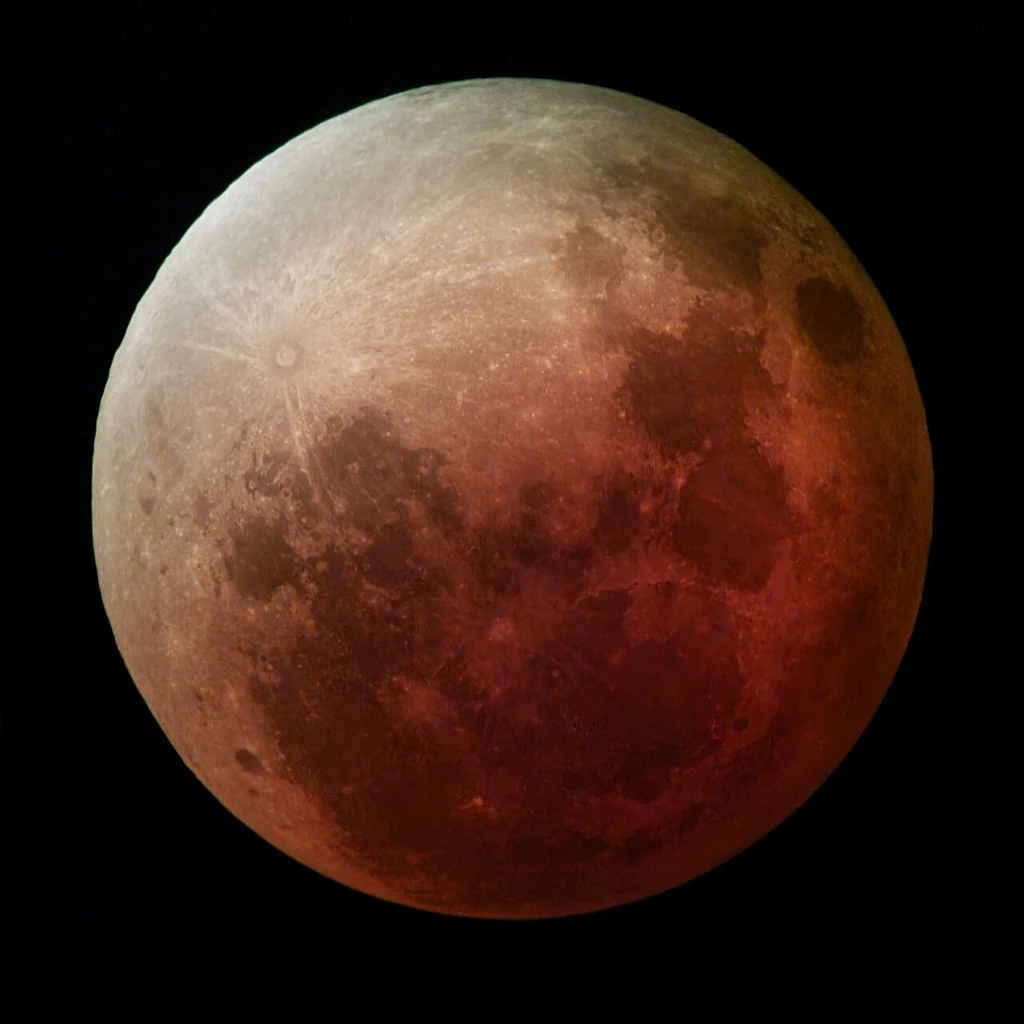
Lunar eclipse: the edge of the shadow is sharp to the naked eye, but it is much less so when seen through a telescope as here. The red Moon or blood Moon is a Moon that reflects the rays of sunlight passing through the Earth's atmosphere.
Image source: F. Aedo, F. Durán/ESO/VLT (new window)
Scientific summary
The Astronoo article explains why the Moon takes on a red hue during certain lunar eclipses and the red Moon. It details the optical mechanisms involved: refraction, Rayleigh scattering and atmospheric absorption. Sunlight passing through the Earth's atmosphere loses its blue and violet components, while red and orange rays are deflected toward the Moon. Atmospheric conditions, volcanic or desert dust modulate the intensity and hue observed. The article also presents the Danjon scale, the differences between total and partial eclipses, as well as the cultural and historical interpretations of this phenomenon.
Why does the Moon turn red during a lunar eclipse?
This article answers a seemingly simple question: why does the Moon turn red during certain lunar eclipses and the red Moon? The answer lies in a subtle blend of celestial geometry and atmospheric optics. During a lunar eclipse, the Earth comes between the Sun and the Moon. The Moon then enters the Earth's shadow cone. Yet it does not disappear completely: part of the sunlight passes through the Earth's atmosphere, where it undergoes refraction, Rayleigh scattering and absorption by aerosols. Short wavelengths, blue and violet, are strongly scattered and absorbed, while long wavelengths, red and orange, are less deflected and reach the lunar surface. The Moon then reflects back toward Earth a reddish light, sometimes coppery or brownish. The exact hue depends on the transparency of the atmosphere, the presence of dust, volcanic ash or pollutants. The article also describes the Danjon scale, partial eclipses, variations in brightness and cultural interpretations of the blood Moon.
Also worth exploring
Continue your exploration of the Universe with these topics:
Origin of the Red Moon and the Blood Moon
Celestial alignment and Earth's shadow
A lunar eclipse occurs when the Earth places itself exactly between the Sun and the Moon, so that the Earth's shadow cone intercepts the Moon's trajectory. This phenomenon is only possible when the three bodies are perfectly aligned on the plane of the ecliptic, that is, during a full Moon. The red Moon or blood Moon results from a combined effect of geometry and optics: although the Moon is plunged into the Earth's shadow, it remains faintly illuminated by sunlight refracted and scattered through the Earth's atmosphere.
Selective scattering and atmospheric filtering
This light is not white but reddish, because red rays, with a greater wavelength, are less deflected and less absorbed by Rayleigh scattering (scattering of light by air molecules and small particles). Blue and violet photons, strongly scattered in all directions, are mostly lost before reaching the Moon. Thus, only the red-orange component of sunlight passes through the atmospheric layers at a low angle, forming a luminous halo around the Earth that illuminates the lunar surface.
Rayleigh scattering
Rayleigh scattering is much stronger for short wavelengths. The scattered intensity varies approximately as \(1/\lambda^4\). In other words, the shorter the wavelength, the more efficiently the photon is scattered. For blue (about 450 nm) and red (about 650 nm), the ratio is: \((650/450)^4 \approx 4.4\).
Blue and violet photons, strongly scattered in all directions, are mostly diverted from their initial trajectory before reaching the Moon. It goes off in any direction. The probability that a scattered photon ends up precisely directed toward the Moon is therefore extremely low. It is "lost" for the beam that reaches the Moon, even if it continues to exist elsewhere, for example by contributing to the blue color of the sky.
Influence of atmospheric conditions
The observed hue depends strongly on the Earth's atmospheric conditions at the time of the eclipse. An atmosphere loaded with volcanic particles, desert dust or anthropogenic pollutants accentuates the absorption of short wavelengths and intensifies the dark red coloration, sometimes to dark brown. On the contrary, a clear and dry atmosphere gives a brighter Moon, with orange tones. Atmospheric transparency can be estimated from the Danjon scale, an empirical scale ranging from L = 0 (invisible Moon, totally dark) to L = 4 (bright, coppery and clearly visible Moon).
Historical symbolism and cultural interpretation
Since Antiquity, the blood Moon has fascinated civilizations: in many cultures, it was perceived as an omen of extraordinary events. The Babylonians saw in it a royal sign, while the Chinese interpreted its red hue as a cosmic imbalance. Today, this phenomenon is understood in the light of atmospheric physics and celestial mechanics, but retains its aesthetic and symbolic power.
Associated optical and astronomical phenomena
Refraction, absorption and residual spectrum
During a total eclipse, sunlight undergoes several physical processes before reaching the Moon: refraction in the Earth's atmosphere, absorption by aerosols and selective scattering of short wavelengths. The light spectrum reaching the lunar surface is therefore dominated by red and orange components, explaining the appearance nicknamed blood Moon. The exact hue depends on the distribution of particles and the density profile of the atmosphere traversed by the sun's rays tangential to the Earth.
Partial eclipses and brightness variations
Partial eclipses do not always exhibit this phenomenon because only part of the Moon enters the Earth's shadow. The portion remaining in the penumbra retains a silvery glow due to direct sunlight. These differences in brightness and hue make it possible to study the structure of the Earth's shadow cone and to assess, indirectly, the clarity of the atmosphere on a planetary scale.
Typical characteristics of red Moons during eclipses
The following table summarizes the main characteristics observed during lunar eclipses giving the Moon a red hue.
| Characteristic | Typical value | Comment |
|---|---|---|
| Hue | Red to brownish | Varies with the concentration of dust and ash in the atmosphere |
| Duration of a total eclipse | ~1 to 2 min | Time during which the Moon passes entirely through the Earth's shadow |
| Lunar phase | Full Moon | A total lunar eclipse can only occur during the full Moon |
| Solar incidence angle | Variable | Influences the distribution of refracted light on the lunar surface |
References
- NASA Eclipse Web Site - Lunar Eclipses (new window)
- ESO - Astronomical observations (new window)
- China Daily - Blood moon observed during total lunar eclipse (interview with Tang Haiming, Shanghai Astronomical Observatory, CAS) (new window)
- University of the Chinese Academy of Sciences - Science Encyclopedia: Blood Moon (detailed explanation of atmospheric absorption and the red color) (new window)
- Global Times - Red moon stuns in early hours (quote from the Purple Mountain Observatory, CAS, on light refraction and scattering) (new window)
FAQ: Everything you need to know about the red Moon and lunar eclipses
What is a lunar eclipse?
A lunar eclipse occurs when the Earth comes between the Sun and the Moon. The Moon then enters the Earth's shadow or penumbra cone. During a total eclipse, the Moon is entirely plunged into the Earth's shadow, but it remains faintly illuminated by light refracted by the atmosphere.
Why does the Moon turn red during an eclipse?
The sunlight passing through the Earth's atmosphere undergoes Rayleigh scattering and absorption by aerosols. Short wavelengths, blue and violet, are dispersed, while long wavelengths, red and orange, reach the Moon. It is this reddish light that gives the Moon its blood Moon hue.
What is the difference between the red Moon and the blood Moon?
The red Moon traditionally refers to the full Moon of April, whose reddened hue is linked to the atmospheric conditions of spring. The blood Moon refers rather to the red hue taken by the Moon during a total lunar eclipse. Both phenomena involve atmospheric scattering, but their astronomical causes differ.
Why do not all full Moons produce an eclipse?
A lunar eclipse only occurs if the Moon is aligned with the Earth and the Sun on the plane of the ecliptic. The lunar orbit is inclined by about 5 degrees, so perfect alignment is rare. This is why lunar eclipses do not occur at every full Moon.
What is the Danjon scale?
The Danjon scale is an empirical scale from 0 to 4 that describes the brightness and hue of the Moon during a total eclipse. L = 0 corresponds to an almost invisible Moon, while L = 4 corresponds to a coppery and very bright Moon. It depends on the transparency of the Earth's atmosphere.
Can the exact color of a blood Moon be predicted?
The exact color depends on the atmospheric conditions at the time of the eclipse: dust, volcanic ash, fires or pollutants. Astronomers can predict the geometry of the eclipse, but the final hue remains difficult to predict with precision. The Danjon scale nevertheless makes it possible to classify the observed appearance. A loaded atmosphere often gives a darker and browner hue.
 Race to the Shadow: The Total Eclipse 2026
  Red Moon and Blood Moon: The Earth's Atmosphere to Blame
  Solar Eclipse: The Sun, the Moon, and the Shadow
  Baily's Beads: Fleeting Jewels of the Solar Eclipse
  Eclipses explained by the plane of the orbit
  The eclipse seen from above: what satellites reveal about the Sun
  Transit of Venus on June 6, 2012
  Lunar Transit Phenomenon: A Small-Scale Eclipse?
  Impact theory at the origin of the Moon
  Periodicity and Repetition of Eclipses
  The annular eclipse of January 15, 2010: the longest ring of fire of the century