


Race to the Shadow: The Total Eclipse 2026

The narrow band of totality of the August 12, 2026 eclipse, a shadowed corridor crossing the North Atlantic, Greenland, and the Iberian Peninsula.
The eclipse shadow appears to stop abruptly in Tunisia for a purely astronomical reason: it is the exact spot on Earth where the Sun sets at the moment of totality, around 19:30 UT (Universal Time).
The eclipse crosses Spain in the late evening (around 18:30–19:00 UT), with the Sun already very low on the horizon. By the time the Moon's shadow slides further southeast and reaches North Africa, the Sun has set below the horizon.
Image source: astronoo.com (new window) — AI-generated image, public domain.
Scientific Summary
This article explores the scientific and logistical challenge posed by the total solar eclipse of August 12, 2026. After a presentation of the phenomenon and its path, the article details the major observational stakes. The study of the solar corona during the few minutes of totality is a central objective for validating coronal heating models. The repetition of the 1919 experiment, aiming to measure the deflection of starlight, will test general relativity of Albert Einstein (1879–1955) with unprecedented precision. Finally, the event is a natural laboratory for studying the atmosphere's response to an abrupt halt in solar radiation. The "race to the shadow" is therefore a race against time for scientists, facing weather hazards and the critical observation window of 2 minutes and 18 seconds at maximum.
Why is the 2026 eclipse a major scientific challenge?
The total solar eclipse of August 12, 2026 is an exceptional "natural laboratory" for science. The challenge is twofold. On the one hand, it is logistical: the band of totality, about 200 kilometers wide, crosses regions such as Greenland, northern Spain, and northern Tunisia. Scientists must position themselves precisely on this path, while hoping for favorable weather conditions. On the other hand, the stake is scientific: totality, lasting at most 2 minutes and 18 seconds, is the only moment when the solar corona becomes visible to the naked eye. It is a unique opportunity to study its structure and temperature, to replicate the famous Eddington experiment that confirmed the theory of general relativity, and to measure the eclipse's impact on Earth's atmosphere. The "race" therefore consists of successfully carrying out, in record time, observations that would take months under normal conditions.
Also worth exploring
Continue your exploration of the Universe with these topics:
The Total Eclipse of August 12, 2026: A Rare Phenomenon
On August 12, 2026, the Moon will perfectly interpose itself between the Earth and the Sun, casting its shadow on our planet. This phenomenon, although regular on a planetary scale, is extremely rare for a given location. A given place on Earth experiences a total eclipse only once every 375 years on average. The 2026 band of totality, about 200 kilometers wide, will begin in the Arctic, cross Greenland, northwestern Iceland, then the Atlantic Ocean before touching the Iberian Peninsula in Spain. It is the first total eclipse visible from Europe since that of August 11, 1999.
This eclipse is the first total one visible from mainland Spain since 1905 and opens a series of three eclipses that the Iberian Peninsula will experience between 2026 and 2028.
N.B.:
The total eclipse of August 11, 1999 was the last of the 20th century and one of the most observed in history, crossing densely populated regions of Europe. Its band of totality, about 112 km wide, traversed the Atlantic, southern United Kingdom, northern France, Belgium, Luxembourg, Germany, Austria, Hungary, Romania (where the maximum was at 11:03 UT (Universal Time)), then Bulgaria, Turkey, Iran, Pakistan, and India. Totality lasted up to 2 minutes and 23 seconds.
What Makes the August 12, 2026 Eclipse So Exceptional?
The August 12, 2026 eclipse stands out for a rare particularity: it will occur at sunset, particularly in Spain where the phenomenon is expected around 18:30–19:00 UT (Universal Time). The Sun, very low on the horizon, will offer a unique twilight spectacle, but will require a perfectly clear western horizon.
The Challenge of the Solar Corona: Unraveling the Mystery of Its Temperature
One of the greatest mysteries of astrophysics is the heating of the solar corona. Although the Sun's surface (the photosphere) has a temperature of about 5,500 °C, the corona, its thin outer atmosphere, can reach several million degrees. This paradox, where the atmosphere is hotter than the surface it surrounds, has been an enigma for decades. The total eclipse offers a unique observation window on this region, usually masked by the Sun's glare. Specific instruments, such as spectro-imagers (wide-field imaging spectrometer), will be deployed along the path to capture the corona's light and analyze its spectrum, revealing its composition, temperature, and dynamics. Numerical models, such as the COCONUT model, will be confronted with real data collected during this eclipse.
Testing Einstein's General Relativity
On May 29, 1919, the expedition led by Arthur Eddington (1882–1944) during a total eclipse provided the first experimental confirmation of Albert Einstein's (1879–1955) theory of general relativity. This theory predicts that light from distant stars is deflected by the Sun's gravitational field. During an eclipse, stars near the Sun become visible, allowing this deflection to be measured. In 2026, astronomers will repeat this experiment with far greater precision. Thanks to high-resolution cameras and advanced astrometry techniques, they will be able to measure light deflection with a precision on the order of microarcseconds, offering an even more rigorous test of general relativity.
The Atmosphere on Alert: A Natural Laboratory for Meteorology
Solar eclipses are ideal "natural laboratories" for studying the atmosphere's reaction to a rapid and predictable radiative forcing. The abrupt drop in solar radiation during totality causes a decrease in ground temperature, a modification of the atmospheric boundary layer, and potentially cloud formation. Measurement campaigns, involving weather stations, radiosondes, and satellites, will be conducted to document these changes at all altitudes. The study of these short-term perturbations allows for a better understanding of atmospheric dynamic processes, which is valuable for improving weather forecasting models.
Summary Table of the Scientific Challenges of the 2026 Eclipse
| Scientific objective | Phenomenon studied | Key questions | Key instrumentation | Historical references |
|---|---|---|---|---|
| Solar corona | Coronal heating and solar winds | Why does the corona reach several million degrees while the surface is at 5,500 °C? How are magnetic fluxes structured? | Spectro-imagers, coronagraphs | COCONUT model, observations of past eclipses |
| General relativity | Deflection of light by gravity | Does the measured deflection correspond exactly to Einstein's predictions? Can microarcsecond precision be achieved? | High-resolution cameras, astrometry | Eddington experiment (1919), 1919 eclipse |
| Meteorology | Atmosphere's response to a radiative halt | How do temperature, pressure, turbulence, and cloud formation evolve? What impacts on the atmospheric boundary layer? | Weather stations, radiosondes, satellites | 1999 eclipse (Europe) and 2017 eclipse (United States) |
The Race to the Shadow: A Logistical Challenge
The term "race" takes on its full meaning for scientists and eclipse chasers. The narrow band of totality requires travel to sometimes remote areas. In 2026, Greenland and northern Spain will be the most accessible places to observe totality, but weather forecasts will play a decisive role. A displacement of a few dozen kilometers can make the difference between a clear sky and a cloudy sky, and therefore between the success or failure of an experiment. This "race" is therefore a perpetual quest for the place where the Moon's shadow will be most visible, a chase that mobilizes teams from around the world.
Citizen Science at Work
The 2026 eclipse concerns not only professional scientists. Many citizen science projects are organized to involve the general public. Mobile applications allow measuring the evolution of temperature, pressure, or brightness. Other projects invite observation of animal behavior, which often reacts surprisingly to the sudden fall of night in broad daylight. These data, collected by thousands of observers across Europe, will provide an invaluable mass of data for researchers and AI.
References
FAQ: Everything You Need to Know About the 2026 Total Eclipse
Where and at what time can the 2026 total eclipse be observed?
The total eclipse of August 12, 2026 will be visible from a narrow band crossing the Arctic, Greenland, northwestern Iceland, and northern Spain. Totality will occur in the middle of the day, around 19:00 UT (Universal Time, equivalent to GMT) (i.e., 21:00 in Spain). The maximum duration of totality will be 2 minutes and 18 seconds. For precise information according to your location, it is recommended to use the ÉclipSEOP application from the Paris Observatory.
Why is the solar corona such an important subject of study?
The solar corona is the outermost layer of the Sun's atmosphere. It is the site of complex phenomena, notably the solar wind and solar flares, which directly influence space weather and can affect satellites and electrical grids on Earth. Moreover, the mystery of its extreme heating (several million degrees versus 5,500 °C at the surface) is one of the greatest challenges of solar physics. Observing it during an eclipse is the only way to see it without being blinded by the photosphere's light.
How will the 2026 eclipse test Einstein's relativity?
According to general relativity, a massive object like the Sun curves space-time, thereby deflecting the path of light. During an eclipse, stars near the Sun become visible. By precisely measuring their apparent position, astronomers can detect this deflection and verify whether it matches Einstein's predictions. The 2026 eclipse will offer an opportunity to perform this measurement with far greater precision than in 1919, thanks to modern technologies.
How to safely observe the total eclipse of August 12, 2026?
During the partial phases, it is imperative to use ISO 12312-2 certified eclipse glasses or an appropriate solar filter. Never look directly at the Sun without protection, whether with the naked eye, binoculars, a telescope, or a camera. Only during totality, when the solar disk is entirely masked by the Moon, can filters be removed and the corona observed with the naked eye. As soon as the slightest fraction of the Sun reappears, eclipse glasses must be put back on immediately. If you are not in the band of totality, keep your filters on at all times.
What can be seen during the totality of the 2026 eclipse?
During the few minutes of totality, several spectacular phenomena are observable: the solar corona extending around the Moon, the red solar prominences visible on the limb, the chromosphere, the diamond ring, and Baily's beads at the very beginning and end of totality. There is also a sudden drop in temperature, the appearance of the Moon's shadow racing at high speed, and sometimes bright stars or planets. The sudden darkness can also alter the behavior of certain animals.
Will the total eclipse of 2026 be visible from mainland France?
No. The totality will not cross mainland France. From France, the eclipse will be partial, with a greater or lesser magnitude depending on the region: it will be more pronounced in the southwest, but the Sun will never be completely hidden. To observe totality, one must travel into the band of totality, for example to northern Spain. In France, therefore, eclipse glasses must be kept on for the entire duration of the phenomenon.
 Race to the Shadow: The Total Eclipse 2026
  Red Moon and Blood Moon: The Earth's Atmosphere to Blame
  Solar Eclipse: The Sun, the Moon, and the Shadow
  Baily's Beads: Fleeting Jewels of the Solar Eclipse
  Eclipses explained by the plane of the orbit
 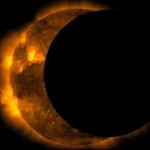 The eclipse seen from above: what satellites reveal about the Sun
 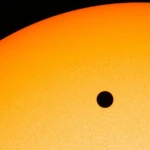 Transit of Venus on June 6, 2012
 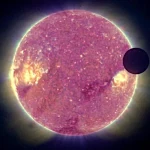 Lunar Transit Phenomenon: A Small-Scale Eclipse?
  Impact theory at the origin of the Moon
 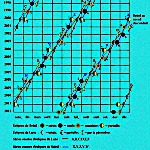 Periodicity and Repetition of Eclipses
 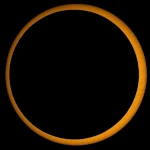 The annular eclipse of January 15, 2010: the longest ring of fire of the century