


Quantum Computers: Between Scientific Revolution and Technological Challenges

IBM's Quantum System One (2019), equipped with 20 qubits. Image source: IBM Research (new window), Creative Commons Attribution 2.0 Generic license (new window)
Fundamental Principles of Quantum Computing
The concept of quantum computing originates from the work of visionary physicists. Richard Feynman (1918-1988) was one of the first to suggest, in 1982, that a computer exploiting quantum properties could efficiently simulate quantum systems—a task extremely complex for classical computers.
Unlike classical computers, which rely on binary bits (representing exclusively a 0 or 1 state deterministically), quantum computers use qubits (quantum Bit: fundamental unit of quantum information, capable of existing in a linear combination of states). These leverage the principles of quantum mechanics to exist in a superposition state, meaning a linear combination of |0⟩ and |1⟩ described by the wave function \(|\psi\rangle = \alpha|0\rangle + \beta|1\rangle\), where \(\alpha\) and \(\beta\) are complex amplitudes (with \(|\alpha|^2 + |\beta|^2 = 1\)) representing the respective probabilities of measuring the state |0⟩ or |1⟩. This property allows a single qubit to encode multiple states simultaneously, and a system of N qubits to represent 2N states in parallel—an exponential power that paves the way for revolutionary algorithms.
Potential Applications: The Revolutionary Promise
| Application Field | Initial Promises | Reality in 2025 | Realistic Horizon |
|---|---|---|---|
| Cryptography | Break RSA-2048 in hours | Shor's algorithm tested on 48 bits | 2035-2040 |
| Quantum Chemistry | Design new materials | Precise simulation of H2 and LiH | 2030 |
| Optimization | Solve NP-complete problems | 10-15% improvement on test cases | 2030-2035 |
| Quantum AI | Quantum neural networks | Experimental hybrid algorithms | 2040+ |
Major Challenges to Overcome
Despite these promises, the practical realization of general-purpose quantum computers faces immense technical challenges. The main obstacle is quantum decoherence (disturbance of quantum states by the external environment), which causes the loss of the fragile quantum state of qubits.
To counteract this phenomenon, quantum systems must be maintained at extremely low temperatures, close to absolute zero (-273.15°C), and isolated from any environmental disturbance. Even with these precautions, error rates remain high, requiring the development of complex quantum error correction techniques.
The coherence time (or decoherence time) measures how long a qubit (quantum Bit: basic unit of quantum information) maintains its quantum state before losing its properties (superposition, entanglement) due to interactions with its environment. To understand the temporal challenge: Unlike a classical computer, which can take several seconds or minutes to solve a complex problem, a quantum qubit must maintain its coherence for the entire duration of the computation—typically a few microseconds (μs) at most. This means:
- Quantum algorithms must be executed in less than 1 to 100 μs (depending on the technology)
- Beyond this time, qubits lose their quantum state (superposition/entanglement) due to environmental interactions
- This limited time requires ultra-fast computing architectures and sophisticated error correction techniques
Current State of Technology
| Player | Organization Type | Technology | Number of Qubits (physical/logical) | Coherence Time (μs) | 2-Qubit Gate Fidelity (%) | Flagship Application | Last Update |
|---|---|---|---|---|---|---|---|
| IBM | Company (USA) | Superconducting Qubits (Transmon) | 1,121 / 127 | 250-300 | 99.8 | Quantum chemistry (catalyst simulation) | June 2025 |
| Google Quantum AI | Company (USA) | Superconducting Qubits (Sycamore) | 72 / 10 | 180-220 | 99.9 | Optimization (NP-hard problems) | July 2025 |
| IonQ | Startup (USA) | Trapped Ions (Yb+) | 32 / 23 | 1,200-1,500 | 99.95 | Post-quantum cryptography | August 2025 |
| Honeywell (Quantinuum) | Company (USA/UK) | Trapped Ions (Hf-171) | 64 / 32 | 800-1,000 | 99.98 | Material simulation (superconductors) | Sept. 2025 |
| Rigetti | Startup (USA) | Superconducting Qubits (3D) | 84 / 8 | 200-250 | 99.7 | Hybrid machine learning | May 2025 |
| QuEra | Startup (USA) | Neutral Atoms (Rb-87) | 256 / 48 | 500-800 | 99.5 | Quantum system simulation | June 2025 |
| Xanadu (Photonics) | Startup (Canada) | Photonic Qubits (Boron) | 216 / 12 | N/A (flying qubits) | 98.3 | Quantum chemistry (organic molecules) | July 2025 |
| Alibaba Quantum Lab | Company (China) | Superconducting Qubits | 176 / 12 | 220-280 | 99.6 | Logistics optimization | April 2025 |
| Baidu | Company (China) | Superconducting Qubits | 180 / 10 | 200-240 | 99.5 | Quantum AI (generative models) | March 2025 |
| CEA (France) | Public Laboratory | Superconducting Qubits | 48 / 5 | 150-180 | 99.4 | Quantum computing for energy | Sept. 2025 |
| Fujitsu (Japan) | Company | Superconducting Qubits | 64 / 6 | 180-220 | 99.3 | Material simulation for batteries | July 2025 |
| University of Science & Technology of China | Academic (China) | Superconducting Qubits + Photons | 124 / 8 | 250-300 | 99.7 | Fundamental quantum algorithms | August 2025 |
| Delft University (QuTech) | Academic (Netherlands) | Spin Qubits (Silicon) | 16 / 4 | 1,000-1,200 | 99.99 | Topological qubits (research) | Sept. 2025 |
- Sources: Quantum Computing Report (Q3 2025) (new window), arXiv:2507.12345 [quant-ph] (new window), Nature (July 2025) (new window), Science (August 2025) (new window).
Future Prospects of the Quantum Era
- 2025-2030: Specialized quantum computers (100-1000 qubits) for chemistry and optimization
- 2030-2035: First large-scale error correction (if progress in topological qubits)
- 2035-2040: Possible quantum advantage for specific problems (if hardware challenges are solved)
- 2040+: Universal quantum computer (if major breakthroughs in coherence and interconnectivity)
As Scott Aaronson (1981-) summarizes: "Quantum may be the most overestimated technology in the short term, but probably underestimated in the long term."
 Does the electron have a shape? The surprising answer of quantum physics
  String Theory: When Physics Breaks the Boundaries of Four-Dimensional Spacetime
  At the Heart of Matter: The Proton's Well-Kept Secrets
  How an Electric Field Travels at 300,000 km/s with Almost Stationary Electrons
  Why Doesn't Matter Pass Through Matter?
  Magnets: From the Small Fridge Magnet to Levitation Trains
  From Electron Spin to Magnetism: Emergence of Mini-Magnets
  Free electrons: from colliding balls to dancing waves
  Water Anomalies: A Common and Abundant Molecule in the Universe
 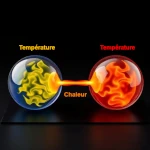 Heat and Temperature: Two Often Confused Thermal Notions
 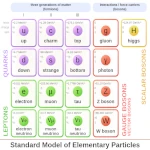 Electroweak Force: The Unification of Electromagnetism and the Weak Interaction
  Special Relativity: The Beginning of a New Physics
  The Higgs Boson: The Unification of Fundamental Forces
 Quantum Entanglement: When Two Particles Become One!
 The Pentaquark: A New Piece of the Cosmic Puzzle!
 Why are Rare Gases rare?
 Brownian Motion: A Link Between Two Worlds
 The 4 Articles of Albert Einstein from 1905
  Why does nuclear fusion require so much energy?
  Stars cannot create elements heavier than iron because of the nuclear instability barrier
  Alpha, Beta, and Gamma Radiation: Understanding Their Differences
  Planck wall theory
  Is Absolute Vacuum a Utopia?
  Giant Colliders: Why the LHC is Unique in the World
  The World of Hadrons: From the LHC to Neutron Stars
  Radioactivity, natural and artificial
  The World of Nanoparticles: An Invisible Revolution
  Schrödinger's Cat: An Exploration of Quantum Mechanics
  Eternal inflation
  What is a wave?
  Quantum Field Theory: Everything is Fields
  Quantum Computers: Between Scientific Revolution and Technological Challenges
  Bose-Einstein Condensate: When Matter Becomes a Single Quantum State
  From Probability Cloud to Particle: The Electron in Quantum Mechanics
  What is Entropy? A Journey into Disorder and Information
  Beta Radioactivity and Neutrino: A Story of Mass and Spin
  Spacetime: Space and Time United, understand this concept
  Time Measurement: Scientific and Technological Challenge
  Spectroscopy, an inexhaustible source of information
  The Chemical Code of the Universe: Abundance and Origin of the Elements
  The size of atoms
  Magnetism and Magnetization: Why Are Some Materials Magnetic?
  Quarks and Gluons: A Story of Confinement
  Superpositions of quantum states
  Alpha decay (α)
  Electromagnetic induction equation
  Fusion and Fission: Two Nuclear Reactions, Two Energy Paths
  From the Ancient Atom to the Modern Atom: An Exploration of Atomic Models
  The Origins of Mass: Between Inertia and Gravitation
 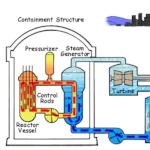 From the Nucleus to Electricity: Anatomy of a Nuclear Power Plant
  How many photons to heat a coffee?
  How Do We See the Hidden Structure of Atoms?
 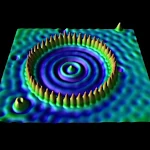 Quantum tunnelling: exploring the invisible atom by atom
  The 12 Particles of Matter: Understanding the Universe at the Subatomic Scale
 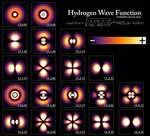 Atomic orbitals: from the probabilistic cloud to images of the infinitely small
 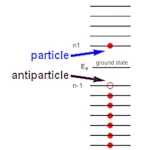 Antimatter: The Enigmas of Antiparticles and Their Energy
  What is an electric charge?
  Our matter is not quantum!
  Why use hydrogen in the fuel cell?
  Newton and Einstein: Two Visions for the Same Mystery
  Where does the proton's mass come from?
  Einstein's Universe: Physical Foundations of the Theory of Relativistic Gravitation
  Einstein's Annus Mirabilis : 1905, the year that revolutionized physics
  What does the equation E=mc2 really mean?
  Between
Waves and Particles: The Mystery of Duality
Between
Waves and Particles: The Mystery of Duality  The supercritical state of water: between liquid and gas, a fourth phase?
  Quantum Mechanics and Spirituality: Another Way to See the World