


The Crab Nebula M1: Remnant of a Historical Supernova

This new multi-wavelength image of the Crab Nebula (January 5, 2020) combines X-ray light from the Chandra Observatory (in blue), visible light from the Hubble Space Telescope (in yellow), and infrared light from the Spitzer Space Telescope (in red).
Image source: NASA (new window)
The Crab Nebula: Supernova Remnant
The Crab Nebula is the remnant of a supernova observed in 1054 by Chinese and Arab astronomers. It is located in the constellation Taurus and is about 6,500 light-years from Earth. M1 is famous for its complex filamentary structure and for hosting a central pulsar (neutron star resulting from the gravitational collapse of a supernova).
Structure and Composition
The nebula features a network of ionized gas filaments, mainly hydrogen and helium, enriched with heavier elements such as oxygen and neon. These filaments are propelled at speeds of 1,000 to 1,500 km/s. The observed radiation mainly comes from synchrotron emission, created by relativistic electrons interacting with the nebula's magnetic field.
The Crab Pulsar
At the center of M1 is a pulsar, a compact remnant of the original star. Jocelyn Bell Burnell (1943-) helped confirm the pulsed emissions. This pulsar (rapidly rotating neutron star emitting regular pulses of electromagnetic radiation) spins at 30 revolutions per second and is the main energy source powering the nebula.
Multi-Wavelength Observations
The Crab Nebula has been observed across all wavelengths: radio, infrared, optical, ultraviolet, and X-rays. These observations allow mapping the distribution of relativistic particles and the magnetic field.
Comparison with Other Supernova Nebulae
| Nebula | Age (years) | Supernova Type | Main Feature |
|---|---|---|---|
| Crab Nebula M1 | ~970 | Type II | Central pulsar, extensive synchrotron emission |
| Cassiopeia A Nebula | ~340 | Type IIb | Intense radio and X-ray emissions, iron and silicon filaments |
| Tycho Nebula | ~450 | Type Ia | Symmetrical expansions, low radio emission compared to M1 |
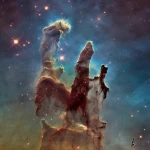 The Eagle Nebula: Stellar Nursery and Pillars of Creation
 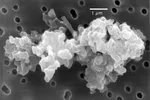 Composition of Interstellar Dust
 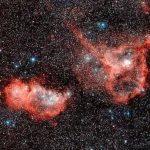 Heart and Soul Nebulae: Giant H II Regions
 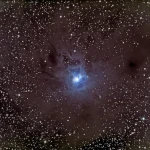 Interstellar Clouds: The Dark Forests of the Galaxy
 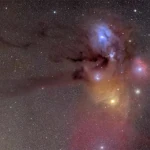 The Black River: Dark Silhouette of the Milky Way
 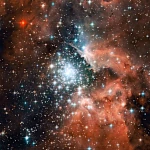 Nebula NGC 3603: One of the Largest Massive Star Factories
 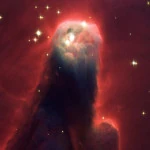 The Cone Nebula and the Christmas Tree Cluster: A Stellar Nursery in the Making
 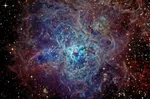 The Tarantula Nebula: A Cosmic Jewel
 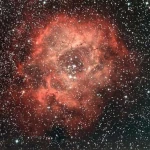 The Rosette Nebula: A Stellar Nursery in Full Bloom
 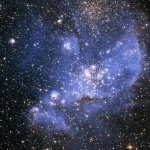 NGC 346: A Stellar Nursery in the Small Magellanic Cloud
 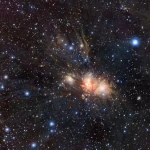 Nebula NGC 2170: A Kaleidoscope of Dust and Light
 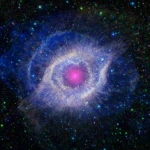 The Helix Nebula: When a Star Dies
 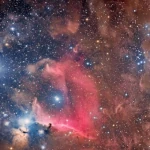 Nebulas: Journey to the Heart of Stellar Cradles
 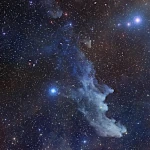 The Witch Head Nebula: Phantom of the Cosmos
 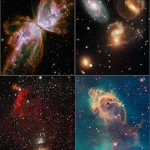 Diffuse, Dark, and Planetary Nebulae: A Physical Classification
 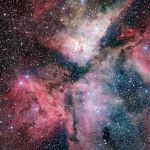 Carina: A Nebula More Active than the Horsehead and Orion Combined?
 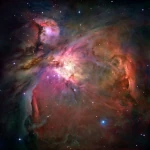 The Orion Nebula: A Stellar Nursery
 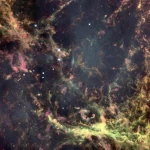 The Crab Nebula M1: Remnant of a Historical Supernova
 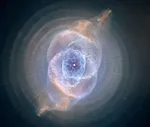 Planetary nebulae
 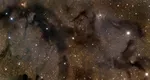 Dark Nebulas: What do the black patches of the cosmos reveal?
  Coatlicue: The Mother Nebula of the Sun and the Solar System